
Explore why virality can’t be manufactured and how brands succeed by creating compelling products and reacting quickly to trends.
Six Inches Apart
From The $200 Grocery Bill: An Uncomfortable Look at Why American Food Costs So Much
Investigative satire. Skeptical of everyone. Funny, but fact-based. Nobody gets off easy — including you.
Last time I told you where your grocery dollar goes. Today I’ll show you what it costs you — and the proof is six inches wide.
Go to the ketchup.
Any store. This afternoon. Stand in front of the ketchup and look at two bottles.
One has a name you’ve known since you were four years old. The other says the name of the supermarket you’re standing in.
Now look at the prices.
There’s your answer. That’s the whole series. Six inches of shelf, and the gap between those two numbers is the closest thing this industry will ever give you to an honest confession.
Because here’s what almost nobody tells you about that store brand:
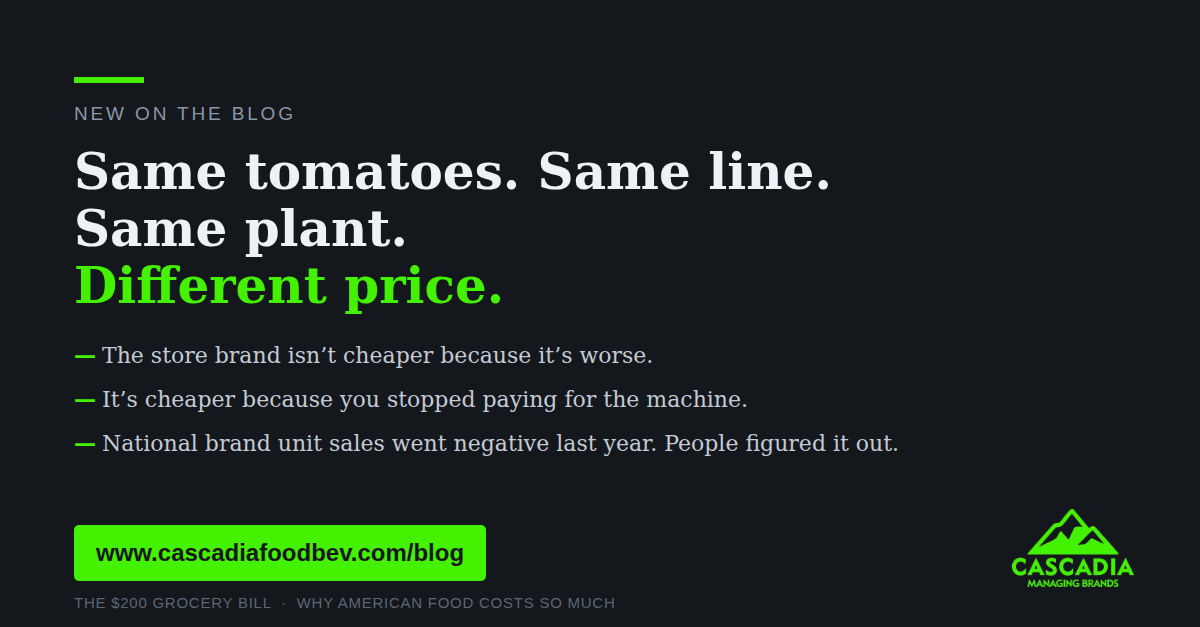
It’s very often made in the same plant, on the same line, by the same people, out of the same tomatoes.
Not always. But often enough that the academic literature on private label spends its time studying which national-brand manufacturers make store brands, rather than whether they do.
Same tomatoes. Same line.
Different price.
So what exactly are you paying for on the left?
Let’s build the national brand price from the bottom up, the way an operator would.
The tomatoes. The vinegar. The sugar. The bottle. The cap. The label. The pallet. The truck. The energy to run the cooker. The people who run the line. The people who run the plant. The QA lab.
That’s the food. That’s the actual, physical, edible object.
Now keep going, because we’re not close to done.
The slotting fee — one to two million dollars for a national launch, by the FTC’s own survey, before a single bottle sells.
The display allowance. The ad fee to appear in the circular. The retail media buy so it shows up first when you search “ketchup” in the app of the store you’re already standing in.
The trade promotion budget — about 20% of revenue, industry-wide, most of which never becomes a discount anybody sees.
The chargebacks. The deductions. The unsaleables allowance. The fee to process the fee.
The brand team. The agency. The agency’s agency. The shopper marketing manager. The insights platform. The Super Bowl spot. The thirty-year-old jingle you can still hum, which was not free.
And the package — which is not a container, it is a billboard, designed by professionals, tested in focus groups, revised eleven times, and thrown in your trash within four minutes of getting home.
That’s the national brand.
Now here’s the store brand.
The tomatoes. The vinegar. The sugar. The bottle. The cap. The label. The pallet. The truck. The plant.
Stop.
That’s the list. That’s the whole list.
No slotting — the store doesn’t charge itself rent. No trade promotion — it doesn’t bribe itself for an endcap. No media buy — it doesn’t sell itself an ad. No chargebacks. No agency. No jingle.
The store brand is not cheaper because it’s worse.
The store brand is cheaper because you stopped paying for the machine.
What the Gap Actually Measures
So look at those two numbers again.
That gap isn’t a discount. Nobody’s being generous with you. There’s no sale.
That gap is a receipt for everything I’ve spent this entire series describing. It is the toll booths, the fees, the deductions, the media, the agency and the focus-grouped label, added up and printed on a shelf tag, in public, in a font you can read without your glasses.
It’s the only place in the American grocery store where the apparatus has a price.
And it’s been sitting there the whole time.
Right next to the thing you were going to buy anyway.
Nobody Is Falling For It Anymore
Here’s what makes this the most interesting thing happening in food right now.
People figured it out.
American shoppers bought $282.8 billion of store brands in 2025. That’s 21.3 percent of everything sold, up from 19.1 percent five years ago. Unit share hit a record 23.5 percent.
And this is the number I’d put on a billboard:
National brand unit sales went negative. Down six-tenths of a percent.
Not slower growth. Negative. Fewer actual physical items, sold to fewer actual people, in a year when the population grew.
Meanwhile store brand dollars grew 3.3 percent.
Nobody ran a campaign for that. There was no jingle. Nobody bought an endcap for the concept of “buying the cheaper one.” Two hundred and eighty-two billion dollars moved because a hundred million people independently arrived at the same conclusion while standing in an aisle, holding two bottles, doing arithmetic.
That’s not a marketing trend.
That’s a verdict.
The Companies That Already Live This Way
Two chains built their entire businesses on this and both are doing fine.
Aldi: more than 90 percent of what’s in the store is its own label. Consumer Reports priced baskets across six metro areas last year and put Aldi at 8.3 percent below Walmart.
Trader Joe’s: more than 80 percent private label, and rated first in the United States in the 2026 American Customer Satisfaction Index. Eleven points clear of Walmart.
Neither one is doing anything clever.
They just stopped paying for the machine, and passed some of it along, and people noticed.
(And to be fair, which I keep promising: Trader Joe’s isn’t cheap. It ranks high on price in that same Consumer Reports study — though on a smaller, non-comparable basket, since it carries almost no national brands to price against. What Trader Joe’s sells isn’t the lowest number. It’s quality and things you can’t get anywhere else, at a price people evidently think is fair. Aldi’s the one selling cheap.)
Honest Math, Because That’s the Deal
Three things cut against me and they go in the text, not the footnotes.
One: private label is not charity. Store brands are generally better margin for the retailer, not worse. The grocer isn’t handing you savings out of civic feeling — it’s keeping a healthier spread on a lower price, which is a nice trick if you can get it. Although the academic work is messier than the conventional wisdom: margins vary a lot by tier, economy store brands can earn less than the mid-tier ones they cannibalize, and a real chunk of private label’s value to a retailer is leverage — a credible threat that makes the national brand negotiate. Which, honestly, is its own kind of useful to you.
Two: some national brands are actually better. Sometimes the formula is different. Sometimes it’s meaningfully different. Fifty years of R&D is a real thing and I’m not going to pretend a store brand always matches it. Buy the one you like.
Three: you can’t run the whole store this way. Aldi carries around a couple thousand items. The average American supermarket carries 33,248. You buy the low price with assortment — no twelve ketchups, no brand you grew up with, no obscure thing your recipe needs. That’s a genuine cost, and plenty of people won’t take the deal.
Fine. All true.
None of it changes what the gap measures.
What This Means for Everything Else in the Store
Here’s the part I actually want you to take home, and it isn’t about ketchup.
That gap is what prices could look like.
Not in a fantasy. Not under a different economic system. Not after a revolution. In the same building, on the same day, made in the same plant — a price that has the apparatus stripped out of it, sitting six inches from a price that doesn’t.
We built all of it ourselves. The slotting. The trade spend. The media networks. The deduction departments. The forty people at the agency. Every dollar of it came out of somebody’s food, and every dollar of it ended up in the number on the left.
And the thing that makes me want to put my head through a wall is that it wasn’t always like this.
There was a time — and this is not that long ago, this is inside my career — when a grocery buyer bought food from a person who sold food, and the negotiation was about the food, and the price was about the food.
Nobody had a media network. Nobody had a chargeback department. Nobody in that conversation had the words “commerce media” in their mouth, and if they had, somebody would have taken them outside.
We didn’t get here because of inflation.
We didn’t get here because of the pandemic, or the war, or the weather, or whatever they told the Senate this year.
We built a machine, we put it between the farm and your mouth, and we billed you for the machine.
And then a hundred million people quietly started buying the bottle on the right, which is the most American thing I’ve heard in years.
The Verdict
Is the store brand a scam? No.
Is the national brand a scam? Also no. Some of those companies make genuinely superior products and have for a century.
But that price gap is the most honest number in the entire grocery store. It’s not marketing. It’s not a claim. Nobody wrote it to persuade you.
It’s a subtraction.
And what got subtracted was every toll booth, every fee, every allowance, every deduction, every media buy, and every focus-grouped label in a supply chain that forgot it was supposed to be about food.
You’re not being offered a discount over there.
You’re being shown the bill for everything over here.
Six inches apart.
Go look.
Case open. Court adjourned, not dismissed.
Next time — the distributors. There was a time this country had hundreds of them, most of them family names, people who actually sold you things. Stow Mills. Cornucopia. Tree of Life. Now there are a handful, they’re worth billions, and I’d argue they don’t really sell anything at all anymore. They move boxes. They’re UPS with a catalog. Here’s what we lost, and what it costs you.
Sources & Receipts
-
Grocery Dive — private label sets record sales and volume in 2025
-
McKinsey — CPG companies invest about 20 percent of revenue annually in trade promotions
-
Ellickson, Kong & Lovett — private label’s bargaining benefit against national brands
Author’s Note On Method
One claim here is industry knowledge rather than a citation, and you should know which. That store brands are frequently produced by the same manufacturers who make national brands is well established — the peer-reviewed work on private label studies which national-brand suppliers make them, not whether they do — but I have not put a specific product, plant or pair of bottles on the record, and I won’t without a document.
I have also deliberately not printed an average price gap between national brands and store brands. Figures circulate; I could not source one with a disclosed methodology, and the argument doesn’t need it. The gap is on the shelf in front of you and it is different in every category. Go read your own.
Where the evidence cuts against the argument — private label being higher margin for the retailer, some national brands being genuinely better, and the assortment you give up — it’s in the text, not the footnotes.