


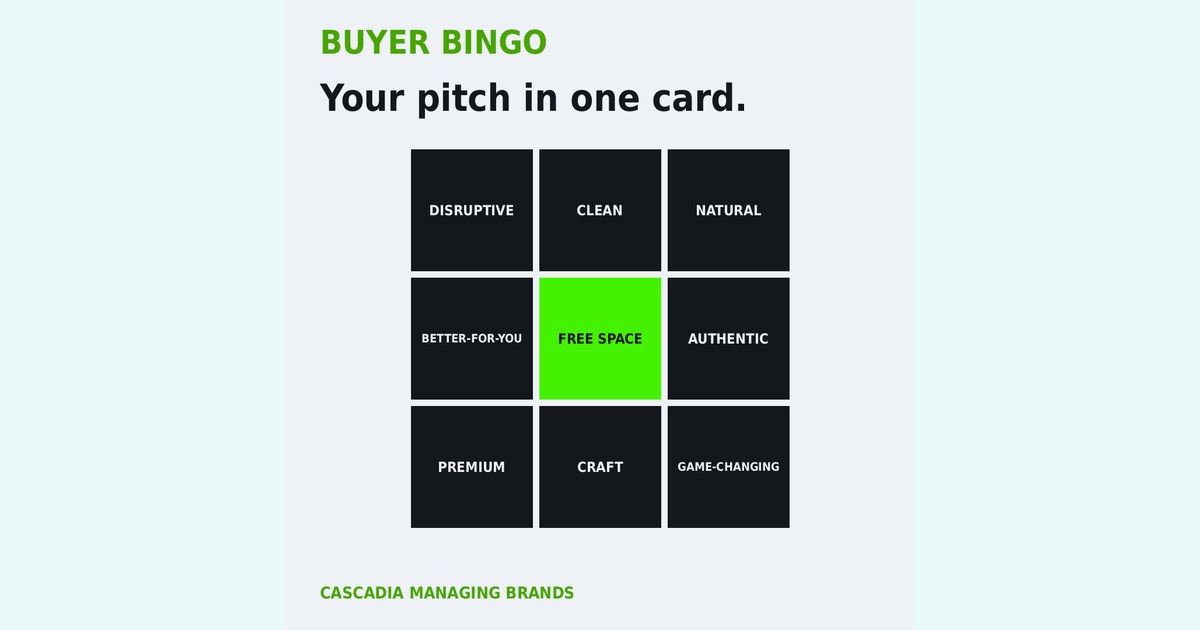
Common food and beverage buzzwords like disruptive, clean, natural, and better-for-you often fail to convince buyers who want clear facts and data.
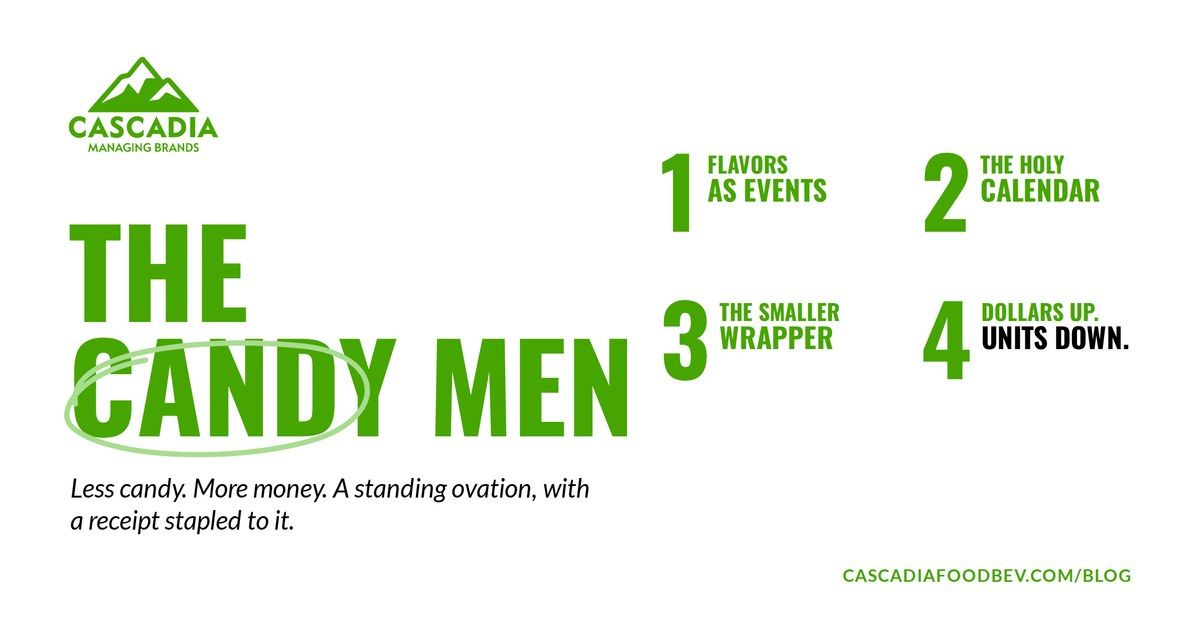
The Candy Men
Americans are eating less candy, and the candy business has never been better. I’d like to register a complaint, and a compliment.
This blog has spent months ripping big food companies apart. Today I’m going to say something nice about them. Sit down. Hydrate. If you feel dizzy, that’s normal.
Groceries cost more than ever. Half the country is cutting sugar. Millions of Americans are on Ozempic, a drug whose entire job is to make you stop wanting the thing in the orange wrapper.
And the candy industry just had a record year. $55 billion. According to the National Confectioners Association, 99.8 percent of American households bought candy last year. You can’t get 99.8 percent of Americans to agree the Earth is round. But they agree on a Reese’s.
Pharma built a drug to kill your sweet tooth, and the candy guys are still sending Christmas cards.
Exhibit A: A Soldier’s Ration Becomes a Fashion Line
M&M’s were born in 1941. Forrest Mars and Bruce Murrie, the two M’s. During World War II they were sold only to the military, because the candy shell let a soldier carry chocolate through the jungle without it turning into soup. Chocolate in body armor.
Then, in 1954, Peanut. And then, for the next thirty-seven years, nothing. Plain or peanut. Like voting in a country where the dictator’s cousin is the other candidate.
Then everything broke loose. Peanut Butter, 1991. Crispy, 1999, cancelled, revived and cancelled again, like a sitcom with a cult. Pretzel. Caramel. Coffee Nut. English Toffee. Hazelnut Spread. At one point the company fired its own cartoon mascots, gave the job to Maya Rudolph, and hired the mascots back after the Super Bowl. That’s not a marketing plan. That’s a custody battle.
They took a wartime ration and turned it into Fashion Week. The candy has seasons now. The candy has a spring collection.
Exhibit B: The Candy Bar With a Prenup
Kit Kat was born in York, England, in 1935, as Rowntree’s Chocolate Crisp. Nestlé, which is Swiss, bought Rowntree in 1988. So Kit Kat is British by birth and Swiss by marriage. And in America it’s made by Hershey, under a license signed back in 1970.
And dig this, because it’s the best clause in American candy. According to the record, that license is perpetual, with a change-of-control clause: Hershey keeps Kit Kat as long as Hershey isn’t sold. Sell the company, lose the bar.
Kit Kat isn’t a candy bar. It’s a prenup. It’s the reason Hershey stays single.
Now go to Japan, where Nestlé runs Kit Kat, and watch it turn into a religion. Japan has seen more than 300 seasonal and regional Kit Kat flavors. Wasabi. Sake. Hokkaido melon. Why? Because “Kit Kat” sounds like kitto katsu, roughly “you will surely win.” Students carry them into entrance exams for luck. So in 2009 Nestlé teamed up with Japan Post and sold Kit Kats you could mail like a greeting card, through about 20,000 post offices.
Somebody in Japan looked at a wafer bar and saw a prayer. Most brand managers I’ve met can’t see a display.
Exhibit C: The Holy Calendar
My old boss at Naked Juice, a former president of Nabisco, used to tell me that God gave us holidays for a reason: to tie food and beverages into them.
The candy companies took that as scripture.
According to the NCA, 63 percent of all candy sales happen around four seasons: Valentine’s Day, Easter, Halloween and the winter holidays. Reese’s makes eggs for Easter, pumpkins for Halloween, trees for Christmas and hearts for Valentine’s. Same peanut butter. Same chocolate. It’s one product in four costumes, and it gets paid four times.
And when God ran out of holidays, the candy industry wrote some more. Circana now tracks “Summerween” as a real sales moment. Summerween. Halloween in July. The pumpkin isn’t even born yet.
The rest of us sell products. The candy people sell dates. They’ve got a better calendar than the Vatican.
Exhibit D: The Lab
Nerds. Born in 1982 as a Willy Wonka candy for kids with allowance money. In 2020 Ferrara, which makes Nerds today, wrapped the pebbles around a gummy and called it Gummy Clusters. Kylie Jenner posted it for free. Addison Rae danced for it at the Super Bowl. Brand revenue went from about $40 million in 2018 to over $500 million in 2024.
Same pebbles. They just gave them a core. That’s a twelve-fold raise for a haircut.
Skittles has been chewy since before most TikTok users were born. So in October 2024, Mars freeze-dried them, meaning the water gets vacuumed out and the candy puffs up and crunches, and launched Skittles Pop’d on TikTok Shop before it hit a single store shelf.
Mars didn’t launch at the checkout lane. It launched in your kid’s phone.
One TikTok video about Swedish candy set off a shortage that lasted about a year. And a YouTuber named MrBeast started a chocolate bar, Feastables, in 2022 and did $215 million in net revenue in 2024, according to internal figures reviewed by Business Insider. Growth slowed to 13 percent in 2025. Turns out candy is hard even with hundreds of millions of subscribers.
The excitement is the product. The chocolate is how they ship it.
Now the Glossary
You know I can’t say this many nice things without checking the language.
Fun Size. It’s the small one. Think about what that says about the big one. The full-size bar is apparently a chore. And fun size is the only size where you get less and they tell you it’s more of a good time.
Share Size. Nobody has ever shared a share size. It’s a single serving for one adult sitting alone in a parked car.
Limited Edition. Limited by what? It comes back next year. It’s not limited. It’s on a schedule. It’s a comeback tour.
Treat. Every candy is a “treat” now. A treat is something you had once a week when you were seven. The industry says the average American gets about 40 calories of candy a day. Every day. That’s not a treat. That’s a pension.
Through the NCA’s “Always a Treat” initiative, companies including Mars, Ferrero, Ferrara and Lindt committed to putting calories on the front of the pack and putting more candy in individually wrapped portions of 200 calories or less. The customer on Ozempic won’t buy a king-size bar. So they sold her a mini she can say yes to.
They didn’t fight the diet. They sold it a smaller wrapper.
The Audit
Atta boy delivered. Now the receipt, because honest math runs both ways.
Americans are not eating more candy. They’re paying more for less of it.
Circana’s numbers for 2025: candy dollar sales up 3.1 percent, to $40 billion. Units down 1.6 percent.
Hershey is public, so it has to tell us. In the second quarter of 2026, its North American candy business raised prices about 14 percent while volume fell about 10 percent. And the word Hershey used for the part where customers walked away is elasticity. Customers didn’t leave. The demand stretched. Like a rubber band.
The price increase has a name too: price realization. They realized a price, like enlightenment. You realized it at the register.
To be fair: cocoa hit record highs in 2024, and trade reporting says manufacturers are still working through contracts locked in back then. That cost is real. But part of this record is a price tag, not a craving.
The drug is real too. A Cornell study published in December 2025 found that households cut grocery spending by about 5.3 percent within six months of somebody starting a GLP-1. Snacks and sweets were among the biggest drops.
So what did candy do about a world that wants less sugar? Mars spent about $36 billion on Kellanova, the Pringles, Cheez-It and Pop-Tarts company, and closed in December 2025. Hershey bought LesserEvil, the better-for-you popcorn and snack brand.
When sugar started losing, they bought the salt. That’s not a pivot. That’s owning both sides of the bet.
Stack It Up
Stack it. All of it.
A wartime ration turned into a spring collection. A British wafer with a Swiss owner and an American prenup. A candy bar turned into a prayer you can mail. Skittles that crunch and Nerds that got a raise. One peanut butter cup in four costumes, getting paid four times. Prices up 14, volume down 10. And when sugar finally lost, they already owned the salt.
Everybody is eating less of this stuff, and these people are still getting paid. That is the best-run fucking aisle in the store.
And you. Yes, you. You swore you were cutting back. Then you saw limited-edition pumpkin spice and said, it’s only here six weeks. That’s not weakness. That’s the product working.
What a Small Brand Should Steal
Founders: you can’t outspend Mars. You can steal from Mars.
A limited edition is a reason to call your buyer again. A holiday is a reason for a display. A smaller pack is how you say yes to a customer who’s been saying no. And an occasion beats an ingredient every single time.
Nobody ever bought a Kit Kat for the wafer.
Verdict
The court finds the candy industry guilty of being very, very good at its job. Sentence: a standing ovation, with a receipt stapled to it. The applause is for the creativity. The receipt is for the 14 percent.
Court adjourned. Pass the fun size. Apparently it’s the fun one.
Sources & Receipts
-
National Confectioners Association, “Confectionery Sales Climb to $55 Billion in 2025” (2026 State of Treating): 99.8% of households purchased; seasonal share 63%; about 40 calories and 1 teaspoon added sugar per day. candyusa.com/news/confectionery-sales-climb-to-55-billion-in-2025/
-
Circana via FoodNavigator-USA, “How candy is winning in 2025: 5 takeaways from Circana” (Sept 23, 2025): dollar sales +3.1% to $40 billion, units -1.6%; Summerween and social-media occasions. foodnavigator.com/Article/2025/09/23/how-candy-is-winning-in-2025-5-takeaways-from-circana/
-
The Hershey Company, “Hershey Reports Second-Quarter 2026 Financial Results” (July 30, 2026): North America Confectionery price realization about 14%, volume/mix about -10%, volume pressure attributed to “elasticity”; LesserEvil acquisition. prnewswire.com/news-releases/hershey-reports-second-quarter-2026-financial-results-302838129.html
-
ConfectioneryNews, “Hershey profit surge masks volume decline and cocoa cost pressures” (May 26, 2026): hedging lag on cocoa costs. confectionerynews.com/Article/2026/05/26/hershey-profit-surge-masks-volume-decline-and-cocoa-cost-pressures/
-
Cornell Chronicle, “Ozempic is changing the foods Americans buy” (Dec 2025), on Hristakeva and Liaukonyte, Journal of Marketing Research, Numerator panel of about 150,000 households: grocery spending -5.3% within six months. news.cornell.edu/stories/2025/12/ozempic-changing-foods-americans-buy
-
Always a Treat initiative (NCA with Partnership for a Healthier America): front-of-pack calories; 200 calories or less per individually wrapped pack; participants include Mars Wrigley, Ferrero, Ferrara, Lindt. alwaysatreat.com/initiative/
-
Mars, “Mars Completes Acquisition of Kellanova” (Dec 11, 2025); deal value about $36 billion per Virginia Business and Food Dive. mars.com/news-and-stories/press-releases-statements/mars-completes-acquisition-of-kellanova
-
Kit Kat history (1935 launch as Rowntree’s Chocolate Crisp, York; Nestlé acquired Rowntree June 1988; Hershey U.S. license from 1970, perpetual with change-of-control clause): Wikipedia, “Kit Kat.”
-
Kit Kat Japan (more than 300 flavors, kitto katsu, 2009 Japan Post campaign, about 20,000 post offices, Cannes Lions 2010): Wikipedia, “Kit Kats in Japan”; Bloomberg, July 25, 2017.
-
Nerds (1982 Willy Wonka Candy Company; Gummy Clusters 2020; Kylie Jenner 2021; Addison Rae 2024 Super Bowl ad; brand revenue about $40 million in 2018 to over $500 million in 2024): Wikipedia, “Nerds (candy)”; Ferrara press release on Super Bowl debut; Variety, 2024.
-
Mars, “Mars Introduces SKITTLES POP’d Freeze-Dried Candy as Newest Innovation” (PR Newswire, Oct 2024): TikTok Shop availability Oct 21, 2024, then retail. prnewswire.com/news-releases/mars-introduces-skittles-popd-freeze-dried-candy-as-newest-innovation-302275792.html
-
CBC News, “How a viral TikTok video led to a year-long global shortage of Swedish candy.” cbc.ca/news/business/swedish-candy-shortage-1.7410201
-
Feastables: $215 million net revenue 2024, 13% growth 2025, per internal data reviewed by Business Insider, as reported by Dealroom.co. Subscriber count per his YouTube channel.
-
M&M’s history (1941 launch, Mars and Murrie, WWII military sales, variety dates, spokescandies and Maya Rudolph): Wikipedia, “M&M’s,” and mms.com company history.
-
Naked Juice / Nabisco holiday quote: author’s personal recollection.
-
Derived notes: “thirty-seven years” is 1954 to 1991. “Fell about 10 percent” restates Hershey’s reported volume/mix, which includes product mix, not units alone.