


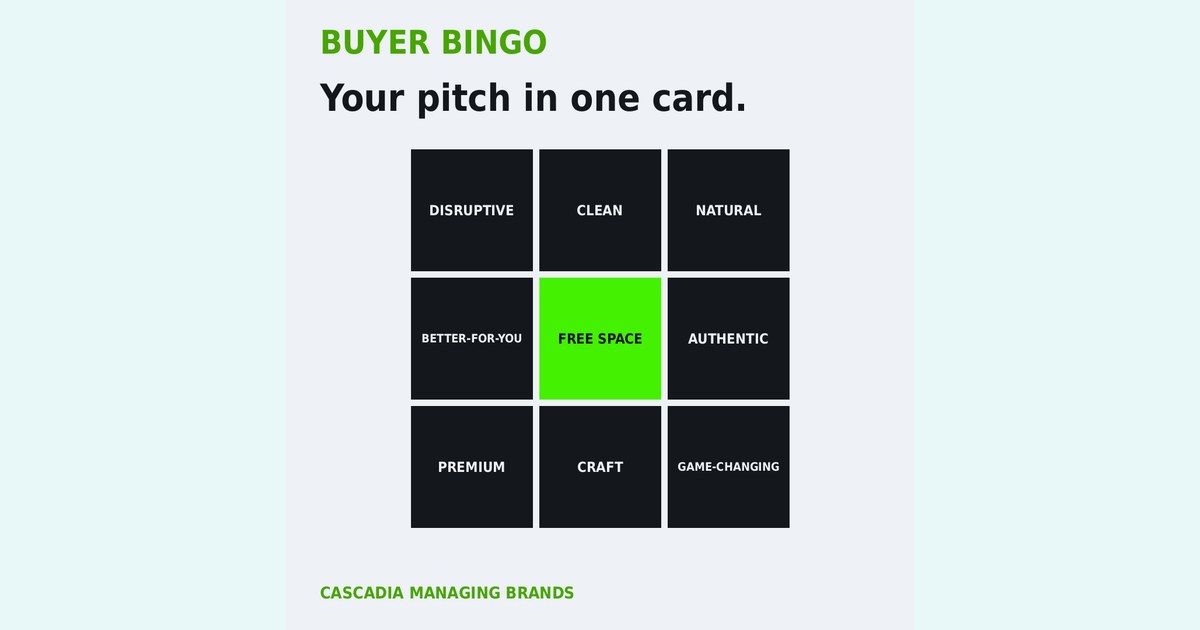
Common food and beverage buzzwords like disruptive, clean, natural, and better-for-you often fail to convince buyers who want clear facts and data.
Footprint
From The $200 Grocery Bill: An Uncomfortable Look at Why American Food Costs So Much
Investigative satire. Skeptical of everyone. Funny, but fact-based. Nobody gets off easy — including you.
Last time I showed you the fee that isn’t on your receipt. Today, the one I’ve been putting off for thirty years, because I have been on both sides of it: the building where your food is actually made, and the growing number of American food companies that have never once set foot in it.
Pick up something in your kitchen. Anything. A box, a jar, a bag.
Turn it over.
Find the small print at the bottom, under the barcode, in the type size that legal picked.
Most of the time it says one of two things.
It says “Manufactured by.”
Or it says “Distributed by.”
Those are not the same sentence. They are not close to the same sentence. One of them means we made this. The other one means we bought it from somebody who made it, and we put our name on the front.
Nobody is lying to you. That’s the part I need you to understand before we go any further. Every word of it is legally accurate, federally required, and printed exactly where the regulation says to print it.
It’s just that the whole story is in two words, in six-point type, under a barcode.
And nobody ever told you to look.
The Word Is “Footprint”
In March of 2025, Conagra announced it was closing a plant in Fennville, Michigan.
Nearly a hundred years old. Eighty-five people. It made pie filling.
Here is the company’s stated reason, and I’m quoting the spokesman exactly:
the need to operate our overall operations and facility footprint as effectively and efficiently as possible
Footprint.
Sit in that one with me.
What is a footprint? Go to the beach. Walk twenty feet. Turn around.
A footprint is the mark left behind by something that has already gone. That is the entire meaning of the word. It is an impression in the sand where a thing used to be. You cannot make a footprint without leaving.
That’s what they call the buildings.
Not the plant. Not the facility. Not the place where four generations of people in Fennville, Michigan made pie filling for a century.
The footprint.
And you don’t close a footprint. You don’t fire a footprint. You rationalize it — there’s that word again, same one the shelf got in Part 11 — or you optimize it, and if you’re feeling especially brave you announce that you are right-sizing it, which is a word so cowardly it should come with a note from its mother.
Then look at how the sentence is built.
“The need to operate our overall operations and facility footprint as effectively and efficiently as possible.”
Find the human being in that sentence.
Go on. I’ll wait.
There isn’t one. The need did it. A need closed the plant. The need arrived, unaccompanied, and eighty-five people in Michigan lost their jobs, and no person appears anywhere in the sentence that explains it.
Somebody decided. Somebody with a name, in a room, on a Tuesday, looking at a spreadsheet. That person exists. That person may even have been right.
But you will never find him in the announcement, because the announcement was built specifically so that you couldn’t.
Now the Part Where I Argue Against Myself, Early, Because It’s Load-Bearing
Here’s where you expect me to tell you American food manufacturing is dead.
It isn’t. Not remotely. And the numbers are so far from my convenient story that I’m going to put them at the top instead of burying them at the bottom.
The Bureau of Labor Statistics — the federal agency that counts American jobs — says food and beverage manufacturing employed about 1.68 million people in 2014.
By 2024 it was 2.1 million.
That’s over four hundred thousand jobs added in a decade. It is now the largest of the twenty manufacturing sectors in the United States. Bigger than autos. Bigger than aerospace.
And BLS projects it adds another 130,000 by 2034 — 6.2 percent growth, which is twice the rate projected for American employment overall.
And there are 43,277 food manufacturing plants operating in this country right now — that count is food only, not counting the beverage plants, so if anything it’s low.
So let’s kill the easy version of this article before it gets going.
The plants did not go away.
The jobs did not go away.
There are more of both than there were when my kids were in school.
Anybody selling you a story about the hollowing-out of American food production is selling you a feeling, and this series does not run on feelings.
So what the hell happened?
What Actually Changed
Something did change. It just isn’t the thing everybody assumes.
What changed is the relationship between the name on the front of the box and the building where the food is made.
The plant is still there. The line is still there. The woman who runs the filler at four in the morning is still there, and there are more of her than there used to be.
She just doesn’t work for the company whose logo is on the package anymore.
There’s an entire industry in that gap now, and it has a size. Food contract manufacturing — companies whose whole business is making food that carries somebody else’s name — is a $404 billion global market as of 2025, and the American share of that is about $113 billion. It’s projected to reach roughly $692 billion worldwide by 2034.
A hundred and thirteen billion dollars a year, in this country, spent by food companies to have other people make their food.
And I want to be careful here, because this is where a lazy writer would sneer. Co-packing is not a scam. It is the single reason any new food brand exists at all. A founder with a good recipe and forty thousand dollars cannot build a plant. She can rent time on somebody else’s line. Every client I have ever worked with started that way. Most of my own career happened because that option exists.
The model isn’t the problem.
What happens when nobody owns the capacity is the problem.
The Four Things That Changed
I keep coming back to a test in this series, and it works here too. The question is never did somebody used to pay for this. Somebody always paid. The question is what changed in the paying.
Four things.
One: who can decide. When your company owned the plant, a person inside your building could walk down to the floor and change something. Slow the line. Fix the filler. Try a new supplier on Tuesday and see how it ran. There was an argument to have and somebody to have it with.
Now there’s a contract.
You cannot walk down to a floor you don’t own. You can submit a change request.
Two: who knows anything. This is the one that actually keeps me up. A food company that has never run a line eventually contains nobody who knows how food is made. Not out of malice — out of arithmetic. The people who knew retired, and the company never hired their replacements, because why would it? It doesn’t have a plant.
So the institution forgets.
And an institution that has forgotten how its own product is made cannot tell when it’s being told something that isn’t true.
Three: where the money goes when things go wrong. The plant used to be a cost you controlled and an asset you owned. Now it’s an invoice you receive. When the co-packer’s costs rise, you get a letter. You don’t get a vote.
Four: what’s left to cut.
And that one deserves its own section, because that one is your grocery bill.
The Only Three Levers Left
Here’s the mechanism. This is the whole reason this article is in a series about why food costs so much.
A food company under margin pressure has to find money somewhere. Always has. That’s not new and it isn’t evil.
If you own the plant, look at everything you can go after. Line speed. Changeover time. Yield — how much of the raw material ends up in the package instead of on the floor. Energy. Maintenance schedules. Layout. Scheduling. Scrap. Water. The thousand boring, physical, unglamorous improvements that a person who understands the building can find by walking it.
Every one of those makes the food cheaper to produce without making it worse.
Now take the plant away.
You don’t control the line speed. You don’t control the yield. You don’t control the changeover, the maintenance, the layout or the scheduling, because you don’t own the building and the building is running four other people’s products this week.
So what’s actually left?
The recipe. Cheaper oil. Cheaper cocoa. A starch instead of the thing the starch is replacing.
The package. Thinner film. Lighter bottle. Less board.
The ounces.
That’s it. That’s the entire toolbox. Three levers, and every single one of them is something the customer can taste, feel, or count.
Ten parts into this series I showed you a company quietly removing three-point-two ounces from a box and told you it wasn’t inflation.
This is why.
It wasn’t greed that reached for the ounces. It was the fact that the ounces were the only thing left to reach for.
The company had already sold the machine that would have let it do something else.
At the Back of the Line
Don’t take that from me. Take it from a man whose job is selling food companies to investors.
Back in 2022 — before either of the closures I just described — Michael Seccuro, at the investment bank Intrepid Investment Bankers, wrote a piece arguing that in-house manufacturing had become a competitive advantage, and that owning a plant commands a premium with strategic and private equity buyers.
He was early. That’s the point of quoting him.
And here is his description of what happens to brands that don’t own one, when capacity gets tight in a category:
consolidation of providers and a scarcity of capacity
leaving co-pack-dependent brands
at the back of the line or without capacity for expansion.
At the back of the line.
That’s an investment banker. Writing to other investment bankers. Describing what happens to a company that did exactly what the market told it to do for fifteen years.
Go asset-light, they said. Don’t tie up capital in bricks, they said. Let somebody else own the hard part.
And four years ago the same industry started quietly circulating a different memo, and the new memo says the people who own the hard part own you.
A Deposition Regarding Who Made This
Let the record show.
Q: Whose name is on the front of this package?
Ours.
Q: Did your company make what’s inside it?
We developed it.
Q: That isn’t the question. Who made it?
A contract manufacturer.
Q: Where?
I’d have to check.
Q: Have you been there?
I have not.
Q: Has anyone at your company been there?
Our quality team does audits.
Q: How often?
Annually.
Q: How many other products does that plant run?
I don’t have that.
Q: If you wanted to make your product cheaper next quarter, what could you change?
The formula. Or the packaging.
Q: Could you change how it’s manufactured?
That’s their line.
Q: So when you say you make food —
We’re a brand.
Q: Say that again for the record.
We’re a brand.
No further questions.
Four Years Out of Five
Now here’s the number that ends the efficiency argument, and I want to be careful with it because it’s the best fact in this article.
Every one of those plant closures was announced in the name of efficiency. Conagra said it out loud. In the fall of 2025 General Mills announced it would close three plants in Missouri, targeting $100 million in savings against $82 million in restructuring charges. The pizza crust plant in St. Charles actually went dark this past June — 163 jobs, eight months after the announcement, which is how long it takes to turn a press release into an empty parking lot.
Fine. That’s the promise. Close the weak plant, run the strong one harder, and get more output per hour of work.
So let’s check.
Labor productivity just means output per hour worked. If a plant makes a thousand jars an hour and next year it makes eleven hundred, productivity went up ten percent. That’s it. That’s the whole concept. It is the single number that tells you whether an industry is genuinely getting better at making things, as opposed to just getting smaller.
BLS measures it for food manufacturing every year.
Here it is, most recent five years:
2021: down 1.5 percent.
2022: up 0.1 percent.
2023: down 1.0 percent.
2024: down 5.1 percent.
2025: down 2.1 percent.
Four years out of five, down.
In 2025 alone: output fell 1.8 percent, hours worked rose 0.3 percent, and unit labor cost — what it costs in wages to produce one unit of stuff — went up 5.6 percent.
Read that sequence one more time.
They closed the plants for efficiency.
And the industry got less efficient. Four years out of five.
I’m not going to claim the closures caused that; the honest answer is that nobody has isolated it and I’m not going to pretend I have. Plenty else happened in those years.
But I can tell you what the record shows, and the record shows this:
We were promised efficiency and we have five years of federal statistics saying we didn’t get it.
Somebody got something. It wasn’t the output per hour, and it sure as hell wasn’t you.
The People in the Building
One stop before the end, and I’m not going to put a joke on top of this one.
The people who actually make American food get hurt more than almost anybody.
The federal injury rate for all private industry in 2024 was 2.3 recordable cases per 100 full-time workers. That’s the baseline. Two point three.
Food manufacturing: 3.3.
Forty-three percent higher than the American average, every year, quietly, in buildings with no windows.
In 2024 the industry recorded 51 fatal injuries.
Fifty-one people went to work in a food plant and did not come home.
Production workers in food manufacturing average $24.70 an hour. A food batchmaker — the person who actually mixes what you eat — has a median wage of $21.07. The packaging machine operator: $21.32.
And when a plant does close, it doesn’t just take those jobs.
Economists at Iowa State studied what happened to Midwest towns after food plant closures. When Tyson closed its plant in Perry, Iowa in June 2024 — 1,276 jobs in a small town — county manufacturing employment fell about 20 percent within one month and more than 30 percent within ten months. Total employment across affected counties dropped roughly 6 percent in the first year. Non-manufacturing jobs fell too, because the diner and the hardware store and the dentist all depended on people who suddenly had no income.
A footprint, they called it.
There are fewer than eight thousand people in that town.
Who Signed It
Now let me show you the other end of the same decision, because it’s disclosed and almost nobody goes and looks.
The decision to close Fennville was made and announced in Conagra’s fiscal 2025 — the plant itself went dark a month into fiscal 2026. Here is what the company paid its five named executive officers in the year that decision got made, out of its own proxy statement:
Sean M. Connolly, President and Chief Executive Officer — $13,140,480.
Noelle O’Mara, Executive Vice President and President, New Platforms and Acquisitions — $5,683,271.
Dave S. Marberger, Chief Financial Officer — $4,084,894.
Thomas M. McGough, Co-Chief Operating Officer — $4,078,863.
And Alexandre O. Eboli, Executive Vice President and Chief Supply Chain Officer — $3,557,425.
Read that last title again, and then read the reason the plant closed one more time: to improve efficiencies and effectiveness within its supply chain network.
That’s his network. That is, precisely and by title, the thing he is paid to run.
Now do the other side of it.
Sixty-one production and maintenance workers. At the federal average for their industry — $24.70 an hour — that’s roughly fifty-one thousand dollars apiece, which puts the annual wages of the entire Fennville production floor at about three point one million dollars.
The Chief Supply Chain Officer was paid more in one year than everyone who ran that building was paid, combined.
I’ll be scrupulous, because this is exactly where people cheat: load in benefits and payroll taxes and the plant’s fully-burdened cost edges back ahead of him. Call it a tie. That’s the honest version, and a tie is damning enough.
Connolly’s single year was about four times the plant floor’s wages. The five of them together, roughly ten times.
And No, This Doesn’t Contradict Part 2
Two parts into this series I put executive pay on trial and acquitted it. Kroger’s seven named officers, forty-six million dollars, worked out to six cents on a $200 cart against $38.40 for the overhead machine they built. I wrote that anybody blaming your grocery bill on executive salaries was selling you a cartoon. I meant it and I still mean it.
So watch what happens when you run the identical test on a manufacturer.
Kroger: $46 million of named-executive pay against $147.6 billion of revenue. That’s about three cents per hundred dollars of everything the company sells.
Conagra: $30.5 million against $11.6 billion. That’s about twenty-six cents per hundred.
Eight and a half times the weight.
Same arithmetic. Same method. Different answer — because a company that sells a hundred and forty-seven billion dollars of other people’s groceries and a company that sells eleven billion dollars of its own food are not the same animal, and the honest thing is to say so rather than protect a verdict I reached about somebody else.
The retailer’s executives are genuinely confetti on your cart.
The manufacturer’s are not confetti. They’re about a tenth of the plant.
Honest Math, Both Ways
You’ve had the biggest one already, up top, and it’s worth repeating because it’s the thing that ought to make you skeptical of me: employment in this sector is growing, not shrinking. Four hundred thousand jobs added in a decade and a hundred and thirty thousand more projected. Whatever is wrong here, it is not a story about the death of American food manufacturing.
Two: co-packing genuinely democratized this business. Before contract manufacturing was widely available, starting a food brand required a factory, which meant it required capital, which meant the only people who got to put food on a shelf were people who already had money. The co-packer broke that open. Every interesting small brand you have ever bought exists because somebody could rent a line. That is a real and considerable good and I’m not trading it for a tidy argument.
Three: sometimes the right answer is to close the plant. A hundred-year-old facility running one seasonal product at forty percent utilization may genuinely be the wrong way to make pie filling in 2026, and keeping it open out of sentiment would just move the cost onto somebody else. I’ve made that call myself. It was correct and it was awful and both of those are true.
Four, against my own productivity point: those BLS declines cover years with a pandemic hangover, a hiring surge, commodity whiplash and a demand shift. Productivity is noisy. I’ve told you what the numbers say and I’ve told you I can’t prove causation. Anybody who tells you they can is doing something other than arithmetic.
Stack It Up
So put it all on the table at once.
The plants are still running and there are more jobs in them than a decade ago.
But the name on the front of the box is increasingly attached to a company that does not own the building, has never run a line, and employs nobody who knows how the food is actually made.
That company has exactly three ways left to find money, and every one of them is the recipe, the package, or the ounces — which is to say, every lever it has left is one you can taste.
When capacity gets tight, an investment banker will tell you in writing that it goes to the back of the line.
The plants that do close, close in the name of efficiency, announced in sentences engineered to contain no human being — the need to operate our facility footprint — and the federal productivity statistics say the industry got less efficient in four of the last five years anyway.
The people inside are hurt 43 percent more often than the American average, fifty-one of them died in 2024, and the ones who mix your food make twenty-one dollars an hour.
And when one of those buildings goes, it takes about a fifth of a county’s manufacturing employment inside of a month, and they call the county a footprint.
Every piece of this is legal. Most of it is even rational. Each individual decision was made by somebody competent, with a spreadsheet, who could defend it in a meeting and probably still can.
And the sum of it is a country where the company whose name is on your dinner has outsourced the one thing that could have made your dinner cheaper without making it worse — and then reached for the ounces, because the ounces were the only fucking thing they had left to reach for.
The Verdict
Here’s what I want you to take out of this one, and then I’ll let you go.
Nobody stole American food manufacturing. It’s right there. Forty-three thousand buildings. Two million people. More than there used to be.
What got separated was knowing from selling.
There is a building in this country where your dinner was actually made, by people who were actually there, at an hour you were asleep. And there is an office somewhere else with a marketing plan, a logo, and a line item for co-packing.
They used to be the same company.
When they were, the company had a hundred ways to make your food cheaper.
Now it has three, and you can taste all of them.
It’s printed on the back of the box, under the barcode.
“Distributed by.”
Two words. They’ve been telling you the whole time.
Case open. Court adjourned, not dismissed.
Next time — the farmer. I’ve put this off twice now and I’m out of excuses. The US Department of Agriculture publishes, every single year, exactly how much of your food dollar reaches the person who grew the food. It’s about fifteen cents. This entire series has been the story of the other eighty-five, and it’s time to go look at the first one.
Sources & Receipts
Author’s Note On Method
Three flags, because this one has more judgment in it than most.
First, and most important: I have not claimed that plant closures caused the productivity decline. I’ve put both facts on the record — the closures were announced for efficiency, and food manufacturing productivity fell in four of the last five years — and I’ve left the causal question open, because no study I could find isolates it and inventing one would be exactly the sin this series exists to mock. Those years also contained a pandemic hangover, a hiring surge and commodity whiplash. Read the sequence and draw your own conclusion; I’ve told you what I can prove.
Second, the two employment figures in this piece measure different things and I want that clear rather than convenient. “Food and beverage manufacturing” — the 1.68 million to 2.10 million series — includes beverages. “Food manufacturing,” NAICS 311, the 1.76 million figure, does not. Both are BLS. Neither is wrong. They are not the same denominator and I have not blended them.
Third, the three-levers argument — that a company without a plant can only reach for the recipe, the package or the ounces — is my analysis built on thirty years of doing this, not a cited finding. The supporting facts around it are sourced. The reasoning is mine, and you’re entitled to argue with it.
A fourth flag, on the Fennville wage arithmetic. Nobody discloses what a Conagra line worker in Fennville, Michigan actually earned — not the company, not the proxy, and the Teamsters Local 406 contract isn’t public. The roughly $51,000 figure is the federal average hourly wage for production and nonsupervisory workers in food manufacturing, annualized, applied to the 61 production and maintenance employees named in the WARN notice. It is an estimate built on a federal average, clearly labeled, and if the real Fennville number is higher then the comparison to the Chief Supply Chain Officer gets closer, which is why I called it a tie rather than a knockout. The executive compensation figures are exact and come from the proxy.
What I deliberately did not do: name a specific brand as not owning its plants. Co-packing relationships are ordinarily confidential, the public record is thin and inconsistent, and naming a company on thin sourcing to make a point would be unfair to a real business. The mechanism is industry-wide and provable. The roster is not mine to publish.