
Rao’s jarred pasta sauce challenged commodity pricing with $8 jars, shifting consumer behavior and growing rapidly through major retailers.
It’s Possible.
A gym, a kitchen, a cookie farmstead and a closed yogurt plant: seven founders who built the real thing in food and beverage, and the part we usually talk people out of.
Let me tell you about a bad business model. Somebody walks into our office and says, “I want to get into food and beverage.” And we, the people who make our living helping founders get into food and beverage, spend the next hour trying to talk them out of it.
My rough estimate, and it’s an estimate, not a study, is that we talk about 80% of the people who come to see us out of getting into this business. Eight out of ten. We are a consulting company that sends most of its leads home. That’s not good for my business. If you ran a car dealership that way, they’d take your keys.
But here’s why we do it. We’ve watched this industry for thirty years, and the one thing we can’t stand is somebody burning their savings on a fantasy about a shelf. So we tell the truth first. The cost, the years, the deductions, the shelf you have to rent and then keep renting.
And then there’s the 20%. The ones who hear all of it, and don’t flinch, and say, “OK. When do we start?”
This piece is for them. Because for all the talking out of it we do, the other half of the truth is on the record, with names and dates and receipts. It’s possible. People did it. Possible is a fact. Easy is a lie. Let’s hold both in the same hand, which is what adults do.
First, the vocabulary
George Carlin used to say you could learn everything about a culture by listening to what it won’t say plainly. So let’s listen.
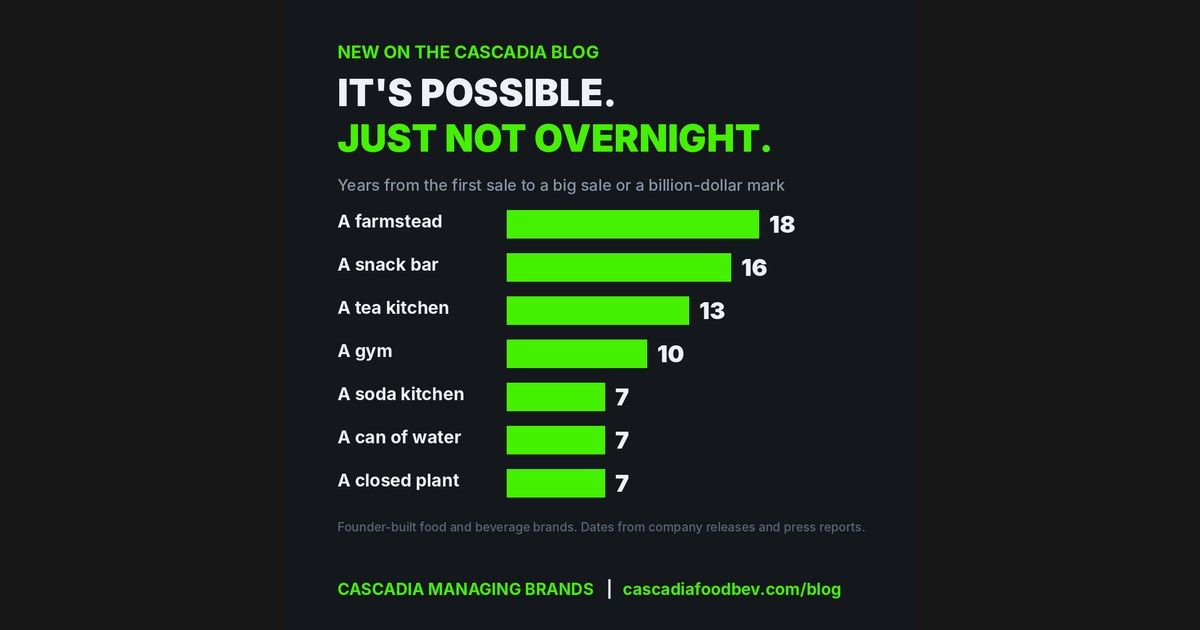
Overnight success. A phrase used exclusively by people who weren’t there for the nights. Every founder in this piece took somewhere between seven and eighteen years. Overnight. Eighteen years overnight. That’s not a night, that’s a hostage situation.
Exit. Look at that word. “Exit.” It’s what you read above a door in a burning theater. In our industry it means somebody bigger bought you, and somehow we made a fire exit sound like a victory lap. It’s a polite word for a very large check, and as you’ll see, it isn’t always the end of the story.
Founder-led. A company where the person who started it still has a say. Two of these seven were still CEO in the most recent reports I found. Others stayed for a while, or stayed in some other role. The word matters less than what it means: somebody cared enough about the product to be wrong about it in public.
Proof of concept. A fancy phrase for “somebody who isn’t related to you paid for it.” Most of the founders in this piece got theirs from one person, in one store.
The gym
Siete Foods started in 2014 in Laredo, Texas. Veronica Garza had been diagnosed with autoimmune diseases, and she wanted to keep eating the foods of her Mexican American family without the grains that made her sick. So she experimented with almond flour tortillas. Her family encouraged her to sell them, and the first place they sold them was the family’s own CrossFit gym.
A gym! The first retail location of what became a major national brand was a place with kettlebells!
From there it was a person-to-person story, which is the oldest kind there is. Veronica carried samples to a co-op in Austin, where the buyer said yes on the spot. On the spot! No category review, no presentation, no 14-slide deck about synergy. A customer at that co-op knew someone at Whole Foods, and that opened the next door. Her youngest brother Miguel, just out of law school, pushed her to start, and he’s now the CEO. Her older brother Rob was relentless about getting the retail accounts. In 2019, the private equity firm Stripes Group put $90 million into the company.
In October 2024, PepsiCo announced it would buy Siete for more than a billion dollars. Miguel said the family planned to stay involved. Ten years from a gym in Laredo to that.
The kitchen
Allison Ellsworth began mixing fruit, apple cider vinegar and soda water in her kitchen, trying to make a soda with less sugar and more fiber. Her husband Stephen was her co-founder. In 2018, she appeared on Shark Tank, and the appearance produced a $400,000 investment from Rohan Oza.
In May 2025, PepsiCo closed its purchase of that brand, poppi, for nearly $2 billion. That figure includes about $300 million in anticipated cash tax benefits, which the net price excludes. (The exact numbers are in Sources & Receipts, where a fact-checker can find them.) Allison remains involved as a creative advisor, according to Fortune.
Seven years from the TV episode to the closing. And notice that the TV episode wasn’t the beginning of the story. It was a stop on the road.
Honest Tea started in a kitchen too. Seth Goldman and Barry Nalebuff tested tea blends in Goldman’s Bethesda, Maryland, kitchen in 1997, and the company was founded in 1998. They pitched a 17-store regional chain called Fresh Fields with thermoses of tea and a relabeled Snapple bottle. A relabeled Snapple bottle! That’s the sales presentation. That’s the pitch. And the chain agreed to buy 15,000 bottles.
Coca-Cola bought a minority stake in 2008 and the rest in 2011. In the 2011 announcement, Coke said Honest Tea’s distribution grew from about 15,000 outlets in 2008 to more than 75,000, and said Goldman would stay on as president and “TeaEO,” reinvesting most of his proceeds in the company.
Thirteen years from kitchen to finish line. And this one comes with a part that the press releases leave out, so hold that thought.
The farmstead
Kathleen King started selling cookies at her family’s farmstead on Long Island at age 11, according to Mondelēz. She founded Tate’s Bake Shop in 2000. By 2018, brand sales had quadrupled over five years, and Mondelēz agreed to acquire the company for about $500 million. Eighteen years, from the cookie stand to the check.
The detail I like best is in the buyer’s own press release. At the time of the sale, it said King still perfected every recipe herself. In my opinion, that’s not a nice anecdote. That’s the strategy. A giant company bought something that only worked because a woman obsessed over a cookie, and had the sense to put it in writing.
The factory nobody wanted
In 2005, Hamdi Ulukaya bought an 84-year-old yogurt plant in upstate New York that Kraft had decided to close. He financed it with an $800,000 SBA loan, Bloomberg reports, plus local incentive grants. Before that he’d started a small feta cheese business that, according to Wikipedia, barely broke even in its first two years. Chobani’s first order, a few hundred cases, shipped in October 2007 to a grocer on Long Island.
Then it went the way you’d hope. After BJ’s and Costco began carrying it, sales reportedly doubled every year from 2009 through 2013, and annual sales passed $1 billion by 2012. Bloomberg says Ulukaya was still the founder and CEO as of April 2026. And in October 2025, Chobani reportedly raised $650 million at a $20 billion valuation to expand its plants.
Think about that. A giant walked away from a plant, and a man with a feta business that barely broke even walked in. In my opinion, the instinct that bought that plant is the same one that’s still running it. And he didn’t run a feta company into the ground and quit. He tried the next thing.
The ones who stayed
Mike Cessario founded Liquid Death in 2017, and as of Fortune’s October 2025 report he was still the CEO. In March 2024, the company raised $67 million at a valuation of more than a billion dollars, and Food Dive reported $263 million in retail sales for 2023. Fortune reported that scanned sales topped $300 million in 2024, and that the company planned to enter the energy drink category in 2026.
Seven years. A can of water. Whatever you think of the branding, and in my opinion it’s the sharpest in the category, the mechanics underneath are the ordinary ones. You have to be on shelves, you have to turn, and somebody has to keep buying.
Daniel Lubetzky launched KIND in the mid-2000s. Mars bought a minority stake in 2017, and in November 2020 announced it would acquire the rest. Terms weren’t disclosed, but The New York Times estimated the price at roughly $5 billion. Per Inc., Lubetzky stepped down as CEO in 2019 and became executive chairman, and said he planned to stay involved. About sixteen years, give or take, depending on which founding year you trust, and the sources disagree.
The part that isn’t in the press release
Here’s where I owe you the honest half.
Coca-Cola announced that it would phase out Honest Tea by the end of 2022. The stated reason was that Coke wanted fewer, bigger brands and was focusing on Gold Peak and Peace Tea. Goldman called it a gut punch. By then he had sold his last stake in 2017, and he said he suffered no financial loss. The team that built it, and the farmers who supplied it, were another matter.
I’m not telling you this to take anything away from these founders. I’m telling you because “possible” has a second chapter that nobody covers. Building the brand is one thing. Keeping what you built alive inside somebody else’s building is another. Sometimes the sale is the finish line. Sometimes it’s a handoff, and the baton lands in a drawer. I’d rather you hear that from me before you sign than after.
Let the record show
Dig this. I want to take a deposition. The witness is Mr. Overnight Success. This one is invented, and I’ve labeled it that way in the sources, but every answer is built from the facts above.
Q: Mr. Overnight Success, how long did it take you?
A: Between seven and eighteen years, depending on which of us you ask.
Q: And where did you start?
A: A gym. A kitchen. A farmstead. A shuttered yogurt plant.
Q: Did anybody tell you it couldn’t be done?
A: Constantly. Several of them were holding thermoses at the time.
Q: How many retailers said yes in the beginning?
A: One. One buyer, in one store, who said it on the spot.
Q: Let the record show that the witness appears to have worked on this every day for years.
A: The record is correct. I’d also like it to show that I was tired.
No further questions. Court adjourned.
What they have in common
These are my opinions, drawn from the facts above and from thirty years of watching brands get built and watching them not get built. Take them as one operator’s read, not a law of nature.
First, they started small and physical. A gym, a kitchen, a farmstead, a co-op. The first yes came from a person standing in a place, not from a program or a presentation.
Second, the first buyer was a human being. A co-op buyer in Austin. A 17-store regional chain. Nobody got their first order from a pitch deck alone.
Third, they were obsessed with the product, and it showed. King, per the buyer’s press release, perfecting recipes. Goldman testing blends. Veronica Garza solving a problem she personally had. In my opinion, buyers can smell when the founder uses the product, because the founder knows what’s wrong with it.
Fourth, they let the business grow at the speed the business could afford. The numbers in this piece are big, but the years aren’t small. Seven. Ten. Thirteen. Eighteen.
Fifth, they didn’t stop when it worked. Ulukaya was still running Chobani as of Bloomberg’s April 2026 report. Cessario was still running Liquid Death as of Fortune’s October 2025 report. King, at the time of her sale, was still perfecting the recipes.
Why we talk people out of it
Back to the 80%.
Here’s what we’re actually doing in that hour. We’re not saying it can’t be done. You just read seven stories that say it can. We’re saying: look at the years. Look at the cash. Look at who had to say yes, one buyer at a time. And ask yourself, honestly, whether you’re built for that.
Most people aren’t. In my opinion, that’s not a flaw, that’s a lucky escape. The ones who walk out of our office relieved are the ones we did the most good for, and they’ll never send us a dime. That’s the worst business model in America, and I’d do it again tomorrow.
The ones who stay are the ones in this article.
Stack it up
Let’s put it all in one pile.
A gym. A kitchen. A farmstead. A plant that Kraft didn’t want. A TV appearance that was a stop, not a beginning. A co-op buyer who said yes in one visit. A chain that bought 15,000 bottles from a guy with thermoses and a Snapple label. Seven years, ten years, thirteen years, eighteen years. Billions of dollars paid by giants.
That’s what “overnight success” looks like with the lights on. It looks like a lot of Tuesdays. It looks like a founder in a parking lot at 6 a.m. with a case of product and a phone full of unanswered emails.
And the people who tell you you can’t compete with the big guys? In my experience, they’re right about the first year and wrong about the tenth. The overnight success is a fucking fairy tale told by people who weren’t there for the nights.
It’s still possible. People did it. We counted.
The verdict
The court finds that it’s possible. Not likely, not easy, not quick. Possible, with names and dates on every one.
If you take one thing from this piece, take the pattern, not the payday. Start where you can taste the product and see the customer. Get one real yes from one real person. Do the boring part in the right order. Give it the years it needs. Then decide, with your eyes open, whether you’re building a brand to sell or a brand to run. Both are legitimate, and both are hard.
And be honest with yourself about what a sale means. Some of the brands in this piece are thriving. One of them was phased out. The check clears either way, but the brand you built is worth protecting, and that starts before the contract does.
That’s what we do at Cascadia Managing Brands. We manage the brokers, we call on the distributors and retailers directly, and we help founders do the basics in the right order. Yes, we’ll try to talk you out of it first. If you’re still standing after the hour, come see us. Possible. Just rarely easy.
Sources & Receipts
Facts reported by third parties:
1. Siete Foods: founded by the Garza family in 2014 in Laredo, Texas; Veronica Garza’s autoimmune diagnoses; first sales at the family’s CrossFit gym; Miguel Garza as CEO; $90 million from Stripes Group in 2019; PepsiCo’s $1.2 billion deal announced October 2024: Texas Monthly, “Will Pepsi Ruin Siete Foods?” The co-op buyer in Austin, the Whole Foods introduction, and Rob Garza’s retail persistence: NBC News, “How Siete Foods went from selling tortillas at a gym to being acquired by PepsiCo for $1.2B,” Oct. 2024. I did not verify the closing date.
2. poppi: PepsiCo completed the acquisition on May 19, 2025, for $1.95 billion including about $300 million in anticipated cash tax benefits, for a net purchase price of $1.65 billion, plus a performance-based earnout: PepsiCo press release, May 2025. Founders Allison and Stephen Ellsworth; kitchen origin; 2018 Shark Tank investment of $400,000 from Rohan Oza; Allison as creative advisor: Fortune, June 16, 2025. Conflict: Fortune gives 2020 as the founding year and also says she began experimenting about ten years earlier. This post gives no founding year.
3. Honest Tea: founded 1998 in Bethesda, Maryland; Coca-Cola bought a minority stake about 2008 and the remainder on March 1, 2011; compound growth above 60% a year; distribution from about 15,000 outlets in 2008 to more than 75,000; Goldman as president and “TeaEO” reinvesting most of his proceeds; Nalebuff as informal adviser; price not disclosed: Coca-Cola Company press release, March 1, 2011. The 1997 kitchen tests, the Fresh Fields order of 15,000 bottles, Goldman selling his last stake in 2017, Coca-Cola phasing out Honest Tea by the end of 2022, the “gut punch” comment, and his statement that he suffered no monetary loss: WTOP, May 2022.
4. Tate’s Bake Shop: founded in 2000 on Long Island; Kathleen King selling cookies at her family’s farmstead at age 11; she still perfects every recipe; brand sales quadrupled over five years; about $500 million deal announced May 6, 2018: Mondelēz International press release.
5. Chobani: 2005 purchase of the closed Kraft plant in South Edmeston, N.Y.; the earlier feta business, Euphrates, barely breaking even; first order shipped October 2007; sales doubling each year from 2009 through 2013; sales above $1 billion by 2012: Wikipedia, “Hamdi Ulukaya.” This is a secondary source with a quality warning and some date inconsistencies, so treat the 2012 milestone as approximate. The $800,000 SBA loan and Ulukaya as founder and CEO as of April 21, 2026: Bloomberg, April 2026 (excerpt only; the full article was not read). The $650 million raise at a $20 billion valuation on October 22, 2025: parsers.vc, a news aggregator, not a primary source.
6. Liquid Death: $67 million at a valuation of $1.4 billion; $263 million in 2023 retail sales; Mike Cessario as founder and CEO: Food Dive, March 11, 2024. Founded in 2017; scanned sales above $300 million in 2024; CEO as of October 2025; planned energy launch in 2026: Fortune, Oct. 14, 2025. I could not confirm his title past that date.
7. KIND: Mars bought a minority stake in 2017 and announced the acquisition of the rest on November 17, 2020; terms not disclosed; The New York Times estimated about $5 billion; Lubetzky stepped down as CEO in September 2019 and became executive chairman: Inc., 2020. Conflict on founding year: Inc. says 2003, Wikipedia says 2004. This post says “mid-2000s.”
The author’s own statements and opinions:
8. The estimate that Cascadia talks about 80% of the people who come to see it out of getting into food and beverage: the author’s rough estimate, not a measured figure.
9. The views that these founders’ habits explain their results (small and physical starts, a human first buyer, product obsession, patience, staying on), that Cessario’s branding is the sharpest in the category, that King’s recipe obsession is the strategy, that buyers can tell when a founder uses the product, and that walking away from the business can be a lucky escape: the author’s opinion, from about thirty years in the industry.
10. The elapsed-time figures (seven, ten, thirteen, eighteen, about sixteen years) are the author’s arithmetic from the dates in the sources above: Poppi 2018 Shark Tank to 2025 close; Siete 2014 to 2024; Honest Tea 1998 to 2011; Tate’s 2000 to 2018; KIND mid-2000s to 2020; Liquid Death 2017 to 2024; Chobani 2005 plant purchase to the reported 2012 sales milestone.
11. The deposition is invented for illustration. No one said those words.
12. The advice on selling versus running, and on protecting a brand before a contract is signed: the author’s opinion.
More information: [url=https://sites.google.com/view/sister-sites-uk-krz]sister sites uk[/url]