


Common food and beverage buzzwords like disruptive, clean, natural, and better-for-you often fail to convince buyers who want clear facts and data.
Surcharge
From The $200 Grocery Bill: An Uncomfortable Look at Why American Food Costs So Much
Investigative satire. Skeptical of everyone. Funny, but fact-based. Nobody gets off easy — including you.
Last time I showed you the plant your food actually gets made in. Today: the truck that brings it, the fuel that moves it, and the single most successful idea in modern American commerce — which is that if you attach a fee to a crisis, you get to keep the fee after the crisis ends.
May 2008.
American Airlines announces it will charge you fifteen dollars to put a bag on the plane.
First major US carrier to do it. And they gave a reason. A real one. An honest one, and here’s the part that matters — a reason you agreed with.
Fuel.
Oil was sitting at a hundred and fifty dollars a barrel. Airlines were hemorrhaging money. Fifteen bucks a bag was an emergency measure, and every one of us nodded and said well, sure, it’s the fuel, and we handed over the fifteen dollars, and we felt reasonable doing it.
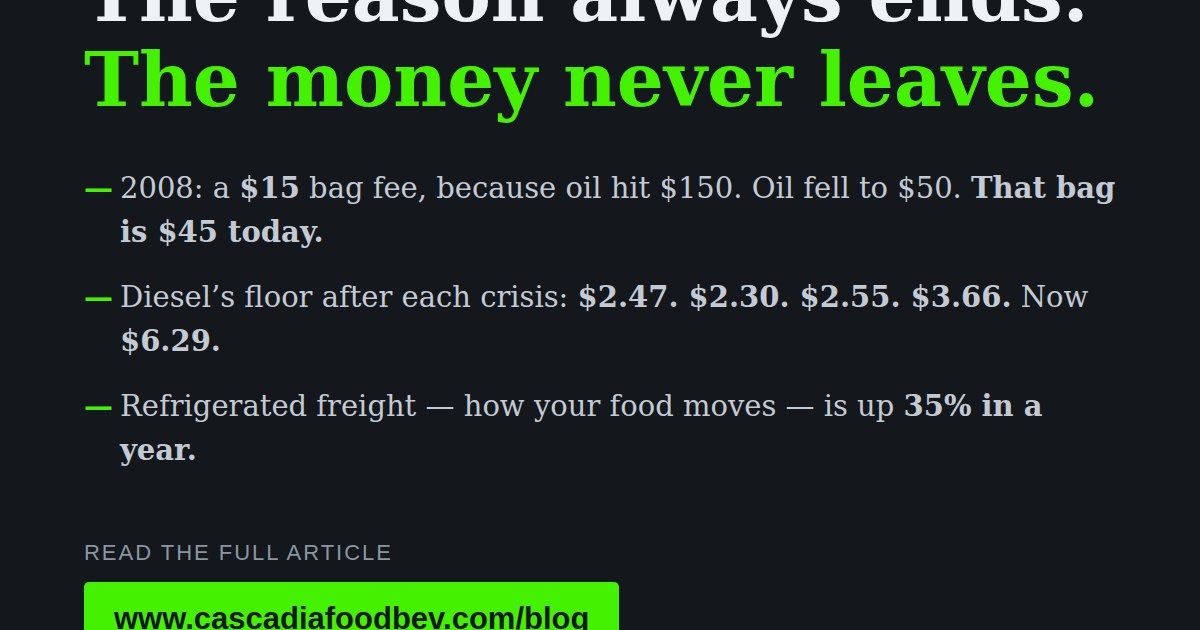
Then oil went to fifty.
The emergency ended.
Now go check what they charge you for a bag.
Go on. I’ll wait.
It’s thirty-five.
Eighteen years. Oil has been up, down, sideways, cratered, spiked, and cratered again.
Not one of those bag fees has ever gone back down. Not once. Not by a dollar.
And now let me tell you what happened to the company that pushed the idea furthest.
In 2010, Spirit Airlines started charging you for the bag you carry — not check, carry — and at the time everybody treated it as a bizarre stunt by a weird little airline, and within a few years half the industry had quietly copied it.
Spirit filed for bankruptcy in November 2024. Came out in March. Filed again in August.
And on May 2nd of this year, after thirty-three years, Spirit Airlines stopped flying. Every flight cancelled, that morning, all at once. The company is being cut up and sold right now.
Cause of death, in the airline’s own accounting: fuel. Jet fuel prices driven up by the war with Iran, and a cost advantage that evaporated once everybody else adopted their playbook.
So read that sequence one more time, slowly.
Spirit invented a fee to survive the price of fuel.
The price of fuel killed Spirit anyway.
And every other airline in America is still charging the fee.
The fee outlived the company that thought of it.
You will never get a cleaner demonstration of what this article is about. The emergency that justified the charge didn’t just end — in this case it came back around sixteen years later and finished the people who invented the charge — and the charge is still sitting there on your itinerary this afternoon, collecting.
Worldwide, airlines now book about a hundred and fifty-seven billion dollars a year in fees, up from sixty-seven billion in 2016.
The reason went away.
The money stayed.
Remember that shape. You’re going to see it again in about a thousand words, and the next time it’ll be standing in your refrigerator.
First, the Word
Surcharge.
Break it in half. Sur- is French. It means over. On top of. Above.
So a surcharge is, by the literal construction of the word, a charge on top of the charge.
Sit with that. Somebody had to invent a word for the second time they bill you for the same thing.
They could have called it a double charge. That’s what it is. But double charge sounds like an error — like something you’d phone the bank about, like something with a 1-800 number attached to it.
Surcharge sounds French. Surcharge sounds like a menu.
And it isn’t even the best one. The airlines call the whole apparatus — the bags, the seats, the boarding, the carnival — “ancillary revenue.”
Ancillary.
Go look it up. Subordinate. Incidental. Of secondary importance.
A hundred and fifty-seven billion dollars a year, which is fifteen point seven percent of everything the global airline industry takes in, and the word the industry itself chose for it is the word you’d use for a side salad.
But the trophy goes to this one, and I want you to find it on your next itinerary, because it’s printed right there and nobody reads it.
The fuel surcharge on an international ticket is formally called a “carrier-imposed surcharge.”
Carrier-imposed.
They named it after themselves. They put a line on your receipt that says, in plain English, “we did this to you.” Not the government. Not a tax. Not the airport. Us. We did it. It’s right here.
And they knew — they knew — that you would look at a column of numbers with words like “taxes and fees” at the top and your eyes would slide across it like a hockey puck on fresh ice.
That’s not a euphemism.
That’s a confession they were confident you’d never open.
The Rule They Wrote in 2012 and Have Never Once Used
There’s a coda here that belongs under glass in a museum.
In October and November of 2012, the Department of Transportation came down on British Airways and Air France and established a standard that sounds absolutely airtight. A surcharge must —
“accurately reflect the cost of the item covered by the charge.”
Beautiful. Common sense, in writing, from a federal agency. I’d have voted for it.
Now.
How many times has the DOT ever gone after an airline over whether a fuel surcharge amount was actually justified?
The researcher who’s tracked this most carefully is Benjamin Edelman, and when he went through the record, he found none.
Not one.
And the example he documented is the one I can’t put down. June 2012. British Airways quoting a fuel surcharge of four hundred and thirty-eight dollars — during a twelve-month stretch when international airline fuel costs, by the federal government’s own measurement, had gone up by nineteen hundredths of one percent.
Zero point one nine percent.
Four hundred and thirty-eight dollars.
Start counting these with me, because we are now four for four.
Part 11: the Federal Trade Commission looks at category captains in 2001, writes down that the dangers are obvious, and goes to lunch for twenty-five years.
Part 12: merchants sue over swipe fees for nineteen years and win four basis points.
Part 13: a hundred-year-old plant closes and the word in the announcement is footprint.
And now the DOT, which in 2012 wrote the exact rule that would fix this, and has spent the fourteen years since not using it.
The rule is not the protection.
The rule is the thing they show you instead of protection.
And Yes, Somebody Will Tell You Flying Got Cheaper
Somebody always shows up with a study, so let’s do this now.
There’s an estimate going around — produced, and please write this on your hand, by a consultancy whose clients are airlines — that once you adjust for inflation, flying costs about forty percent less than it did in 2016.
I went and asked the government instead.
And the government says: partly true, which is the most annoying possible answer. Adjusted for inflation, fares did fall for years. Fine. I’m not going to stand here and call it a lie.
Except that study is measuring a world that ended about eight months ago. Airline fares just went up twenty-five and a half percent in twelve months. Today they sit eleven percent above 2016 in the actual dollars that actually leave your actual hand, and no cashier in America has ever offered to inflation-adjust anything for you.
But forget all that, because there’s a simpler problem and it’s fatal.
That index is comparing a 2026 basic economy seat to a 2016 coach seat.
Basic economy. There’s another one. They took the thing that used to just be called “a seat” and renamed it after the bottom.
No bag. No seat assignment. No changes. On some airlines, no overhead bin — you may have the seat, but the air above the seat is a separate product.
To buy in 2026 what a ticket in 2016 simply came with, you have to buy up. And the second you do, the forty percent evaporates like it was never there, because it never was.
That’s not a price decline.
That’s unbundling, wearing a price index as a disguise.
And if that rings a bell, it should, because it is the identical trick the cereal box plays on you. The index says the price per box went down. The box got smaller. The index says the seat got cheaper. The seat got smaller.
Nobody lied either time.
Both numbers are garbage.
Now let’s go find the truck.
Watch the Bottoms. Nobody Watches the Bottoms.
One number. Measured the same way, by the same agency, every year, for twenty-four years. The average American price of a gallon of diesel.
2002, the year before the Iraq War: a dollar thirty-two.
Then the war. Then the climb. Then 2008 at three-eighty and everybody losing their minds on the evening news.
And then it crashed, the way these things do.
And here is where I need you to stop watching the part everybody watches.
Nobody is stealing from you at the top. The spikes are real. The spikes are wars and hurricanes and a pandemic and a shooting conflict in the Persian Gulf. Nobody in an office invented those.
The theft is at the bottom.
After 2008, diesel bottomed out at two forty-seven.
Not a dollar thirty-two. Two forty-seven.
Next bottom, 2016: two thirty.
After COVID, 2020: two fifty-five.
After Ukraine, last year: three sixty-six.
Read those four numbers out loud, in order, like you’re reading a ransom note, because that’s what they are.
Two forty-seven. Two thirty. Two fifty-five. Three sixty-six.
Every crisis lifts the floor. The crisis ends. The floor stays lifted. And then we all go back to normal, except normal now costs more than the emergency did the last time.
Honest math, because I promised you honest math and because you’d catch me anyway: one of those four went the wrong way for my argument. 2016 came in just under 2009, and it has a name — the American shale boom, a genuine supply shock in the other direction that nobody in this story engineered.
So it’s three out of four. Not four out of four.
And I would like to point out that the exception — the single best bottom the United States of America has managed in twenty-four years — was still seventy-five percent above where we started.
That’s the win.
That’s the year it went our way.
And today, with Iran in the market, diesel is six twenty-nine a gallon, up two and a half dollars in twelve months, four point eight times what it cost before the Iraq War.
Nobody has ever once gotten a dollar of that back.
Now, Trucking Is Not the Airlines, and I’m Not Going to Pretend It Is
Here’s where the lazy version of this article cheats, and you’d never catch it, so I’m going to tell on myself before I do it.
Freight has fuel surcharges too. Every truckload in America moves with one.
And the trucking fuel surcharge is not the airline bag fee. It’s pegged to the government’s own weekly diesel number. It recalculates constantly. When diesel drops, it genuinely drops. It floats both directions, in public, on a published formula.
Anybody telling you the freight fuel surcharge is a permanent bolt-on is wrong, and I would rather hand you a messier story than a cleaner lie.
So the surcharge isn’t the ratchet.
The floor underneath it is.
Because an honest formula bolted to a dishonest baseline produces an honest answer to the wrong question. The surcharge does exactly what it promises. It just does it starting from three sixty-six instead of a dollar thirty-two.
And that’s the whole miserable thing, and it’s why there’s nobody to indict.
There’s no fee to repeal. No clause to strike. No villain to subpoena. No smoke-filled room.
There is just a number that used to start with a one, and now starts with a six, and every honest, floating, transparently-calculated, publicly-audited formula in American freight is bolted to it and working perfectly.
What It Costs You, and It’s Going to Disappoint You
Your food rides in a refrigerated trailer. In the trade we call it a reefer, which is short for refrigerated, and has been since long before it meant anything else, and if you’re going to be like that about it you can leave.
Reefer freight, mid-2025: a dollar ninety-six a mile.
Reefer freight this month: two seventy-one.
Up about thirty-five percent in a year.
Take a thousand-mile run — Midwest plant to Northeast distribution center, a road somebody drives at four in the morning while you’re asleep. That truckload cost $1,960 last year.
This year: $2,710.
Seven hundred and fifty dollars more. Same truck. Same road. Same food. Same guy driving.
Spread that across the cases on the trailer and you get about fifty cents a case. A dozen units to a case.
Four cents a package.
Four cents.
I know. I know exactly what you’re thinking, and you’re right, and I’m going to say it before you do: four cents is nothing. If I stood up here and told you your grocery bill is high because of freight, I’d be doing the thing on cable television that this entire series exists to make fun of, and I’d deserve everything you’d say about me.
Four cents is nothing.
Now put forty items in a cart.
That’s a couple of bucks on your two hundred — from one input, in one link, in one year, out of a chain that by my count has at least six links in it and we’re only fourteen articles in.
And that’s the answer. That’s the whole answer to why your bill went up and never came down, and it is the most unsatisfying answer imaginable, which is precisely why nobody puts it on television.
It was never one thing.
It’s four cents here and a nickel there and two and a half percent somewhere else. Every one of them too small to get mad about. Every one of them calculated honestly, disclosed properly, indexed fairly.
Not one of them ever reversing.
All of them compounding.
Every year.
Forever.
A Deposition Regarding the Bottom
Let the record show.
Q: Diesel was a dollar thirty-two a gallon in 2002.
Correct.
Q: What is it today?
Six twenty-nine.
Q: Was there a reason for the increase in 2003?
A war.
Q: 2008?
A commodity spike.
Q: 2020?
A pandemic.
Q: 2022?
Another war.
Q: 2026?
Another one.
Q: In every single instance there was a real reason.
Yes.
Q: A reason you’d have accepted at the time.
Yes.
Q: A reason I’d have accepted at the time.
…Yes.
Q: And in every instance, eventually, the reason ended.
Yes.
Q: Did the price go back?
No.
Q: Not once in twenty-four years?
Not once.
Q: Then let me ask the only question that matters. What is the mechanism — the actual, physical, functioning mechanism — by which a price in this country comes back down?
The witness is conferring with counsel.
Q: Take all the time you need.
Honest Math, Both Ways
One: the small carriers did not all die, and I’ve been telling people they did. Three brutal years, spot rates underwater against what it costs to run a truck, and yes it ended a lot of small operations — but the federal count of for-hire trucking companies was basically flat last year, and there are still about eighty-six thousand more of them out there than before the pandemic. A third more. Capacity tightened. It didn’t collapse. The apocalypse version is a better story and it isn’t true, so it isn’t going in.
Two: the new driver rules are real policy and, so far, small numbers. A federal rule in February 2026 restricted commercial licenses for non-domiciled drivers after an audit found more than thirty states had issued them to ineligible applicants. That’s real, and in 2027 it may matter enormously. But English-proficiency enforcement accounted for 184 carrier revocations in a month when total revocations ran in the thousands. Anybody telling you that’s why your milk costs what it does is doing politics, not arithmetic.
Three: the freight fuel surcharge floats down. Said it above. Saying it again, because it’s the thing that keeps this piece honest.
Four, and this one goes at the whole premise: diesel is expensive right now for reasons that have nothing whatever to do with anybody’s greed. There is a shooting war affecting oil markets. Six twenty-nine is not a scheme. It’s a price. No one in an office decided it.
The scheme, if you want to call it one, isn’t the spike.
It’s that we have built an entire food system on the quiet assumption that the spike never fully unwinds — and then priced accordingly — and been right every single time.
Stack It Up
So put the whole thing on the counter at once, because individually every piece of this is defensible and together it is insane.
A fee arrives with a reason, and the reason is true, and you agree with it.
The reason ends.
The money does not.
The airlines proved the model in 2008 and have spent eighteen years and a hundred and fifty-seven billion dollars a year teaching it to every industry in America, and they call it ancillary, like a garnish.
A regulator writes down in 2012 that a surcharge has to reflect an actual cost, and then never once — not one time in fourteen years — makes anybody prove it, which is now the fourth time in this series I’ve watched a rule get written and filed and forgotten.
Diesel’s floor climbs from a dollar thirty-two to three sixty-six across four crises, sits at six twenty-nine today, and every freight formula in the country is honestly, transparently, impeccably bolted to it.
Refrigerated freight goes up thirty-five percent in a year, which is four cents a package, which is nothing, which is two dollars on your cart, which is one input, in one link, in one year.
And when somebody finally runs it all and announces that adjusted for inflation it got cheaper — they’ll be holding up a smaller box next to a bigger box and calling the difference progress.
Every formula is honest. Every rate is published. Every surcharge is indexed, disclosed, auditable and fair.
Every single person in this chain made a defensible decision.
And the result is that you cannot buy a gallon of diesel, a checked bag, or a box of cereal for what it cost you before the last emergency — and there is not one mechanism, anywhere in this entire fucking country, whose actual job is to give any of it back.
There’s a Chief Revenue Officer.
There’s a Chief Growth Officer.
Show me the Chief Give-It-Back Officer.
The Verdict
I’m not angry about the spikes. Spikes are weather. Wars happen, pandemics happen, oil comes out of contested ground dug up by people shooting at each other, and anybody expecting a flat line has never read a newspaper.
I’m angry about the bottoms.
Because a price that goes up in a crisis and comes back down afterward — that’s a market. That’s the deal. That’s what every one of us signed up for and it works and it’s fine.
A price that goes up in a crisis and comes back down partway is not a market.
It’s a collection plate.
And we have passed it around five times in twenty-four years, every single time for a genuinely good reason, and not once — not one time, in a quarter of a century — has anybody handed the plate back.
Here’s the part I can’t get past, and then I’ll let you go.
We agreed to all of it.
Every one of us. Fifteen dollars for the bag, because it was the fuel and the fuel was real. A little more for the cereal, because there was a war and the war was real. We are reasonable people and we said yes to reasonable things, one at a time, for twenty-four years, and somewhere in there we built a machine that only turns one direction and we handed it the keys and we didn’t write down a single rule about giving anything back.
Nobody did this to us.
We did it to ourselves, forty reasonable dollars at a time, and we’re still doing it, and the next one is going to have a very good reason too.
That bag fee was an emergency measure in 2008.
The airline that took the idea furthest is being liquidated as you read this, killed by the exact thing the fee was invented to survive.
And the fee is still there.
Go look at what they’re charging today.
Case open. Court adjourned, not dismissed.
Next time — the farmer. No more excuses. The US Department of Agriculture publishes every year how much of your food dollar reaches the person who actually grew the food, and the answer is somewhere between eleven and sixteen cents depending on which of their two yardsticks you pick — a discrepancy I intend to spend real time on, because how a government chooses to measure a thing is never, ever an accident. This whole series has been the story of the other eighty-five. Time to go meet the guy at the front of the line.
Sources & Receipts
Author’s Note On Method
Five flags, and one of them is a correction to something I said out loud last week.
The diesel ratchet is three of four completed cycles, not four of four. The 2016 bottom came in just under 2009, and the reason was the American shale boom — a real supply shock that had nothing to do with anybody in this story. I’ve put that in the text rather than down here, because burying the one number that cuts against me is exactly the move this series exists to mock.
I had been telling people the freight recession wiped out the small carriers. The FMCSA data says capacity tightened but did not collapse, and that roughly a third more for-hire trucking companies are operating now than before the pandemic. I was overstating it.
On the below-cost claim: I originally set the $1.65 dry van spot rate against ATRI’s $2.27 all-in cost per mile, which is apples to oranges — the spot rate is linehaul only, before fuel surcharge, and ATRI’s figure includes fuel. The fair comparison is ATRI’s non-fuel cost of $1.78 against $1.65 of linehaul. Carriers were still running underwater, by about thirteen cents a mile rather than sixty-two. Thirteen cents a mile for three years will still finish a small trucking company; it just isn’t the massacre the sloppy number would have described.
The per-package arithmetic is an illustration, not a published figure. The reefer rates are real and sourced. The conversion — a thousand-mile haul, roughly fifteen hundred cases on a fifty-three-foot trailer, a dozen units to a case — is mine, and case counts vary enormously by product, since a heavy load weighs out long before it cubes out. The direction is solid. The decimal place is an estimate.
On the “zero enforcement cases” claim: my source reviewed the record in the years following the 2012 orders, not through last Tuesday. I went looking for a case brought since and could not find one, which is not the same as proving none exists. What I can tell you is that the rule has sat there since 2012 and I cannot find anyone who has ever been made to answer to it.
And on the claim that flying got forty percent cheaper — I have not called it false, because by the federal government’s own inflation-adjusted measure it largely held through 2025. My argument is narrower: the estimate comes from a firm whose clients are airlines, it measures a period that ended before a twenty-five percent fare spike, and the index underneath it compares two things that are not the same thing. Judge that on its merits.