
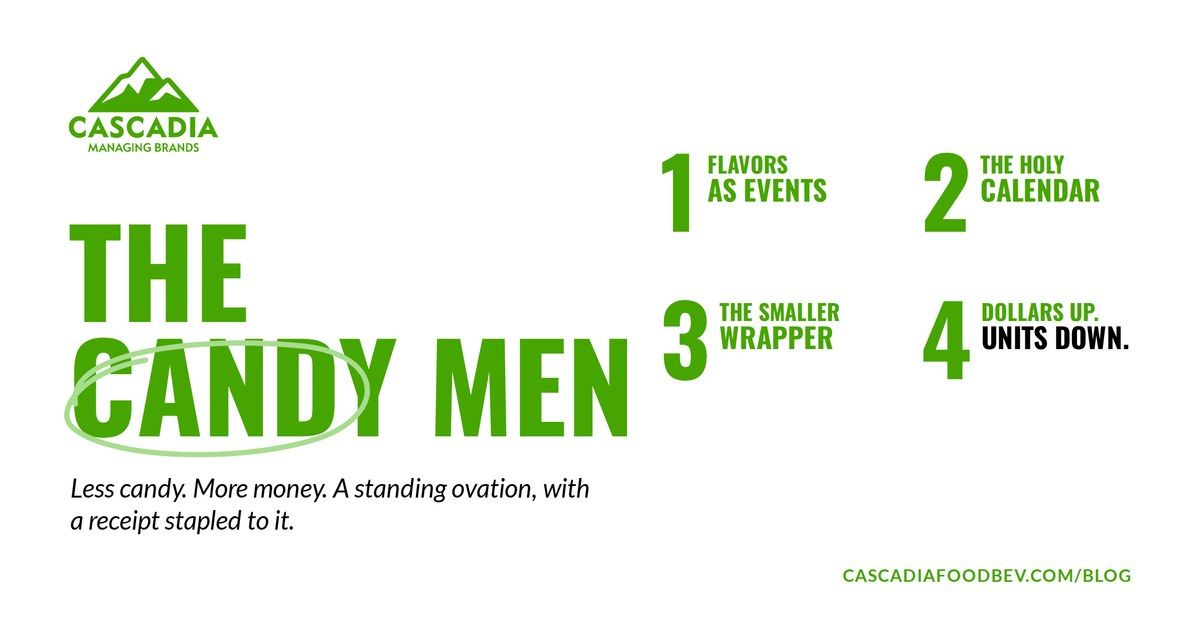
The candy industry has a record year despite Americans eating less candy and cutting sugar. Innovative marketing and product launches keep sales strong.
Amazon Is Not a Store
It’s a search box with a warehouse attached, and you pay rent by the click.
Every founder I meet says the same sentence, in the same tone, like they’re mentioning they also have a dog. “Oh, and we’re on Amazon.”
Also. As if it were a second location. As if you’d opened a nice little shop on Main Street and then, on a whim, put a kiosk in the mall.
Amazon is not a kiosk. Amazon isn’t even a store. A store is a place where a human being walks down an aisle and sees your product whether they were looking for it or not. That’s the whole magic of a shelf: accidental discovery. Amazon is a search box. Nobody strolls through a search box. Nobody wanders a search box humming, picking things up, reading the back. You either show up on page one, or your product is in the witness protection program. Alive, technically. Nobody can find it.
First, the vocabulary
George Carlin taught us to read the words before we read the numbers, so let’s read the words.
Amazon calls you a “selling partner.” Partner. Lovely word. It suggests two people splitting the risk, toasting at the holiday party. Read your monthly fee statement and then point to the partner. I’ll wait. To be fair, Amazon does a staggering amount of work for that money, warehouses, trucks, customer service, returns, the whole circus. But a partner is someone who loses when you lose. On Amazon, the fees get paid whether you made a dime or not.
Then there’s “Sponsored.” The most polite word ever invented for “paid for.” That little gray label means the product sitting in the top spot of your search results is an ad. Not the best granola. Not the most popular granola. The granola that bid the most at that moment. If a supermarket did that, put a tiny gray sign on every end cap saying “this spot was purchased by the highest bidder at 3:14 p.m.,” we’d call it what it is. Online we call it “Sponsored,” and everybody nods.
And my favorite: “organic ranking.” Organic. In a food company’s ear, that word means no pesticides. On Amazon it means “the position you earned without paying for it,” which for a new brand with no sales history and no reviews is somewhere around page eleven, between a phone charger and a garden gnome.
The toll booths
Here’s the part founders skip, because it’s math and math is rude.
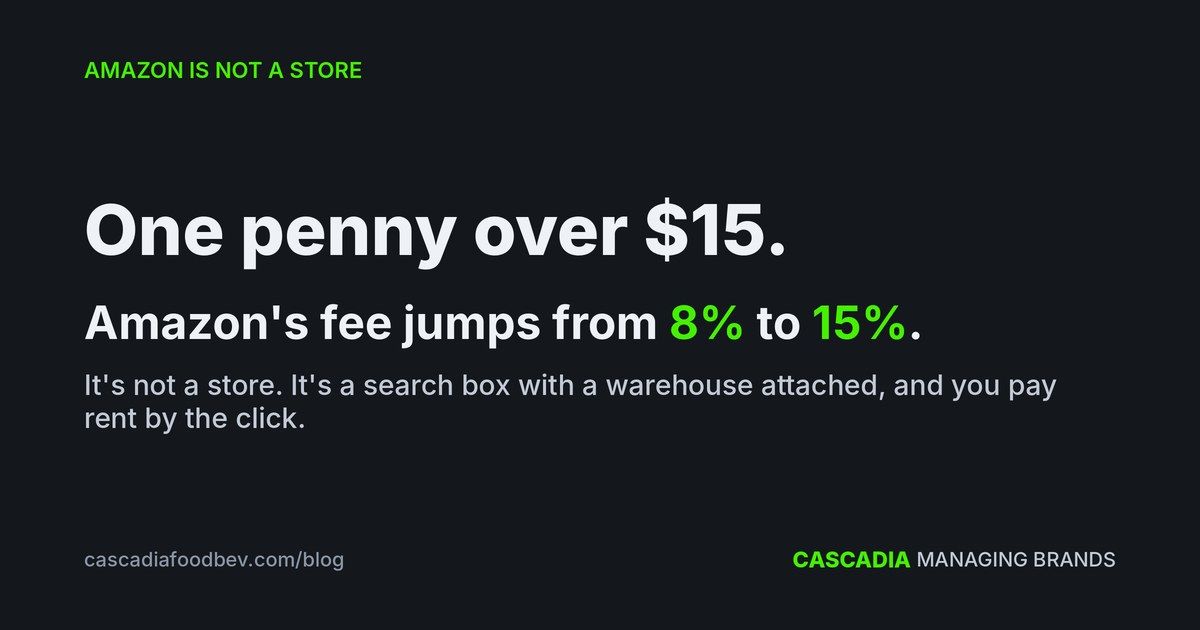
Toll booth one: the referral fee. In Grocery and Gourmet, Amazon takes 8% of the selling price if the item sells for $15 or less, and 15% if it sells for more. Notice what that does. Price your bundle at exactly fifteen dollars and the fee is about a buck twenty. Price it one penny higher and the fee jumps to about two and a quarter, because the higher rate applies to the whole price. One penny costs you more than a dollar. That is not a pricing strategy. That is a trap door with a price tag on it.
Toll booth two: fulfillment. If Amazon stores and ships it for you (Fulfillment by Amazon, or FBA), there’s a fee per unit to pick, pack and ship it, plus storage fees for every month it sits there. Those fees went up again in January 2026. They usually do.
Toll booth three: the clock. Food expires, and Amazon knows it. Expiration-dated product generally has to arrive at the warehouse with more than 90 days of shelf life left, and units get pulled and disposed of when they get to around 50 days before the date. Disposed. Not returned. Thrown out. Your granola gets a funeral you’re not invited to, and you pay for the casket.
Toll booth four: the ads. We’ll get there. Sit down first.
The auction
Amazon’s advertising business brought in about $68 billion in 2025. Sixty-eight billion dollars. That isn’t a side business. That’s the business you’re standing in. The store is the free part. The rent is the clicks.
And it works, because people shop there by searching. A 2023 PowerReviews survey of more than 8,000 American consumers found that half of product searches start on Amazon. Half! Not on Google. Not in a store. In the Amazon search box.
So picture it. You launch a new protein bar. You have zero reviews. Your competitor has forty thousand reviews, eleven years of sales history, and an ad budget the size of your Series A. You both bid on the words “protein bar.” Guess who the algorithm likes. Guess who pays more per click to show up underneath them. Guess who’s going to keep paying, every day, forever, because the moment you stop paying, you drop back down to page eleven next to the garden gnome.
Who designed this? It’s like a casino where the house also owns the parking lot, and the only way to leave the parking lot is to put another chip on the table.
The review problem
New products have no reviews. Products with no reviews don’t sell. Products that don’t sell don’t get reviews. That’s not a business problem. That’s a riddle a sphinx asks you right before it eats you.
The shortcut everybody’s cousin suggests is having your cousin write one. Don’t. The Federal Trade Commission’s Consumer Review Rule bans fake reviews, paying for positive ones, and undisclosed reviews from insiders and relatives. Each violation can cost up to $53,088. Your cousin’s five stars are the most expensive words he will ever type. Amazon has legitimate ways to get early reviews, like its Vine program, and they’re worth the money. Fake ones are worth the lawyer.
The price leak
Here’s the thing nobody tells you until it costs you a chain.
Your Amazon price is the most public number in your company. Every retail buyer in America can see it in four seconds. If your product sells for less online than it does on their shelf, the buyer notices before you do, and the next phone call isn’t about adding flavors.
And you may not even control that price. Somebody buys your product on a deep promotion somewhere else, throws it up on Amazon as a third-party reseller, and undercuts you. Now your brand has a price you never set, attached to a seller you never met, and a supermarket buyer who wants to know why.
Quick definitions, because this is where it gets confusing. Sell as a Vendor (what Amazon calls “first party,” or 1P) and Amazon buys from you at wholesale and sets the retail price itself. Sell as a Seller (third party, or 3P) and you sell directly to the customer and set your own price. Each has its trade-offs. Picking one without knowing which you picked is how founders find out they’ve been running a different business than they thought.
Stack it up
So add it up. Lewis Black would be red in the face by now, so let’s give him the floor.
The referral fee. The fulfillment fee. The storage fee. The ad bid, every click, every day. The coupon you ran to get the first hundred sales. The Vine program to get the first reviews. The returns. The product thrown out at 50 days. The reseller who broke your price, and the chain buyer who saw it. And then the founder stands in front of a dashboard showing forty thousand dollars in sales, turns to his CFO, and asks the only question that matters: where the fuck is the money?
It’s in the toll booths. Every one of them was disclosed. Nobody added them up.
The verdict
None of this means stay off Amazon. Amazon can be a fantastic channel. Shoppers are there, the logistics are world-class, and a product that works there can build real momentum. Plenty of brands make good money on it.
It’s common sense, really. You just have to treat it like what it is: a separate business with its own profit and loss. Know your margin per unit after every fee before you list a single item. Treat ad spend like a launch cost, with a budget and a stop date, not a monthly utility bill. Protect your price, because your retail buyers are watching it. Get reviews the legal way. And size your inventory to the shelf-life clock, not to your optimism.
Possible? Absolutely. Easy? Almost never. The difference is usually having someone in your corner who has run the numbers before.
That’s part of what we do at Cascadia. If you want somebody who’s been around this business for thirty years to look at your Amazon math before Amazon does, give us a call.
Sources & Receipts
-
Amazon referral fees, Grocery and Gourmet: “8% for products with a total sales price of $15.00 or less, and 15% for products with a total sales price greater than $15.00.” Amazon, “Selling on Amazon: Pricing,” sell.amazon.com/pricing (checked October 5, 2026).
-
FBA fulfillment fee increase effective January 15, 2026, averaging about 8 cents per unit: Amazon announcement, reported by Supply Chain Dive, “Amazon hiking fulfillment fees in 2026,” October 17, 2025.
-
FBA expiration-dated products (more than 90 days of remaining shelf life required at receiving; units within 50 days of expiration are removed and disposed of): eComEngine, “The FBA Seller’s Guide to Amazon Expiration Dates,” updated April 22, 2024, summarizing Amazon Seller Central policy. Confirm current requirements in Seller Central before shipping.
-
Amazon advertising services revenue of $13.9 billion (Q1), $15.7 billion (Q2), $17.7 billion (Q3) and $21.3 billion (Q4) in 2025, about $68.6 billion for the year: Amazon.com, “Amazon.com Announces Fourth Quarter Results,” February 5, 2026, supplemental net sales table.
-
Half of consumers search Amazon first when shopping online: PowerReviews, “Survey: The Ever-Growing Power of Reviews (2023 Edition),” survey of 8,153 U.S. consumers, April 2023.
-
FTC Consumer Review Rule; civil penalties up to $53,088 per violation: Federal Trade Commission press release, “FTC Warns 10 Companies About Possible Violations of the Agency’s New Consumer Review Rule,” December 22, 2025. Rule remains in force and enforced in 2026 (DLA Piper, July 2026).
#CPG #FoodAndBeverage #Amazon #EmergingBrands #FoodStartups #BeverageIndustry