
Explore why virality can’t be manufactured and how brands succeed by creating compelling products and reacting quickly to trends.
Who Paid For the Merger?
From The $200 Grocery Bill: An Uncomfortable Look at Why American Food Costs So Much
Investigative satire. Skeptical of everyone. Funny, but fact-based. Nobody gets off easy — including you.
Last time I showed you forty years of consolidation sold on the promise of efficiency. Today, the question I should have asked first: who paid for it?
I owe you a confession before we start.
I’ve done the efficiencies.
Not written about them. Done them. I have sat in the room and made the list and signed the thing. I have looked at an org chart and found the redundancy and eliminated it, which is a word we use so we don’t have to say the other word.
And it worked.
That’s the part nobody tells you, and it’s the part that should bother you most. The cuts — sorry, the efficiencies — were real. The costs came down. Exactly as promised. On schedule. In the deck. Somebody probably got a bonus, and honestly, they’d earned it.
The investors made more money.
The price never went down.
Not once.
Not a penny.
In thirty years I have never once watched a savings walk out of a conference room and land on a shelf tag. Not at my companies. Not at anybody’s. I have never met a single person in this industry who has seen it happen, and I have asked.
I used to think that was a failure of will. Somebody just forgot to pass it along.
It isn’t. There’s a reason. And it took me until this week to go find it, because I was asking the wrong question for thirty years.
I kept asking where the savings went.
I should have been asking where the money came from.
Nobody Buys a Company With Cash
When one of these giants swallows another one, there’s a number in the press release. Two point nine billion. One point seven seven billion. Eleven billion.
And every single time, every one of us reads that number and pictures something that does not exist: a company with a large bank account, writing a large check.
That is not what happens.
They borrow it.
And the moment they do, something is created that did not exist the day before — a new, permanent, non-negotiable cost, owed to a bank, that has absolutely nothing to do with food.
There’s a word for this and it’s beautiful. George Carlin would have had a field day.
Leverage.
It’s a physics word. A lever. The most benign, elegant idea in all of engineering — a small force, correctly applied, moves an enormous weight. Archimedes. Give me a place to stand.
Finance borrowed the word and kept exactly half of it.
They kept the part about the small force. They quietly dropped the part about where the weight lands.
Because a lever doesn’t make the weight lighter. It never did. It just moves it somewhere else, onto something else, and if you are standing at the other end of that lever you do not experience it as elegant.
You experience it as a rock.
Let me show you what that looks like on an actual balance sheet.
One Hundred Fifty Million to Two Point Eight Billion
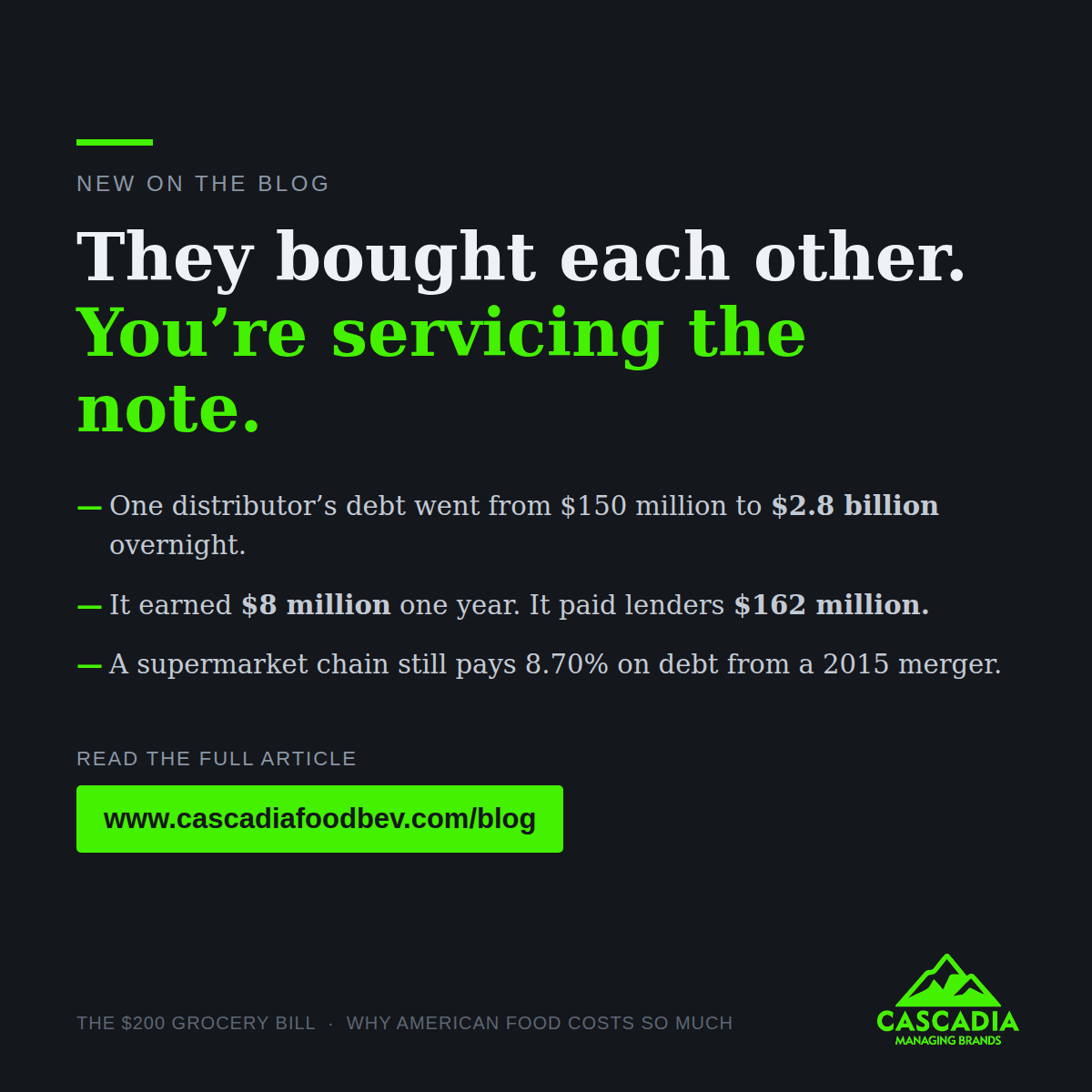
Before it bought SUPERVALU in October 2018, UNFI carried $150 million of long-term debt. A reasonable amount. The kind of number a $10 billion company carries in one hand and never thinks about.
At the end of the next fiscal year, it carried $2.8 billion.
Read that again.
A hundred and fifty million. To two point eight billion.
Nineteen times over. In one year.
(If you go pull the filing, it prints that as “2,819.0” — because the whole table is denominated in millions, which is how a company says two point eight billion without anybody flinching.)
No stock was issued. No equity was raised. They borrowed all of it, two ways.
A term loan. One point nine five billion dollars. That’s a mortgage — a lump sum handed over at the closing table, paid back on a schedule, at a set rate. Goldman Sachs arranged it.
And a bigger credit line. They expanded an existing revolving facility — essentially a credit card secured by the inventory and the receivables — from two billion to two point one, and drew on it for the rest.
Then, on top of both, they inherited whatever SUPERVALU already owed. That comes with the building.
Add it up and a company that had been carrying a hundred and fifty million dollars of debt was carrying two point eight billion, and every dollar of it had to be paid back, with interest, whether or not a single additional can of soup moved.
The term loan priced at LIBOR plus 4.25 percent. Today, after refinancing, that facility runs SOFR plus 4.75 percent — and at the end of fiscal 2025 the effective rate was 9.11 percent. There are also $500 million of senior notes at 6.75 percent, due 2028.
Nine percent. On a business that makes one percent.
Now hold on, because here comes the bill.
Eight Million Dollars
Since the SUPERVALU deal closed, UNFI has paid, in interest alone:
More than $1.3 billion.
That is not a projection. That is the sum of eight reported annual figures out of eight sets of audited financial statements. One point three billion dollars, to lenders, for the privilege of having bought a company.
But the number that stopped me cold is this one.
In five of the eight fiscal years since that deal, UNFI’s interest expense was larger than the company’s entire operating profit.
Five out of eight.
And fiscal 2024 is the year I’d put on a plaque:
UNFI earned $8 million running a $31 billion business.
It paid its lenders $162 million.
Twenty times as much to the bank as it made from the work.
Sit in that for a second, because I don’t think the shape of it registers on first pass.
Thirty-one billion dollars of food moved through that system. Grown. Picked. Packed. Trucked. Frozen. Warehoused. Pulled. Palletized. Delivered at four in the morning. Stocked by a guy named Dave who has been doing it since 2009 and whose knees are shot.
All of it.
An entire national food distribution network, running flat out, three hundred and sixty-five days, for twelve months.
Net result: eight million dollars.
Which is roughly what one good Chick-fil-A does in a year. One. With a drive-thru.
And then they wrote a check to a lender for twenty times that amount — and the lender didn’t move a pallet, didn’t miss a delivery window, didn’t get deducted for the wrong door, and didn’t get up at four in the morning for anything.
The lender lent money.
That’s the whole contribution. Somebody moved a number from one account to another account in 2018 and has been collecting nine figures a year ever since, and Dave’s knees are still fucked.
Dave moved the food.
Who’s Actually Running the Company
And here is the part that should genuinely unsettle you, because it answers the question this entire series has been circling.
In December 2025, UNFI’s board had $138 million of authorized share buybacks left.
How much can they actually spend?
Twenty-five million. Capped. Not by the board. By the loan agreement.
From the filing, verbatim: repurchases are limited to $25 million “pending improvement in the company’s leverage ratio under its existing Term Loan Agreement.”
And there’s that other word. Covenant.
A covenant is a sacred promise. It’s a biblical term. God made covenants. Noah got one. Abraham got one. It is, historically, the most solemn undertaking a human being can enter into.
In modern finance a covenant is a clause that says you can’t buy your own stock back until a bank in Manhattan says the ratio looks better.
Same word. God to a spreadsheet in four thousand years.
Think about what that sentence means. A publicly traded American corporation cannot decide what to do with its own money, because a covenant written by lenders in Manhattan says it can’t until it pays them down further.
That’s who’s in charge.
Not the CEO. Not the board. Not the category managers, not the buyers, and certainly not the guy in Vermont trying to get his hot sauce on a shelf.
The lender.
And a company being run to satisfy a leverage covenant does not wake up in the morning asking how to lower the price of oat milk.
It wakes up asking where it can find another twenty-five million dollars by March.
Now.
Where do you suppose it looks?
Where It Looks
You already know, because we’ve spent this whole series in that room.
It looks at the people who sell it food.
And because two terms are about to do a lot of work, and because I’ve been throwing them around like everybody in America sits through trade negotiations for a living, let me stop and define them properly. They are not the same thing. The difference between them is the entire point.
The Fee
In May 2024, UNFI simplified its supplier charges into one flat rate: 2.5 percent of everything you sell through them.
Off the top. Every case. Forever.
In exchange you get access to a data portal. One supplier ran the numbers and concluded the data was worth less than three-tenths of one percent to his business. The CEO of a hot sauce company said, more politely than I would have, “The portal access would be nice, but not at the price that it’s going to cost us.”
Is it optional?
Technically, yes. In the sense that breathing is optional.
You can decline the 2.5 percent the same way you can decline to be in the two national distributors that reach the stores you need to be in. Brands doing under a hundred thousand dollars through the system aren’t even eligible for the simplified terms — the little guys, the ones a regional distributor used to take a flyer on, don’t get the simple version.
But at least the fee is a number. You can see it. You can plan around it. You can put it in a spreadsheet and decide whether the business works.
The other thing is not like that at all.
The Deduction
A deduction is money taken out of your payment.
Not billed. Not invoiced. Not requested.
Taken.
Here’s how it actually happens, and I want to walk it slowly because almost nobody outside this industry knows it works this way.
You ship the product. You send an invoice for, let’s say, forty-eight thousand dollars. Thirty or sixty days later a payment arrives.
It’s for forty-four thousand three hundred.
There’s a code on the remittance. Maybe it’s a late delivery. Maybe a damaged case. Maybe a promotional allowance somebody says you agreed to. Maybe a data fee. Maybe a compliance charge for a barcode that didn’t scan on a Tuesday in a distribution center you’ve never seen.
Now — and this is the part I need you to hold onto —
Nobody asked you.
You did not approve this. You were not consulted. There was no negotiation, no conversation, no email saying hey, we think you owe us thirty-seven hundred dollars, what do you think?
The money was already gone when you found out about it.
And Now You Get to Prove a Negative
If you think it’s wrong, you can dispute it.
Wonderful. Here’s what disputing it looks like.
You pull the bill of lading. You pull the proof of delivery with the signature. You pull the appointment confirmation. You find the photograph of the pallet, if somebody took one, which they usually didn’t. You assemble it into a packet and you submit it to a portal, and then you wait.
That’s a day of somebody’s life. For thirty-seven hundred dollars.
And most small companies don’t have a somebody. They have a founder, a broker and a co-packer, and the founder is doing the QuickBooks at eleven at night.
So they don’t. In an industry survey of two hundred and three companies, two-thirds reported a standing policy of automatically writing off any deduction below a threshold — and in food and beverage, that threshold runs around a hundred dollars.
Under a hundred bucks, nobody even looks.
Not because they think it’s right.
Because arguing costs more than surrendering.
That’s the difference between the fee and the deduction. The fee is a price. The deduction is a withdrawal, and you’re the only one in the transaction who doesn’t have the keys.
What That Actually Does to a Company
I have a client who, when we started working together, was carrying deductions at a level I’m not going to put in a headline because nobody outside the trade would believe it. I have another we inherited who owes a distributor sixty-five thousand dollars that nobody inside the company can fully reconstruct.
(Those are my clients, anonymized, and that’s my testimony rather than a filing. If you’re in this business you’re nodding. If you’re not, go ask any small brand founder what the word “deduction” means to them and watch what happens to their face.)
And here is what I want to say to every one of those founders, because I have watched them take it personally:
It isn’t about you.
Nobody in that building woke up thinking about your hot sauce. Nobody has a grudge. Nobody’s twirling a mustache. Half of them are decent people who would help you if they could.
It’s a company with a covenant, looking for twenty-five million dollars by March, and you are a line it can reach.
Now Watch the Loop Close
Here’s what a food company does when it can’t predict what it will actually be paid.
It goes looking for costs to cut.
It finds a thinner film for the bag. A lighter bottle. A cheaper co-packer two states farther away. It takes a half-ounce out of the box, because a half-ounce across twelve million units is real money and the shelf tag doesn’t have to change.
It goes looking for efficiencies.
Same word. Third time in this series.
And so the bank charges the distributor, and the distributor deducts from the manufacturer, and the manufacturer quietly removes three-point-two ounces from the package — and the thing lands in your cart weighing less than it did last year, and you assume it’s inflation.
It isn’t inflation.
It’s a covenant, transmitted through four companies, arriving in your hand as a smaller box.
Albertsons, Because You Can Actually See It
UNFI sells to stores, so I can’t honestly convert their interest into cents on your cart. Anyone who tries is making it up.
But Albertsons sells to you.
In the fiscal year ended February 2026, Albertsons booked $83.2 billion in revenue, $727.6 million in operating income — and $504.2 million in net interest expense.
Sixty-nine percent of everything the company earned from operating grocery stores went to service debt.
For every $200 of revenue, $1.21 went to interest.
And two years after the Safeway merger — the fiscal year ended February 2017 — the numbers looked like this. Operating income: $608 million. Interest expense: just over a billion dollars.
One hundred and sixty-five percent. The interest bill was more than half again what the entire company earned.
Per $200 of sales that year: $3.36.
(Honest caveat, and it’s important: that’s an accounting share of revenue, not proof your cart would have been $3.36 cheaper. Nobody can prove that counterfactual and I’m not going to pretend to.)
Oh — and one more thing. Open Albertsons’ debt schedule today, eleven years after that merger, and sitting right there among the modern loans you will find Safeway debentures at 7.25, 7.45, 7.75, 8.00 and 8.70 percent.
Eight point seven percent.
Read that number, then remember what your savings account pays you. It starts with a zero and a decimal point.
Now here’s the part that got me.
Safeway is still there. The stores are open. The sign is up. You can go buy bananas at one this afternoon.
What ended in 2015 wasn’t Safeway — it was Safeway’s independence. Albertsons bought the company, and the debt Safeway had taken on came along with it, the way a mortgage comes with a house.
Eleven years later it’s still on the books. Still accruing. Every day. At rates set in a different decade by people who have long since moved on to other jobs.
So you can walk into a Safeway today, buy a gallon of milk, and some fraction of what you hand over goes to service borrowing that happened before the company was bought — a transaction you weren’t part of, about a deal you didn’t make, for a merger nobody asked you about.
The stores kept going.
The note kept going too.
Honest Math, Both Ways
Now the part where I hand you every good argument against me, because that’s the deal here and it’s the only reason to believe the rest.
One: not every deal is a leveraged bet. When C&S bought SpartanNash last September, the financing was roughly half equity — $903 million — against up to a billion of debt. That’s a real company putting real money down, and it does not fit the story I’m telling. KeHE’s outside investment in 2019 was equity, not debt, and the ESOP stayed majority owner. I’m not going to smear everybody with one brush.
Two: the academic finding is conditional, and the popular version of it is wrong. Judith Chevalier’s famous 1995 study of supermarket LBOs did not simply find that debt raises prices. She found prices rose where the LBO chain’s rivals were also leveraged — and fell where rivals were strong and unlevered, because those rivals used price to drive the indebted chain out of the market. Debt softens competition when everybody’s carrying it. It makes you prey when you’re the only one.
Three, and this is the strongest thing against me: a 2022 study in the same journal looked at modern private equity deals and found price increases of only about one percent on existing products — and concluded that growth came from new products and new markets, not from raising prices. The authors say directly that their findings are at odds with Chevalier’s. That is a serious, peer-reviewed challenge and it belongs in the text, not a footnote.
Four: no regulator treats merger debt as a harm. I looked. The FTC and DOJ scrutinize concentration, not leverage. Nobody at any agency is checking whether a company borrowed more than it can carry before it buys its competitor. That’s not a scandal. It’s just not anybody’s job.
So I can’t tell you a merger’s interest bill lands on your receipt as a specific number.
Here’s what I can tell you.
The Verdict
There is one finding in all of this that I think about every time I walk into a store now.
A 2011 study in the American Economic Journal looked at what leverage actually does to a supermarket, and it didn’t measure price. It measured stockouts.
Highly leveraged supermarkets let the shelves go empty.
Because inventory is cash. And cash is what you owe the bank. And the bank calls on a schedule.
The shopper does not.
You have stood in front of that empty spot. Everybody has. The hole where your thing goes. And you assumed supply chain, or weather, or that everybody else got there first on a Sunday.
Sometimes it’s a covenant.
Sometimes the reason you can’t buy the thing you came for is that eleven years ago two companies bought each other and the note is still outstanding.
So here’s the answer to the question I spent thirty years asking wrong.
We were told consolidation would make things efficient, and it did. The savings are real and economists have measured them.
But nobody mentioned that the consolidation itself had to be paid for. That buying the company created a brand-new obligation — nine percent, compounding, due monthly, senior to everything, owed to people who have never once set foot in a grocery store in a professional capacity.
The efficiency went to the interest.
All of it. Every efficiency, every cut, every restructuring, every round of people walking out of a building with a box — went to pay a bank for the transaction that produced the restructuring in the first place.
The merger didn’t fail to lower your price.
The merger created a bill that didn’t exist before, handed it to a company already earning a penny on the dollar, and then that company went out looking for a penny somewhere else.
It found the supplier.
It found the broker.
It found the farmer.
It found the shelf.
It found you.
And one more piece of vocabulary before I let you go, because this one is the whole thing in a single verb.
You don’t pay debt in this business. You service it.
Service. You service a furnace. You service a transmission. It’s a word for maintenance — for keeping a machine running so the machine can keep doing the thing it does for you.
Except this machine doesn’t do anything for you.
It sits there. It accrues. It gets serviced. Faithfully, monthly, for a decade, by everyone in the chain — and not one person in this entire arrangement ever gets around to servicing you.
And the most maddening sentence I can write is this one: every dollar of it is legal, disclosed, audited, and filed with the federal government, where you could read it right now, tonight, for free.
They bought each other.
You’re servicing the note.
Case open. Court adjourned, not dismissed.
Next time — what’s left on the shelf. Because the note doesn’t just get serviced with your money. It gets serviced with your choices. Three distributors decide what a hundred thousand stores are allowed to carry, and somewhere out there is a product you would have loved that never got a shot at you. Nobody voted on that either.
Sources & Receipts
Author’s Note On Method
The opening is mine. I have run cost-reduction programs, they worked, the investors were pleased, and I never once saw the savings reach a shelf tag. That’s testimony, not data.
So are the two deduction examples. Both are real clients, both anonymized, and neither is a filing. If you want the documented version of that mechanism, it’s in the earlier pieces in this series, with citations.
Three things I deliberately did not do. I did not convert UNFI’s interest expense into cents on a grocery cart — the arithmetic requires three assumptions no filing supports, and building that number would be a fabrication dressed up as math. I did not print a price-increase percentage from the Chevalier research, because the figure that circulates comes from lecture notes rather than the paper, and I have not read the published tables. And I did not claim regulators police merger debt, because they don’t; the FTC and DOJ examine concentration, not leverage.
The Albertsons per-$200 figures are simple division on audited statements. They are an accounting share of revenue — not a claim that your cart would be cheaper by that amount. Nobody can prove that counterfactual, including me.
The strongest argument against this article is in it, at full strength: a 2022 study in the Journal of Finance found modern private equity deals raised prices only about one percent, with growth coming from new products rather than pricing, and its authors say plainly that they disagree with the older supermarket research. Read it before you decide I’m right.