


Explore why virality can’t be manufactured and how brands succeed by creating compelling products and reacting quickly to trends.
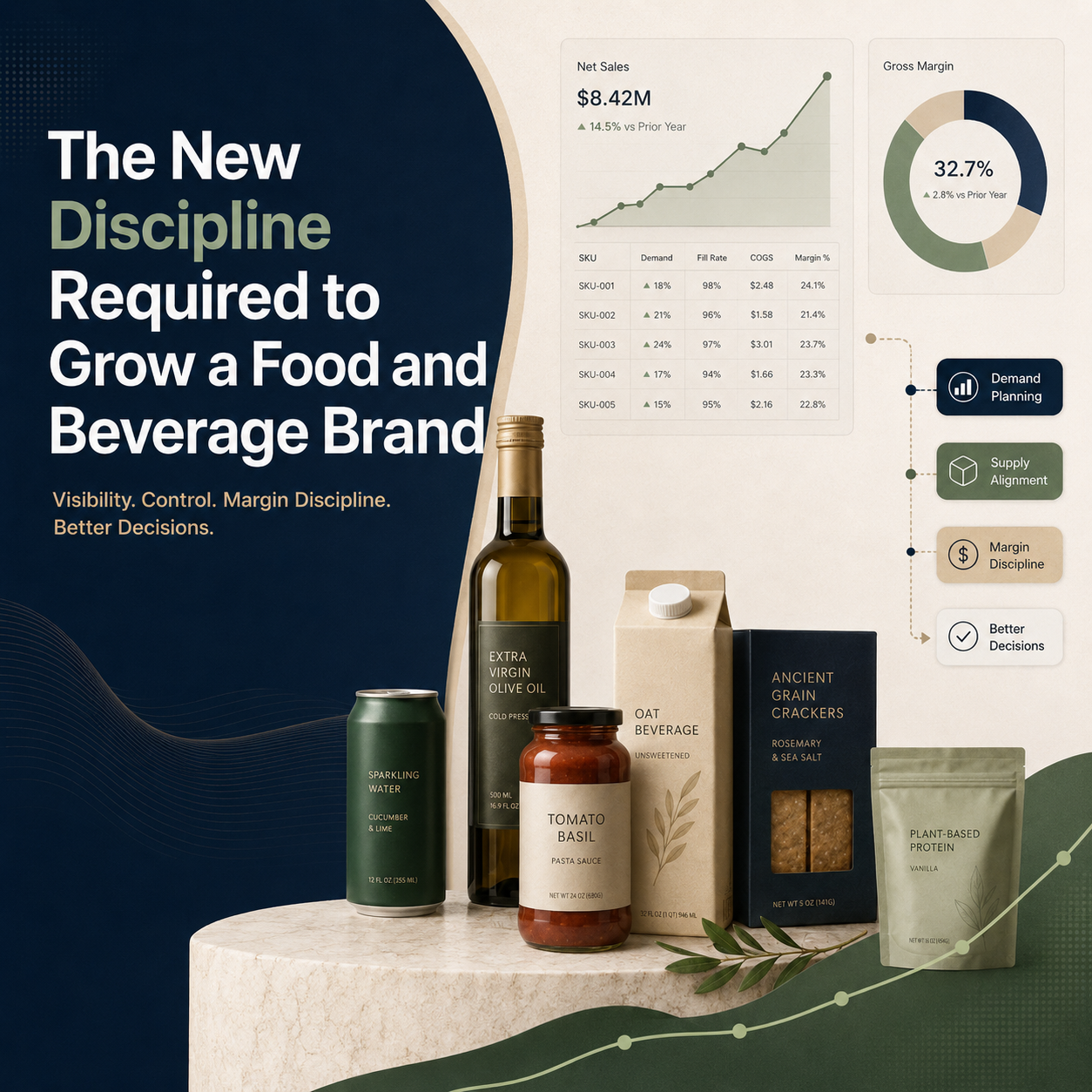
The New Discipline Required to Grow a Food and Beverage Brand
It has been a few months since we last wrote here.
That was not because there has been nothing to say. Quite the opposite. We have been deep in a large food and beverage project that has taken a great deal of time, attention, and energy. We are not ready to share the details yet, but the work has reinforced something we have believed for a long time:
Food and beverage brands do not usually lose control in one dramatic moment.
They lose it gradually.
They lose it through pricing decisions that are not fully modeled. Through promotions that look good on the surface but do not hold up after deductions, freight, discounts, broker commissions, retailer requirements, and operational costs are included. Through trade spend that is approved in one place, tracked in another, deducted somewhere else, and explained months later by someone trying to reconstruct what happened.
They lose it when sales, finance, operations, and leadership are all looking at different versions of the business.
That problem is becoming more important, not less.
The food and beverage industry is still full of opportunity. Consumers are still looking for better products, better ingredients, new flavors, functional benefits, convenience, indulgence, value, and authenticity. Retailers still need brands that can bring energy to the shelf. Distributors still need suppliers that can execute. Foodservice operators still need products that solve real problems.
But the margin for error is shrinking.
Growth is more expensive than it used to be. Retailer expectations are higher. Freight, packaging, labor, ingredients, chargebacks, slotting, promotions, and trade deductions can turn a good-looking sales opportunity into a weak financial outcome very quickly.
Volume alone does not solve the problem if the business underneath the volume is not disciplined.
That is the new reality.
A food and beverage company can no longer afford to treat growth as simply “more sales.” Growth has to be managed. It has to be modeled. It has to be reviewed before commitments are made, monitored while programs are active, and reconciled after the fact.
That sounds obvious, but in practice it is where many companies struggle.
A brand may know its list price but not its true net price. It may know its gross margin but not its margin after promotional spend. It may approve a deal without fully understanding the deduction risk. It may chase distribution without knowing whether the account is structurally profitable. It may celebrate a big order that creates cash pressure, operational strain, and little real profit.
None of this means growth is bad.
It means undisciplined growth is dangerous.
The best food and beverage companies are not necessarily the ones that say yes to every opportunity. They are the ones that understand which opportunities are worth pursuing, which ones need to be renegotiated, and which ones should be declined.
That requires better operating discipline.
Operating discipline does not mean bureaucracy. It does not mean slowing everything down. It does not mean taking the entrepreneurial spirit out of the business.
It means creating enough structure so good decisions can happen faster.
It means knowing the numbers before making the commitment.
It means connecting sales plans to financial reality.
It means making trade spend visible before it becomes a deduction problem.
It means giving teams a shared view of what is approved, what is pending, what has been promised, what has been shipped, what has been deducted, and what still needs to be resolved.
In many companies, the real issue is not lack of effort. The issue is fragmentation.
Sales is trying to grow the business.
Finance is trying to protect the economics.
Operations is trying to make and move product.
Leadership is trying to understand what is actually happening.
Everyone may be working hard. Everyone may have good intentions. But if the information is disconnected, the business becomes harder to manage than it needs to be.
That is when small issues become expensive.
A promotion is approved without a clear understanding of the true cost.
A deduction arrives months later and no one can immediately match it to the original commitment.
A customer program looks profitable in the sales deck but becomes questionable once freight, spoilage, brokerage, allowances, and payment timing are included.
A new account creates excitement, but the operational requirements strain production or cash flow.
A team spends too much time explaining what happened instead of managing what should happen next.
These are not abstract problems. They are daily food and beverage problems.
They show up in trade spend.
They show up in cash flow.
They show up in inventory.
They show up in pricing.
They show up in broker management.
They show up in retailer conversations.
They show up in the gap between projected margin and actual margin.
The companies that manage these details well give themselves a better chance to grow profitably.
The companies that do not may still grow, but they often grow into confusion.
That is the part of growth that does not get discussed enough.
Growth feels good. Distribution wins feel good. New accounts feel good. Big orders feel good. Velocity gains feel good.
But growth also adds complexity.
More customers.
More promotions.
More brokers.
More distributors.
More deductions.
More pricing exceptions.
More production demands.
More forecasts.
More approvals.
More pressure on cash.
More people making decisions.
At some point, the informal system breaks down. Not because people are careless, but because the business has outgrown the way it is being managed.
That is the moment many brands mistake activity for progress.
They are selling more, but not necessarily earning more.
They are entering more accounts, but not necessarily building a stronger business.
They are approving more promotions, but not necessarily improving velocity in a profitable way.
They are adding more reports, but not necessarily gaining more clarity.
The answer is not to stop growing.
The answer is to grow with better control.
That means building a business where sales and finance are not in conflict. Where operations has visibility before commitments create problems. Where leadership can see risk early. Where decisions are made with a full view of the economics.
It means treating margin as something that has to be protected before, during, and after the sale.
Every case shipped carries a financial story with it.
Price.
Cost.
Freight.
Discounts.
Allowances.
Deductions.
Service levels.
Payment timing.
Cash impact.
The brands that understand that story will make better decisions.
The brands that do not will keep discovering too late that growth and profit are not the same thing.
This also matters because of the way technology is entering the industry.
There is a lot of discussion right now about artificial intelligence in food and beverage. Some of it is useful. Some of it is noise.
AI can absolutely help companies analyze information, identify risk, summarize patterns, support decision-making, and improve visibility. Used properly, it can become a meaningful tool for operators, finance teams, sales leaders, and executives.
But AI cannot fix a business process that has no discipline underneath it.
If the data is scattered, the approval logic is unclear, the margin assumptions are inconsistent, and no one knows which number is the real number, AI will not magically solve the problem.
It may simply make the confusion faster.
The companies that will benefit most from AI are the companies that first understand their own operating model.
How are deals approved?
How is trade spend tracked?
How are deductions matched back to commitments?
How is profitability reviewed?
How are pricing decisions made?
How does leadership know what is actually happening in the business?
Who has authority to make commitments?
Where are those commitments recorded?
How does the company know whether a promotion worked?
How does the company know whether an account is worth the cost of serving it?
These are not software questions first. They are business discipline questions.
Software can help. AI can help. Dashboards can help. Automation can help.
But only if the underlying logic is sound.
That has been the focus of much of our recent work: helping food and beverage companies think more clearly about visibility, control, margin discipline, and better decision-making. We are not ready to discuss the full project publicly yet, but the underlying issue is simple.
The industry does not need more disconnected tools.
It needs better operating systems.
Not necessarily software in the narrow sense, but systems in the broader business sense: clear processes, clean information, connected workflows, defined approval points, and financial visibility that keeps up with commercial activity.
Food and beverage is too complex to run by memory, scattered spreadsheets, email chains, and after-the-fact explanations.
That may work for a while. It may even work during the early stage of a brand’s life, when the team is small and everyone is close to every decision.
But as the business grows, complexity grows faster.
The better question is not whether a company can manage the next order.
The better question is whether the company can manage the next stage.
Can it grow without losing sight of margin?
Can it support new accounts without creating operational strain?
Can it approve trade spend without losing control of deductions?
Can it price intelligently?
Can it forecast realistically?
Can it understand what is happening quickly enough to act?
Can it make better decisions before the financial impact is already locked in?
Those are the questions that matter now.
This is also why education remains so important in this industry. Food and beverage is a business with its own language, its own financial realities, its own operating traps, and its own learning curve.
That was one of the reasons I wrote Everything You Always Wanted to Know About the Food and Beverage Industry But Were Afraid to Ask, which is now available on Amazon.
The purpose of the book is simple: to make the industry easier to understand for founders, operators, investors, advisors, employees, and anyone trying to make better decisions in a complicated business. There are plenty of people in food and beverage with passion, product knowledge, and ambition. What many need is a clearer operating map.
What do the terms mean?
How do the pieces connect?
Where does margin disappear?
Why do trade deductions matter?
How do retailers, distributors, brokers, manufacturers, and brands interact?
What should a growing company understand before it makes commitments it may not fully appreciate?
The book was written to answer those kinds of questions in practical language.
I will also be speaking at BevNET Live NYC on June 8, where I’ll be discussing many of the same themes: what it really takes to build, manage, and scale a food and beverage company with more discipline, better visibility, and a clearer understanding of the numbers behind growth.
The book, the presentation, and the larger project we have been working on all come from the same belief:
Food and beverage companies need more practical tools, clearer language, and better operating systems to navigate the next stage of growth.
The industry will always reward creativity. It will always need great products, strong branding, smart salespeople, good relationships, and the ability to move quickly.
None of that is going away.
But creativity without control is fragile.
The next stage of growth in this industry will belong to companies that can combine entrepreneurial energy with operating discipline. Companies that can move fast without losing track of the numbers. Companies that can say yes with confidence, no with clarity, and “not yet” when the economics do not work.
That is where we believe the industry is heading.
And that is why we have been so focused lately on the less glamorous side of growth: the systems, decisions, controls, and visibility that allow food and beverage brands to scale without losing themselves in the process.
More to come.