


Explore why virality can’t be manufactured and how brands succeed by creating compelling products and reacting quickly to trends.
CPG Marketing Myths Debunked: Things Founders Tell Me That Are Simply Not True
After thirty-plus years in food and beverage, I’ve noticed that the most expensive sentences in this industry all start the same way: “Everybody knows…”
A founder sits across from me and states something as absolute fact. No source. No data. Something they heard at a conference, read in a comment thread, or absorbed from another founder who heard it from somebody else. And then — this is the part that gets me — they make real decisions with real money based on it.
I wrote recently about the mythology around how Liquid Death was built. Today I want to debunk two more myths, because both of these were said to me by actual clients, with total confidence, as reasons to change strategy. Both are flat wrong. And unlike the people repeating them, I checked.
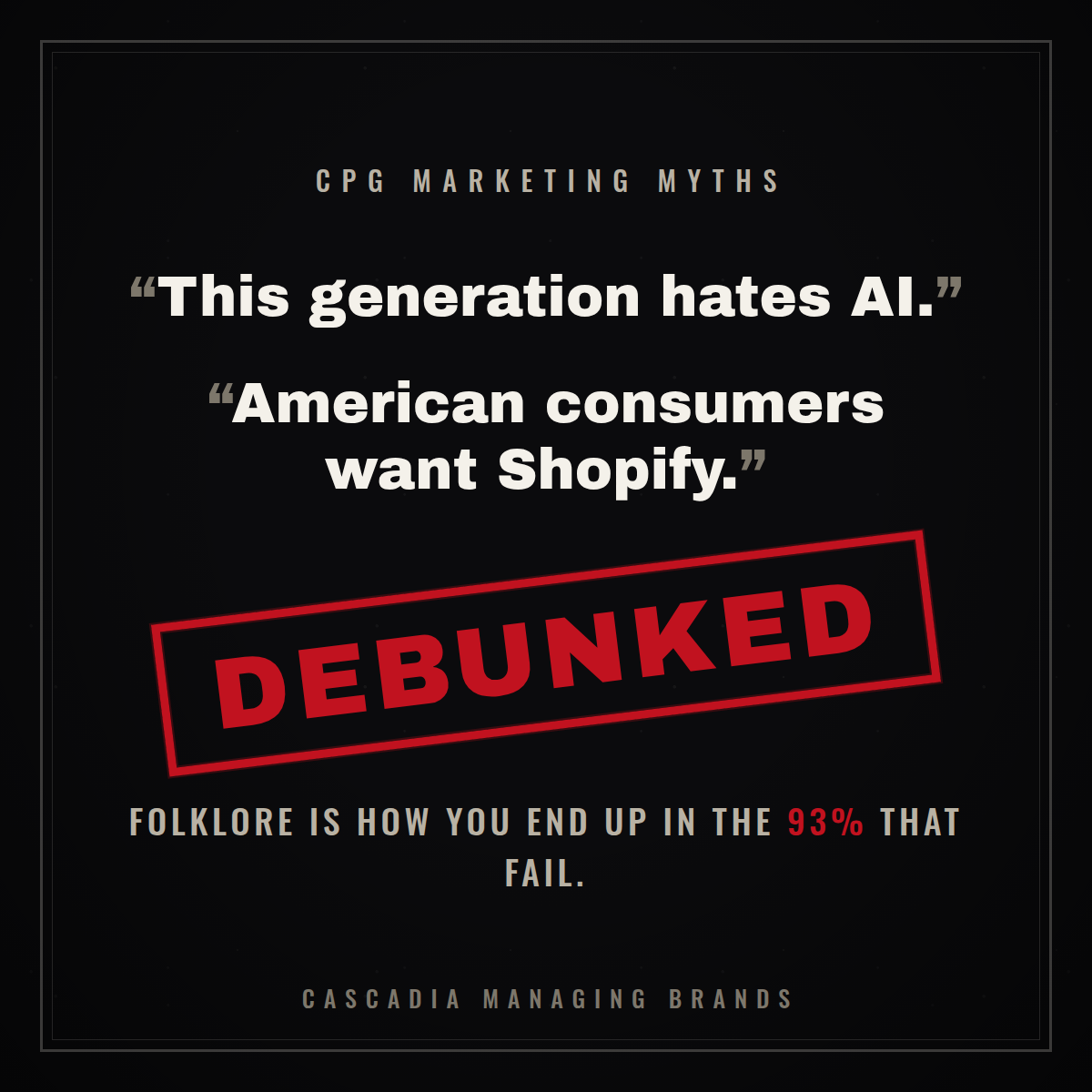
Myth #1: “This generation hates AI”
A client told me this as a reason to steer clear of AI. This generation hates it, he said. They’ll turn on us.
Here’s the problem: it’s the opposite of true. Gen Z doesn’t hate AI. Gen Z uses AI more than any generation in history — including, almost certainly, the founder who told me they hate it.
Look at the actual numbers. Gallup found that 51% of Gen Z uses generative AI at least weekly, with curiosity — not anger — as their #1 emotion toward it. Klaviyo’s research found Gen Z is the most AI-trusting generation measured, that 41% of them consult AI before they even touch a search engine, and that 46% used AI to help make purchases in the last six months. This is not a generation that hates AI. This is a generation that shops with it, searches with it, and talks to it every day.
So where does the myth come from? Because there IS a backlash — the client wasn’t hallucinating, he was misdiagnosing. What this generation actually hates, according to the research, is two very specific things:
They hate bad AI. The sloppy, obviously machine-made stuff the internet now calls “AI slop.” In Attest’s survey of 1,000 young Americans, 41% said AI slop is lowering the quality of content. Klaviyo found Gen Z notices AI slop at nearly twice the rate of average consumers, and 41% of them trust a brand LESS the moment marketing looks obviously AI-generated. They can tell. They are 60% more confident than the average consumer in spotting AI, and they are right to be confident.
And they really hate being fooled. Sprout Social’s 2026 survey of over 2,000 social media users found that unlabeled AI-generated content is the #1 brand turn-off on social media — it beat out engagement bait for the top spot. Per Emplifi, 91% of consumers expect brands to disclose when they use AI. And here’s the kicker: Yahoo and Publicis found that disclosing AI use actually increases consumer trust. Hiding it is what destroys you.
So the real lesson isn’t “avoid AI.” It’s the same lesson as everything else in brand building: don’t be lazy, and don’t lie. Use AI with judgment and taste, be honest about it, and this generation is fine with you. Put out lazy slop, or use AI while pretending you don’t, and they will torch you — and they’ll be right to.
My client’s advice, taken literally, would have had us avoid the most powerful tool of the decade to appease a generation that uses it more than he does.
Myth #2: “American consumers want Shopify”
Another client told me this one. American consumers want Shopify, he said, so we need to move off WooCommerce.
I want you to sit with that sentence for a second, because it describes a preference that cannot exist.
The ecommerce platform is plumbing. The shopper sees a storefront, a product page, and a checkout button. They do not see the platform, and they cannot see the platform — it’s so invisible that an entire cottage industry of detection tools and how-to guides exists to help industry professionals figure out what platform a site runs on, by inspecting the source code. If it takes developer tools to find out, I promise you the consumer standing in line for coffee ordering your product on their phone has no idea and less interest.
Want proof nobody’s ever measured consumer platform preference? Nobody’s ever measured consumer platform preference. Every Shopify-vs-WooCommerce comparison ever published tracks market share among merchants — stores, not shoppers — because “which backend do you prefer?” is a question no shopper on earth can answer. Both platforms are everywhere: Shopify powers roughly 26% of ecommerce websites and around 29–30% of the US ecommerce software market; WooCommerce runs over four and a half million stores of its own. Millions of Americans bought something today from a WooCommerce store and a Shopify store and couldn’t tell you which was which, because it never occurred to them to wonder.
The kernel of truth, and it’s a small one: Shopify’s Shop Pay checkout is genuinely fast, and fast checkout does convert better. But consumers want fast checkout, not Shopify — the same way they want a cold drink, not a particular brand of refrigeration compressor. WooCommerce stores bolt on Apple Pay, PayPal, and Stripe Link, and the difference to the shopper disappears.
Here’s why this myth actually matters, though. It’s not about the platforms — either one will take an order just fine. It’s about where a founder’s hours go. A food and beverage brand lives or dies on product, brand, velocity, and distribution. Those are the things that decide whether you join the 93-plus percent of new food and beverage brands that fail. Re-platforming your website for a consumer who will never notice is the ecommerce version of arguing about which hammer to buy while your house has no foundation — and in beverage especially, DTC is a sliver of the business anyway. The volume is in retail. Every hour spent migrating between two functionally identical platforms is an hour not spent on a distributor call or a chain authorization.
The pattern
Two different myths, same disease: somebody heard something, repeated it as fact, and was ready to spend money on it. Nobody asked the only question that matters: how do we know that’s true?
So here’s my challenge to every founder reading this. The next time someone in your orbit — an advisor, an investor, a fellow founder, you — states a market “fact” with total confidence, ask for the source. Not a vibe. Not “everybody knows.” A source. It takes ten minutes to check, and yes, you can use AI to do the checking — just remember to verify what the AI tells you too, because as I’ve written before, it isn’t always right either.
Ten minutes of checking is the cheapest insurance in this industry. The alternative is building your brand on folklore, and folklore is how you end up in the 93 percent.
Sources
Gallup / Walton Family Foundation: Gen Z’s AI Adoption Steady, but Skepticism Climbs (April 2026)
Klaviyo: How Gen Z Uses AI (2026)
Attest: Gen Z Media Consumption 2026
eMarketer / Sprout Social / Emplifi: Hiding AI use is brands’ biggest social media sin (2026)
Yahoo / Publicis Media: AI Ad Disclosure Increases Consumer Trust
MobiLoud: WooCommerce vs Shopify Market Share Statistics 2026
Epic Design Labs: How to Tell What Ecommerce Platform a Site Is Using
Bill Sipper is Managing Partner of Cascadia Managing Brands, which has helped launch and build brands including Liquid Death, Zico, Hint, and Nantucket Nectars. If you’d rather build on facts than folklore, get in touch.