

Explore why virality can’t be manufactured and how brands succeed by creating compelling products and reacting quickly to trends.
The Big Four and the Money Behind Them — Part 3 of The $200 Grocery Bill: An Uncomfortable Look at Why American Food Costs So Much
Investigative satire. Skeptical of everyone. Funny, but fact-based. Nobody gets off easy — including you.
One thing before we start, and I need you to hold onto it the whole way through.
Nobody in this piece broke a law.
Not one person. Not one company. Everything below is disclosed, filed, stamped, and searchable by anyone with a library card and an afternoon.
Which — once you see the whole picture — should bother you more than a crime would.
A crime has a criminal. A crime has a trial. A crime ends.
This doesn’t end. This renews.
I made you a promise in Part 1. I said the giant meat processors standing between the rancher and your refrigerator deserved their own full episode. It’s later. This is the episode. Bring a calculator.
And bring the question. The one this whole series runs on. You know the one.
Wait. Wait just a minute. Does this make sense.
FOUR COMPANIES, ONE COW, NO CHOICE
Here’s a word.
Concentration.
Say it out loud. I’ll wait.
It sounds like focus. It sounds like something your teacher wanted more of. It sounds healthy, like orange juice.
Here is what it means in the beef business.
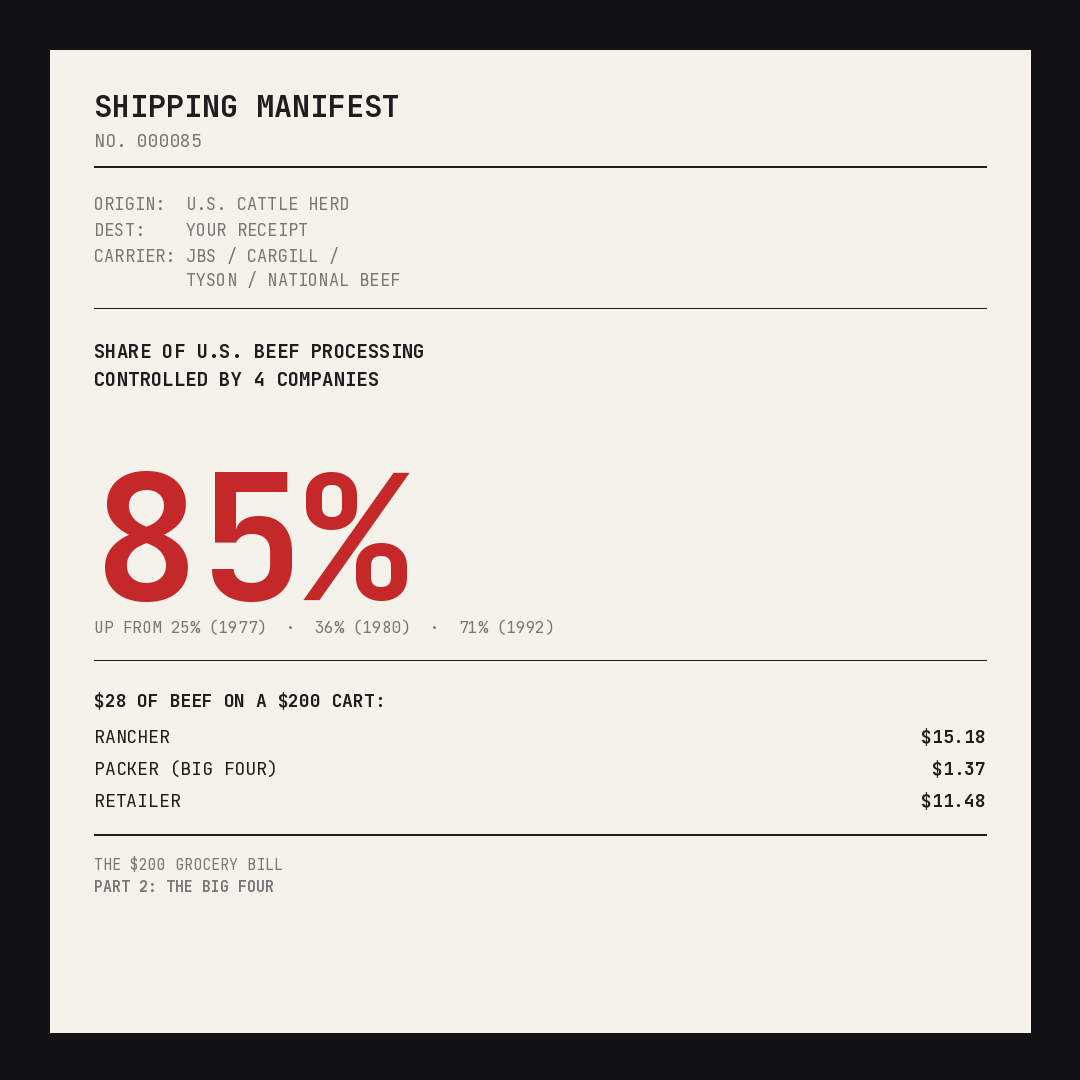
Four companies — JBS, Cargill, Tyson, and National Beef — control roughly 85% of all cattle processing in America.
Eighty-five percent. Not “a big chunk.” Not “a leading market position,” which is the phrase a press release uses when it wants you to picture leadership instead of a stranglehold. Eighty-five out of every hundred cows in this country walk through a door owned by one of four companies.
If you’re a rancher and none of those four wants your cattle this week?
There is no fifth door.
There’s a truck, some gas money, and a long quiet drive home, thinking about supply and demand the way a hostage thinks about room service.
Now — this didn’t happen by accident. Nothing in this series happens by accident. In 1977, those same four processors controlled about 25%. By 1980, 36%. By 1992, 71%. Today, 85%.
That’s not a market evolving.
That’s a funnel closing. Decade by decade. One politely waved-through merger at a time. While you were busy being told to argue about something else.
And here’s the part that should make you laugh. Not the happy laugh. The Carlin laugh. The laugh of someone who has just seen the wiring.
America already fixed this once.
Congress passed the Packers and Stockyards Act in 1921 because five meatpackers got too big, too coordinated, and too comfortable squeezing everyone standing near them. We saw the problem. We named the problem. We legislated the problem.
Then we spent a hundred years quietly un-fixing it, one antitrust shrug at a time, until we arrived at four companies holding more concentrated power than the five that made Congress angry in 1921.
We didn’t forget the lesson.
We let it expire. Like a coupon.
WHAT DINNER ACTUALLY COSTS NOW
One number before we go on, because the headlines keep rounding this one gently, and gentleness is how they get you.
You may have seen beef quoted at a record $9.64 a pound. True. Also misleading. That’s a blended average — ground chuck and roasts and steaks all mashed into one polite number.
Here’s the unblended truth, from the government’s own price series, July 2026:
Ground beef: $6.89 a pound. An all-time record. It was $3.77 nine years ago. That’s an 83% increase on the cheap cut. The everyday cut. The one that doesn’t even get a fancy name.
Steak — the government’s steak-only index: $13.06 a pound. And that index still includes the modest cuts. An actual ribeye at an actual warehouse club has been running $15 to $19 a pound.
The burger meat is $6.89.
The burger meat.
Use the blended number when you want to sound calm about your grocery bill. Use the ribeye when you want to be honest about what dinner costs.
This book — this series — is in the honesty business.
A BRIEF DEPOSITION REGARDING THE PRICE OF YOUR STEER
The witness today is a pricing formula. An actual formula. The kind that determines what a rancher gets paid for a truckload of animals he raised for two years.
Q: How is the price of your cattle determined?
A: By formula.
Q: Whose formula?
A: The packer’s.
Q: Did you help write it?
A: No.
Q: The number the formula is pegged to — where does that come from?
A: The cash market.
Q: The cash market. Where buyers bid against each other. In the open.
A: That market.
Q: How much of the beef business actually trades on that open market anymore?
A: Nationally? About twenty percent. In Texas, as low as three.
Q: So the formula that sets your price is anchored to a market that barely exists.
A: …
No further questions.
Here’s that deposition in plain English, because plain English is the only language the formula was designed to avoid.
The share of cattle actually sold in open, negotiated, competitive bidding has collapsed — from roughly 55% in 2005 to about 20% today. USDA’s own numbers. The rest moves through “formula pricing” and packer-owned “captive supply” — cattle the processor already locked up before the market opened, priced off a formula the processor controls the inputs to.
And the national number is the flattering version. In the Texas–Oklahoma–New Mexico region — some of the biggest cattle country on Earth — negotiated trade runs as low as 2.6%. Colorado, 8.3%. Kansas, 12.5%.
In America’s cattle heartland, the “open market” is a rumor.
The concentration index in those regions tops 3,200. The Justice Department’s own threshold for “highly concentrated” is 2,500.
Now watch how the machine works, because this is the elegant part. This is the part they should teach in schools and never will.
When the reference price for nearly every transaction is generated by a sliver of transactions that small, in a market that concentrated — nobody has to fix anything.
Nobody meets in a parking garage. Nobody whispers. Nobody breaks a single law.
The structure does the fixing.
Quietly. Weekly. Legally.
Built in.
THE HONEST PART, BECAUSE THIS SERIES DOESN’T DO CLEAN VILLAINS
Now I have to tell you something you’re not going to like, because you were warming up a nice clean rage and I’m about to complicate it.
I told you in the letter at the front of my book: if you’re looking for something that confirms what you already believe, this is not that book. Same rule here.
You’d assume the packer in the middle is skimming the fat off your steak money. The receipt disagrees with you.
The rancher’s share of the retail beef dollar is about 54 cents — and it’s been rising, up from roughly 30 cents in 2000. The packer’s share is about a nickel — and it’s been falling, down from 11 cents.
Put it on your cart. At July 2026 prices, call it $38 of your grocery run in beef — and yes, that number was $28 when I first drafted this, and no, it didn’t grow because I got dramatic. It grew because the price of beef did. On the honest math: about $20.60 of that goes back to the rancher. About $1.86 to the packer. About $15.50 stays with the store.
So acquit the number.
But convict the structure. Because margin is not power.
A company doesn’t need a big slice of your dollar if it controls the only number your dollar is measured against. That’s what the deposition was about. The Big Four don’t need to skim at the register. They set the price at the chute — upstream, in the dark, where 80% of the transactions never see open air.
A casino doesn’t need to win every hand.
It owns the table. It sets the odds. It makes sure you keep sitting down.
Small cut. Total control of the reference price everybody else’s cut is calculated from.
That’s not a margin story. That’s a room story. And you know my rule about rooms:
You are not in it.
THE FAMILY FARM WENT SOMEWHERE. GUESS WHERE.
While four buyers were consolidating on one end of the pipe, the sellers were disappearing off the other end.
American farms peaked at 6.8 million in 1935. Today: 1.865 million. Since 2017 alone — another 140,000 gone. An entire industry’s worth of FOR SALE signs, staked into land that used to grow food and now grows a subdivision called Meadowbrook Estates.
There is no meadow. There is no brook.
Meanwhile, farms doing over $5 million a year have nearly doubled. Operations over 500 acres now sit on 82% of American farmland.
The little guy isn’t holding steady while the big guy grows around him. He’s being absorbed. One retirement. One bad year. One buyout at a time.
That’s not a business cycle.
That’s a very slow, very polite eviction. And everybody shook hands on the way out.
Four buyers on one end. A vanishing pool of sellers on the other. And no — this is not a conspiracy. A conspiracy requires somebody to whisper.
This sat in a public spreadsheet for fifty years.
Nobody had to whisper a word.
THE SUBSIDY SHELL GAME
Next word.
Subsidy.
The word’s gone soft. Sanded down until it sounds like charity. Like a casserole somebody leaves on a struggling farmer’s porch.
Here is what a subsidy is.
Tax money. Your money. Taken by force of law — skip your taxes and count the days until a man with a badge arrives — and handed to a private company, because the private company asked nicely and hired the correct former official to do the asking.
Now. Ask an average American who farm subsidies help and you’ll get a Norman Rockwell painting. Overalls. A red barn. A family scraping by. Maybe a dog.
Sweet image. Belongs in a museum.
Between 1995 and 2021, the top 1% of subsidy recipients collected 27% of all farm subsidy dollars. The top 10% collected 79%.
And the smallest farms — the ones actually matching the painting? Fewer than a quarter of them get any subsidy at all.
The safety net was sized, marketed, and photographed for the man in overalls. It mostly caught the man in the jet.
Do you understand the design skill that takes? That is a life raft engineered to inflate only for people who already own a yacht.
And the money doesn’t stop at the farm gate. Why would it. It’s having a wonderful time. State and local governments have handed meat processors over half a billion dollars in tax breaks since 2006 — Tyson alone accounts for more than half of that. Federal food purchasing runs the same direction: in 2022, just 25 vendors captured nearly half of all federal food-procurement dollars, with Cargill, Tyson, and Smithfield landing awards in the megamillions.
And when a USDA Secretary was asked why the government kept writing checks to JBS — JBS specifically — the honest answer was, roughly: because there’s so little competition left that avoiding the biggest company would cost taxpayers more.
Read that again.
The government’s own grocery list is now written by the concentration it was supposed to prevent. That’s not a defense of the system. That’s a eulogy for the alternative.
Oh — and USDA did respond. A $59 million grant program for independent processors. Fifty-nine million, against half a billion in tax breaks flowing the other way.
That’s not a rescue.
That’s a man arriving at a five-alarm fire with a garden hose, a press release, and a photographer.
WHOSE TEAM ARE THEY ON, EXACTLY?
Here’s the part nobody puts on the packaging.
A meaningful chunk of your concentrated American food supply isn’t, strictly speaking, American.
Beef: two of the Big Four — JBS and National Beef — are Brazilian-owned. Half your beef pyramid answers to São Paulo. Somewhere right now there’s a guy in a Kroger squeezing a steak, checking for the “Product of USA” sticker, feeling patriotic. He is, functionally, FaceTiming Brazil.
Pork: Smithfield Foods. The hams. The bacon. The little pig on the package practically wearing a straw hat and humming “God Bless America.” Majority owned by WH Group, a Hong Kong–based conglomerate, since 2013 — the largest Chinese acquisition of an American company in history. Smithfield alone controls roughly a quarter of U.S. pork. Stack JBS’s pork operation on top: roughly 40% of American pork runs through foreign-controlled companies. No sector of American agriculture has a bigger foreign ownership stake.
The man buying bacon at 7 a.m. is funding two continents with the same twelve dollars. Nobody told him. Nobody was ever going to tell him.
Poultry: Tyson is genuinely Tyson — Arkansas, no notes. But JBS holds majority ownership of Pilgrim’s Pride, one of the largest chicken producers in the country. The Brazilian thread runs through all three proteins. Quietest exactly where you’d expect it loudest — which is how the best tricks work. They hide in the one place you stopped looking.
Now, fair is fair, and I’ll be fair for exactly one paragraph: foreign investment is not a crime. Capital doesn’t carry a passport. These companies employ real Americans doing real, backbreaking work.
But “who is actually on the other end of this squeeze” is a fair question. And right now the honest answer runs through Brazil and China about as often as it runs through Arkansas.
That’s not an accusation.
That’s a geography lesson your receipt never mentioned it was giving.
THE INVESTIGATION IS NOT HYPOTHETICAL
This isn’t history I’m dredging up for effect.
As of right now — 2026 — the Department of Justice and USDA have an active antitrust investigation into the Big Four: whether their concentration lets them coordinate prices, inflate what you pay, and suppress what ranchers get paid. Both ends of the chain. Simultaneously. Which, if true, would be the single most efficient squeezing operation in the history of squeezing.
And this industry has been here before. Recently.
In May 2026, DOJ settled with a company called Agri Stats — which spent decades collecting detailed pricing and output data from competing meat processors and handing it back to them, dressed up as “industry benchmarking.” The government’s read, in plain English: that wasn’t benchmarking. That was a laundering service for exactly the information competitors are legally barred from sharing directly. Chicken, pork, and turkey processors moving prices in the same direction — without anyone ever picking up a phone.
One honest caveat, because getting this wrong would rot the whole piece: Agri Stats says on the record it never operated in beef, and the case covered chicken, pork, and turkey only. So it is not proof of beef collusion.
It is proof of something else.
It is proof the playbook exists. That it ran. Successfully. For years. In the industries one aisle over, in the same meat case.
Whether beef has its own edition is precisely what the new investigation exists to find out.
THE COP WHO ISN’T ALLOWED IN
You want to know what the FTC — the agency whose entire job is stopping this kind of thing — does about four companies controlling 85% of American beef.
Here’s the answer. It deserves its own paragraph. It deserves its own plaque.
The FTC is barred from investigating it.
Not too busy. Not asleep. Statutorily excluded. The law carves meatpacker conduct — the captive supply, the formula pricing, the exact machinery we just autopsied — out of the FTC’s jurisdiction and hands it to one small office inside USDA: the Packers and Stockyards Division.
That’s it. That’s the whole cop.
And that cop’s budget was just cut 22% in a single year — $31 million down to $24 million — under an administration that campaigned on investigating exactly this industry. Staffing: roughly 110 people. For an industry that slaughters more than 30 million cattle a year.
You can have four gates in the chute, or you can have enough inspectors to watch four gates.
America chose neither.
And before you say incompetence — no. Incompetence is random. This is consistent. The watchdog with jurisdiction has no money, and the watchdog with money has no jurisdiction, and that arrangement has survived every administration of both flavors for decades.
That’s not a bug.
That’s architecture. Somebody drew it that way. In a room.
You know the room.
Credit where due, because the FTC does have teeth in the one lane Congress left open: its own staff report found grocery retail margins climbed from 5.6% before the pandemic to over 7% by late 2023 — meaning some of what you were told was “just passing along costs” was retailers pocketing extra while blaming the supply chain. And in December 2024, the FTC blocked the Kroger–Albertsons merger outright. Real actions. Real results. Aimed at the one gate they’re allowed to guard.
It took a presidential executive order — December 2025 — to finally create a joint task force to look at meatpacking concentration at all. Forty-five years after the funnel started closing.
That’s not urgency.
That’s a fire department showing up to write a report on the ashes.
“BUT THEY HIRE AMERICAN WORKERS”
Here come the defenders, and they’re holding a sentence: these companies employ real Americans.
True. JBS is the largest employer in Greeley, Colorado. The work is real, brutal, dangerous, and it keeps the entire chain moving. That’s not nothing. I was not raised to pretend working people are nothing.
But let’s finish the sentence instead of stopping where it’s comfortable.
Average meatpacking pay runs $16 to $19 an hour. Call it $33,000 a year. For a job the Bureau of Labor Statistics repeatedly flags as more dangerous than the rest of manufacturing — which is a polite government way of saying the job hurts you, and it does not pay you back for the hurting.
Now hold that wage up against the product. Ground beef: $6.89 a pound, remember. The record.
The person cutting, boning, and packing thousands of pounds a shift earns — in a full hour of that work — enough to walk out with about two and a half pounds of the thing they just made.
Before taxes. Before gas. Before rent, and rent always wants a word.
They built the receipt. They can’t afford to be on the customer side of it.
That’s not a labor dispute. That’s a closed loop with a cruelty setting.
And it’s boiling, not simmering. April 2026: thousands of workers at JBS’s Greeley plant walked out for three weeks — the first strike at an American slaughterhouse since 1985. They won a raise and a bonus. They gave up their pension to get it. The company itself later expressed public regret about the pension — on the workers’ behalf — which is a genuinely remarkable thing for a corporation to say out loud with a straight face.
One more. This should be a headline somewhere and it’s a footnote everywhere.
A national study of food companies whose employees receive SNAP — food stamps — found Tyson was the only meat processor on the list, with workers on food assistance in at least two states. The company processing a fifth of America’s meat has employees who need government help buying groceries.
Some of those groceries are the product they made that morning.
The man on the line is a person. I need you to hold that. He is not a unit of labor cost. He is not “headcount.” He stands in cold rooms doing work that wears his body out so that dinner exists, and at the end of the week he qualifies for assistance to buy the dinner.
So yes. They hire American workers.
The same way the casino has a working ATM.
It’s not generosity. It’s plumbing. The money has to pass through somebody’s hands on its way up.
Nobody’s grateful for being the pipe.
THE LOBBY: BUYING THE WEATHER
Follow the money past the plant, into the building where the rules about the plant get written.
The Food & Beverage industry spent $29.6 million lobbying the federal government in 2024. The top 20 food and beverage trade groups have spent a combined $303 million since 2008 — with just three of them accounting for nearly half.
Now, honesty: that’s not the biggest pile in Washington. Pharma laps it. Tech laps it. What makes food lobbying worth your attention isn’t the size.
It’s the aim.
This money is not sprayed across a hundred causes. It’s a rifle. And every target it’s zeroed on has your grocery receipt standing directly behind it.
Exhibit A. October 2025. Coca-Cola, PepsiCo, Kraft Heinz, General Mills, Nestlé, and Tyson formed a coalition to fight state laws banning artificial dyes from school lunches. The coalition needed a name. Are you sitting down. They named it:
“Americans for Ingredient Transparency.”
A group whose entire purpose is to stop transparency laws. Named “transparency.”
I could not invent that. If I invented that, an editor would cut it for being too on the nose. That is a burglar wearing a shirt that says SECURITY GUARD, waving at your doorbell camera.
Exhibit B. The Shrinkflation Prevention Act — the bill from Part 1, the one requiring companies to tell you the box got smaller — died quietly in committee. Opposed by this same cluster of trade groups, on the grounds that disclosure is “an unnecessary burden.”
An unnecessary burden. On telling you the box got smaller.
Somewhere a lobbyist said that sentence into a microphone and was not struck by lightning. Which tells you something about the atmosphere.
And the campaign donations? Messier than either team wants — and I say that with regret, because a clean partisan villain would write this section for me. Historically the industry leaned Republican. In 2024, food manufacturers gave more to the Democratic presidential campaign while tilting Republican in Congress, and total giving fell by nearly half from 2020 — both parties losing about equally.
This is not a party-loyalty story. Neither team is coming to save you. The money doesn’t love anybody.
The money follows the committee seat, not the mascot.
THE DEBT TRICK: HOW TO OWN A GROCERY CHAIN WITHOUT FEEDING ANYBODY
This is the section that should bother you most, because this is the money that never even pretends to be about food. It doesn’t put on the little apron. It doesn’t wave at the produce section.
It walks straight through the store, out the loading dock, and into a spreadsheet in Manhattan.
Albertsons — the supermarket — has been a private equity instrument since 2006, when Cerberus Capital Management bought in. (Cerberus. The three-headed dog that guards the gate of Hell. They chose that name. Themselves. On purpose. I just want that on the record.)
Cerberus grew Albertsons through debt-financed acquisitions, including the $9.2 billion Safeway deal — 82.5% of it borrowed. That is buying a house on a credit card and calling yourself a real estate mogul.
The result: roughly $12 billion in debt on a company that sells lettuce. Albertsons’ debt-to-earnings ratio runs more than twice Kroger’s — and thirteen times Publix’s. Publix, you’ll want to know, is employee-owned. Same aisles. Same shelves. Wildly different math. Because one of them is optimized to feed shoppers, and the other is optimized to feed Cerberus.
And only one of those two has ever felt hunger.
Then comes the harvesting. 2017: despite weak performance, Albertsons pays a $250 million dividend to Cerberus and friends — financed partly by selling the stores’ real estate and renting it back. The stores now pay rent on buildings they used to own. That is selling your childhood home and then paying a stranger monthly to sleep in your old bedroom.
2022: as the Kroger merger was being negotiated, Albertsons announces a $4 billion dividend to its private equity owners — $2.5 billion cash, $1.5 billion in fresh debt. A move so aggressive the credit agencies downgraded them for it, and multiple state attorneys general sued to stop a supermarket from giving itself a bonus.
Sit with that sentence. State attorneys general. Suing. To stop a grocery store. From paying its owners.
All told, Cerberus extracted an estimated $350-plus million in fees and dividends and reportedly cleared roughly a 200% return. Not by selling you cheaper cereal.
The cereal was never the business.
The cereal was the collateral.
Say that back to yourself slowly, because it’s the ugliest sentence in this piece and it earned its place. You — standing in the aisle, comparing unit prices like a responsible adult — you were never the customer the way you think you were.
You were the cash flow.
The store wasn’t built to sell you Cheerios. The store was built to be worth something on paper, so a man in another city could borrow against it, pay himself, and walk away whole whether the Cheerios sold or not. If the store dies in five years, his money left in 2017 and 2022. The downside belongs to somebody else.
The cashier. The stock clerk. The town that loses its only grocery store.
You.
Still checking the unit price. Like the unit price was ever going to save you.
And this isn’t one villain’s origin story. The same researchers documented private equity firms bankrupting seven regional grocery chains between 2015 and 2018 with this exact playbook. Buy with debt. Extract the dividend. Sell the land out from under the stores. Leave the operating company holding interest payments that should have been groceries.
The Kroger–Albertsons merger itself? Dead. Blocked by the courts in December 2024, after the two companies burned over a billion dollars trying.
The deal died. The debt didn’t.
Somebody still pays interest, every month, on money that was borrowed to enrich people who never bagged a single grocery.
None of it illegal. Every dollar disclosed. Filed exactly as required.
Externality, remember. Someone else’s decision, landing on you. You are not in the accounting.
You are where the accounting goes when it doesn’t want to be accounting anymore.
THE TWIST, BECAUSE TRUE BEATS SATISFYING
Now the part that keeps this piece honest instead of merely enjoyable. My book has a rule and this series inherits it: the discomfort is information. Including mine.
If concentration equals squeezing, packer margins should be obscene right now. Record beef prices, historic cattle scarcity — the Big Four should be doing backstroke through a money vault.
Check the actual numbers.
Packer margins through much of 2025 and into 2026 have been negative. At points in early 2026: negative $200 to $300 per head. Cattle got so scarce, so fast, that the cost of the cow outran what packers recover on the beef. Ranchers — for once, briefly, in this one corner of the machine — captured more of the price gains than the packers standing next to them.
The little guy is winning a round. Nobody threw him a parade. I’m mentioning it because accuracy demanded it, not because it ruins my story.
Because it doesn’t ruin the story. Hear the distinction:
The gun is loaded. Structurally. Permanently. It’s sitting right there on the table, and I’ve spent this whole piece showing you the ammunition. Whether it’s being fired at this exact moment — today’s numbers say: not clearly, not right now.
Power and the exercise of power are two different facts.
A series that fuses them because fusion makes a better ending isn’t journalism. It’s just outrage with a bibliography. A better ending isn’t the job.
A true one is.
THE VERDICT: EXPOSURE, NOT A CRIME SCENE
So. Line it up. All of it. In one place. Slowly.
Four companies control 85% of your beef. Two of them answer to Brazil. A quarter of your pork answers to China. Family farms have been consolidating out of existence for ninety years while the subsidy programs wearing their name — overalls, red barn, dog — mostly pay the largest operations in the country. The federal government is actively investigating whether all this concentration lets prices be coordinated, and has already proven the quiet-coordination playbook ran for years in the industries next door. The workers keeping the machine moving can’t afford the product they make, and the company processing a fifth of America’s meat has employees on food stamps. The industry spends tens of millions a year making sure disclosure bills die in committee, through a group with “Transparency” in its name whose purpose is preventing transparency. And the biggest grocery merger in American history collapsed on top of a company that had already handed its private equity owners four billion borrowed dollars on the way out the door.
Every fact in that paragraph is legal.
Every one. Filed. Disclosed. Notarized. Indexed.
Nobody needs to be a villain for all of it to be true at once. That’s not a weakness in the argument.
That is the finding.
The system doesn’t run on people breaking rules. It runs beautifully on people following them. Which is worse — and you already know it’s worse, you felt it get worse somewhere around the word “collateral.”
So here it is plain. No bit. No bow.
You’re not being cheated by a crime. You’re being cheated by a design. And the design has better lawyers than you do — every name in this piece would win in court, because court only asks whether the rules were followed, and the rules were followed, because the people following them are the people who wrote them.
In the room.
Where you are not.
I can’t get you into the room. I never promised that. What I promised is smaller and more dangerous: the pause. The one the whole apparatus — the blended averages, the patriotic stickers, the transparency coalitions against transparency — is engineered to prevent.
So. Standing there next week, in the meat case, holding the $6.89 ground beef in the package that’s quietly gotten smaller:
Wait.
Wait just a minute.
Does this make sense.
That’s it. That’s the whole ask. That pause is the one thing in this entire piece they can’t formula-price, externalize, or lobby against.
Next time — Part 3.5: the court cases, the water bills, and the bribery scandal that didn’t fit here. Then Part 4: the family farms still standing, and what it actually takes to be one.
Bring the calculator. It’s getting a workout this series.
Sources & Receipts
- Drovers / AgWeb — DOJ, USDA antitrust investigation into “Big 4” beef packers
- Investigate Midwest — fact-checking Big Four beef processing concentration
- Farm Action — “Meatpacking: Four Corporations, Total Control”
- Federal Register — Price discovery and competition in markets for fed cattle (Oct. 2024) — 55% (2005) to ~20% (2021) national negotiated cash share, regional breakdowns
- American Farm Bureau Federation — Examining Cattle Transactions in the U.S. — regional negotiated trade percentages
- Drovers — Do Packers Control Cattle and Beef Prices? — packer share 10.9% (2000) to 4.9% (2025), rancher share ~54%
- Meat Institute — Summary of Market Conditions, Oct. 2025 — producer share of retail beef dollar
- USDA ERS — Farms received 11.8 cents per dollar spent on domestically produced food, 2024 (beef dollar share context)
- BLS/FRED — Average Price: Ground Beef, 100% Beef, U.S. city average (series APU0000703112) — $6.89/lb, July 2026
- BLS/FRED — Average Price: All Uncooked Beef Steaks, U.S. city average (series APU0000FC3101) — $13.06/lb, July 2026
- Warehouse Runner — Costco Kirkland Signature boneless ribeye steak price tracker
- Yahoo/Creators — Beef hit a record $9.64 a pound, blended average context (April 2026)
- Investigate Midwest — Packers and Stockyards Division budget cut 22%, from $31M to $24M (March 2026)
- AGDAILY — Do feds now lack resources to crack down on meatpackers? (April 2026)
- USDA AMS — Packers and Stockyards Division Annual Report to Congress, 2021–2022 — staffing figures
- FTC — Jurisdiction and Activities of the Federal Trade Commission with Respect to Livestock and Grain Products
- FTC — Feeding America in a Time of Crisis: FTC Staff Report on the U.S. Grocery Supply Chain and COVID-19 (March 2024)
- FTC — Statement on securing a halt to the Kroger-Albertsons grocery merger (Dec. 2024)
- WilmerHale — New Executive Order Demands Antitrust Crackdown on the Food Supply Chain (Dec. 2025)
- DOJ Office of Public Affairs — Agri Stats settlement, May 7, 2026
- National Hog Farmer — Agri Stats settlement, incl. statement beef was never covered
- Center for a Humane Economy — foreign ownership shares of U.S. pork production
- USDA Economic Research Service — number of U.S. farms, 2017–2024
- American Farm Bureau Federation — 2022 Census of Agriculture
- Center for Responsible Food Business — subsidy concentration among largest producers
- Investigate Midwest — over half a billion in tax subsidies to meatpackers since 2006
- Farm Action — federal food procurement contracts favoring largest processors
- Missouri Independent — USDA $59M grant program for independent processors
- AP (via multiple outlets) — JBS Greeley, Colorado strike and settlement, April 2026
- Union of Concerned Scientists — Tyson Foods and SNAP-dependent workers
- The National Provisioner / Pro Farmer — 2026 packer margin and cattle spread data
- OpenSecrets — Food & Beverage lobbying totals, 2024–2026
- OpenSecrets — Consumer Brands Association lobbying profile
- Food Dive — CBA and beverage industry among largest lobbying/donor spenders
- Food Dive — 2024 election food & beverage donation trends
- EWG / US Right to Know — “Americans for Ingredient Transparency” coalition
- NW Labor Press / Forbes — Kroger-Albertsons merger blocked, December 2024
- International Supermarket News — merger cost breakdown, $864M combined legal/advisory spend
- CEPR — “Private Equity Pillage: Grocery Stores and Workers At Risk”
- Private Equity Stakeholder Project — Albertsons $4B dividend and Cerberus payout
- Food & Power — states challenge Albertsons private equity payout