
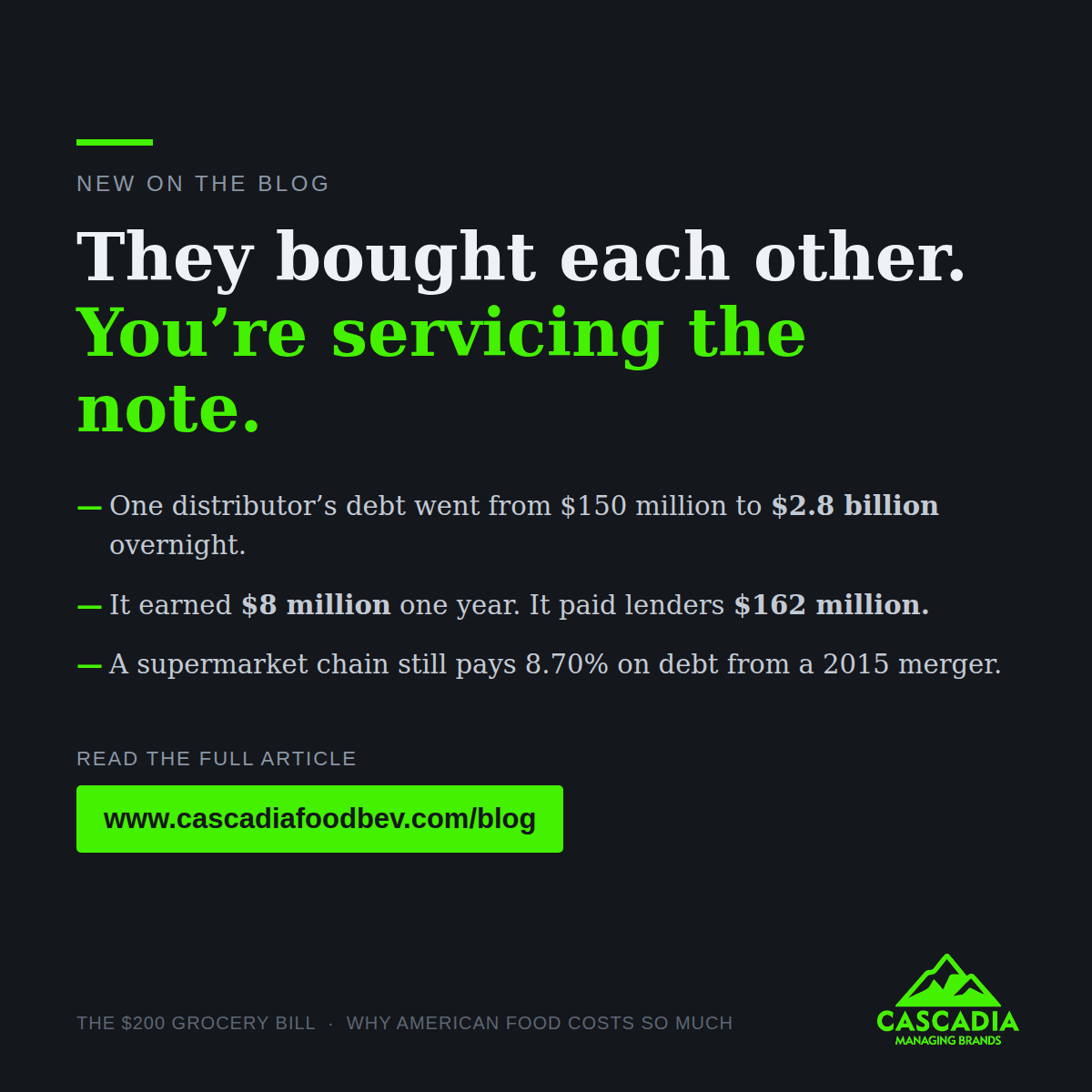
This article reveals how mergers in the food industry create massive debt, leading to high costs that don’t lower consumer prices.
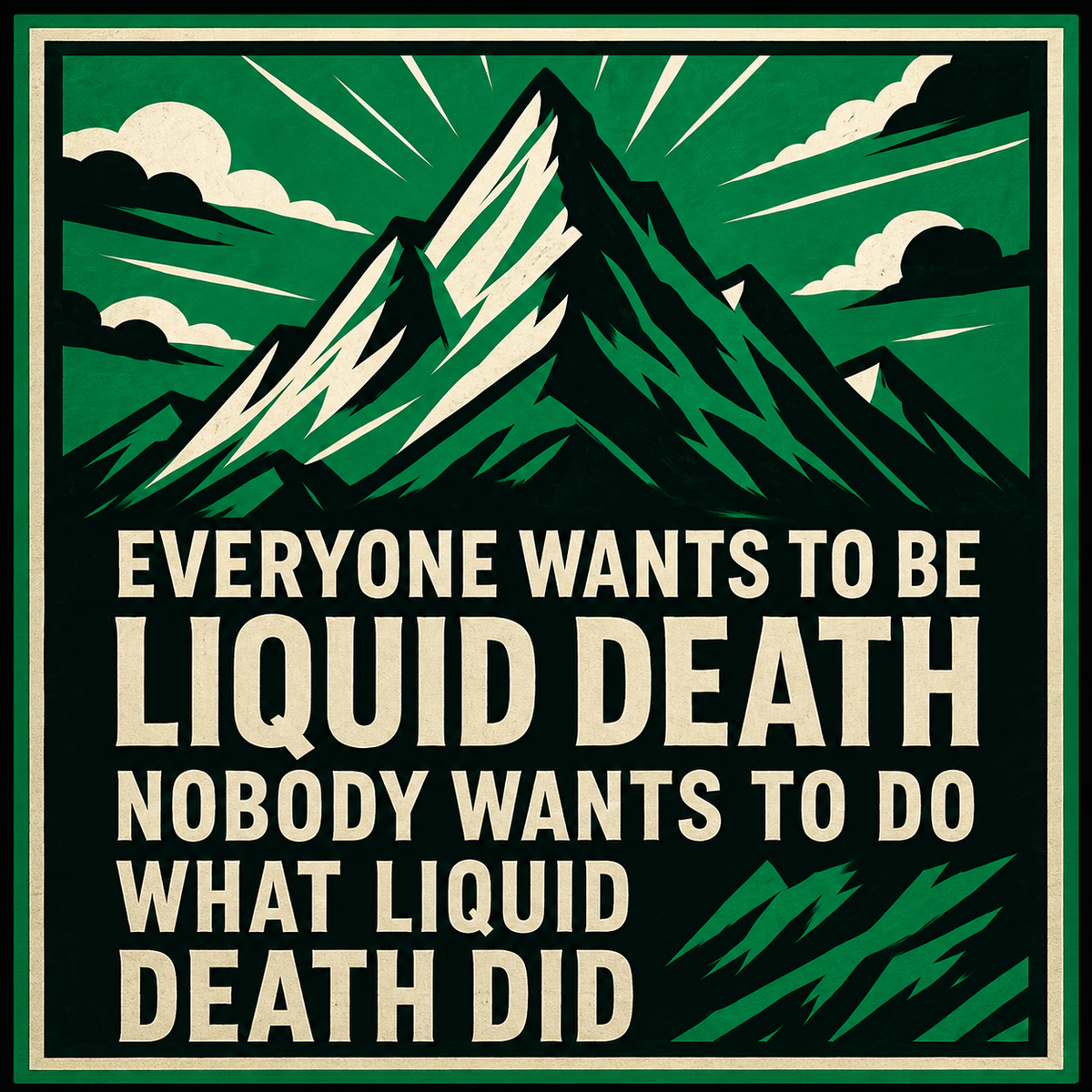
Everyone Wants to Be Liquid Death. Nobody Wants to Do What Liquid Death Did.
I hear it in almost every first meeting now.
“We want to do it the way Liquid Death did it.”
And then I watch them do the exact opposite. Every single time.
I need to say something about this, because after thirty-plus years launching beverage brands, this particular flavor of ignorance has become one of my biggest pet peeves. Not because people admire Liquid Death — they should. Because almost nobody who invokes that name has any idea what actually happened. They’ve fallen in love with the ending of the movie without watching the first two acts.
We were there for the first two acts. Cascadia started working with Liquid Death six months before the product ever reached the market — back when Liquid Death was a logo. Not a brand. Not a business. A logo, a concept, and a founder who had bet everything on it. For the next twelve months after launch, we set up and managed their initial distributor system and their key chain authorizations, and we stayed on until we helped them recruit and hire their first VP of Sales and transitioned the role in-house.
So when someone tells me how Liquid Death did it, I listen carefully. And most of what I hear is mythology.
Myth #1: They started with a pile of money
They did not.
People assume Liquid Death launched with millions behind it because the brand felt big from day one. That feeling was the craft, not the capital. The truth is they raised their first real chunk of money after their sixth or seventh month of being in distribution — after the product was on trucks, in stores, and proving itself. Not before.
And here’s the part everyone skips: when they did raise, they raised from a group of investors who could open doors, not just write checks. The money was strategic. The people attached to it mattered as much as the amount.
Compare that to the founders I meet who believe the raise comes first, the brand comes second, and distribution is somebody else’s problem to figure out later. That’s not the Liquid Death playbook. That’s the playbook of the 93-plus percent of new food and beverage brands that fail.
Myth #2: The marketing was magic, not method — sets up your “magical” line in the section while promising to expose the method.
Liquid Death was brilliant, and part of that brilliance was luck and timing — I’ll never pretend otherwise. But the marketing wasn’t an accident. It was the most disciplined organic social program I have ever seen, and the discipline is exactly the part people refuse to copy.
Mike came out of Netflix. He quit his job and put everything on the line for this idea. He had a breakthrough logo that cut both ways in the beginning — it attracted people and repelled people, and both reactions did work for the brand. And because of where he came from, he could pull together a group of talented friends to make videos inexpensively. Not cheap-looking videos. Great videos, made cheaply. There’s a difference, and it’s everything.
Their first video did 300,000 views. Organically. Zero promotion behind it.
Read that again, because this is the whole point: in the early days, they did not pay to promote their posts and videos. They didn’t post every day. They didn’t run silly contests and pay people to sign up. They didn’t have friends and family liking, commenting, and sharing to game the algorithm. Mike wasn’t out there doing “Happy Birthday America” posts to fill a content calendar.
It was 100% organic by design. That is why it worked.
The content was so good it drew people in on its own. That’s what made the marketing magical — the audience found it, shared it, and felt like they’d discovered something. You cannot buy that feeling. The moment you pay for it, you’ve killed it.
The ego trap: marketing that feels like work but isn’t
Since we’re on the subject, let me list what founders actually do when they say they’re “doing it like Liquid Death” — the activity that fills the calendar, burns the budget, and builds nothing.
Online contests. Almost all of them. Paying people to sign up, tag three friends, and share for a chance to win. Congratulations — you’ve just bought a list of people who wanted a free prize, not your product. They’ll never buy it, and the algorithm now thinks your audience is sweepstakes hunters.
Sampling at 5K marathons. This one might be my favorite. Who remembers the brands they grabbed at mile marker two of a 5K? Nobody. And if you’re handing out sparkling beverages — who on earth wants carbonation during or after a run? You paid for the booth, the tent, the product, the staff, and the ice, and the only thing you got out of it was a photo for your investor update.
Which is really what all of this is. It’s mental masturbation. It feels like marketing. It photographs like marketing. It’s ego-satisfying — the founder gets to stand at a table, see people holding the can, and feel momentum. But it’s usually a complete waste of time and money, and the brands doing it can’t tell you what a single one of those activities returned, because the answer is nothing.
Add to the list: posting every day because a growth guru said the algorithm demands it. Boosting mediocre content to strangers. Paying influencers who have never once bought the product and whose audience can smell it. Having friends and family flood the comments so the post “performs.” Buying a festival sponsorship because a competitor did. None of it builds a brand. All of it spends like one.
Liquid Death did none of this. Not because they were cheap — because they were creative. They understood that one piece of content people genuinely love beats a hundred activities that just make the founder feel busy. Creativity is the whole game. If you don’t have an idea good enough to spread on its own, no contest, no 5K table, and no boosted post is going to save you.
And now everyone’s new favorite shortcut: AI
Before anyone accuses me of being a dinosaur — I love AI. I use it every day. I have a relationship with AI. We have a saying in our offices: “If you’re not using AI every day, you’re going to get fired.” That’s a little tongue in cheek, but you get the point.
Here’s what I don’t love: founders who think AI is the brand. The same people running the contests and the 5K tables are now flooding their channels with AI-generated posts, AI-generated captions, AI-generated “content strategies” — and wondering why nothing connects. AI is a tool, and like any tool, it’s only as good as the hands holding it.
Prompting is both an art and a science, and it all starts with how and what you say in the prompt. Garbage in, garbage out — at scale, faster than ever before. That’s why we train our people on how to use AI, when to use it, and just as importantly, when not to.
And you have to check it, because AI isn’t always right. I can attest to this personally: I’ve had AI tell me things about brands we worked with — brands I helped build — and the information it quoted was literally not true. I was in the room. The AI wasn’t. If it can get the facts wrong about my own history, imagine what it’s confidently telling a first-time founder about distributor margins or chain reset calendars.
Use AI every day. But use it with common sense, train your team on it, and verify what it tells you. The founders who treat AI as a replacement for judgment are just doing the ego-trap marketing faster and in greater volume. Liquid Death would have been brilliant with AI or without it, because the creativity and the judgment came from people. That part hasn’t changed.
Myth #3: You can skip the unglamorous part
Nobody quotes the distribution part of the story, because there’s nothing sexy about distributor meetings and chain authorization timelines. But a viral video sells water exactly once if the water isn’t on a shelf when the customer goes looking for it.
While the internet was discovering Liquid Death, there was a distributor network being built market by market. Key chain authorizations being fought for and won. A sales plan, a P&L, pricing and promotional structures — the plumbing. And they started a category that barely existed. Canned water. That meant every conversation with a distributor and a buyer was a category education, not just a sales pitch.
The brand made people want it. The plumbing made it possible to buy. You need both, and everyone who says “we want to do it like Liquid Death” is invariably asking me to help them build only one.
What “doing it like Liquid Death” actually means
It means going all in before anyone validates you — Mike quit his job; he didn’t test the idea nights and weekends with someone else’s money.
It means being so focused and so counter to what everyone else is doing that your brand is unmistakable — not posting more, posting better, and having the restraint to stay silent when you have nothing great to say.
It means earning your audience organically before you spend a dollar amplifying anything. Yes, a new brand has to spend more on digital today than it did in 2019 — that’s real. But paid spend amplifies what’s already working organically. If the organic foundation isn’t there, you’re pouring money into a brand that’s going down like the Hindenburg, and no media budget in the world will keep it in the air.
It means building distribution like your life depends on it, because it does.
And it means raising money when you have proof, from people who bring more than money.
Liquid Death had a great brand, great luck, and great timing. Two of those three you can’t control. What you can control is everything else they did — the part nobody wants to talk about, and the part that made the luck and timing matter.
So the next time you’re about to say “we want to do it the way Liquid Death did,” ask yourself whether you actually mean it. Because I was there, and I promise you: the way they did it is harder, slower, and less glamorous than the way you think they did it.
That’s exactly why it worked.
Bill Sipper is Managing Partner of Cascadia Managing Brands, which has helped launch and build brands including Liquid Death, Zico, Hint, and Nantucket Nectars. If you want to talk about doing it the way they actually did it, get in touch.