

This article reveals how mergers in the food industry create massive debt, leading to high costs that don’t lower consumer prices.
Three CEOs in a Sprinter Van: Why Nothing Matters More Than Hitting the Streets
Yesterday we spent the day in the field in New York City with a large multinational beverage company we work with. The day started the way you’d expect for a company like this: a board of directors meeting, presentations, numbers, strategy.
Then something happened that you don’t see often enough. Everybody got up from the boardroom table and climbed into a Sprinter van.
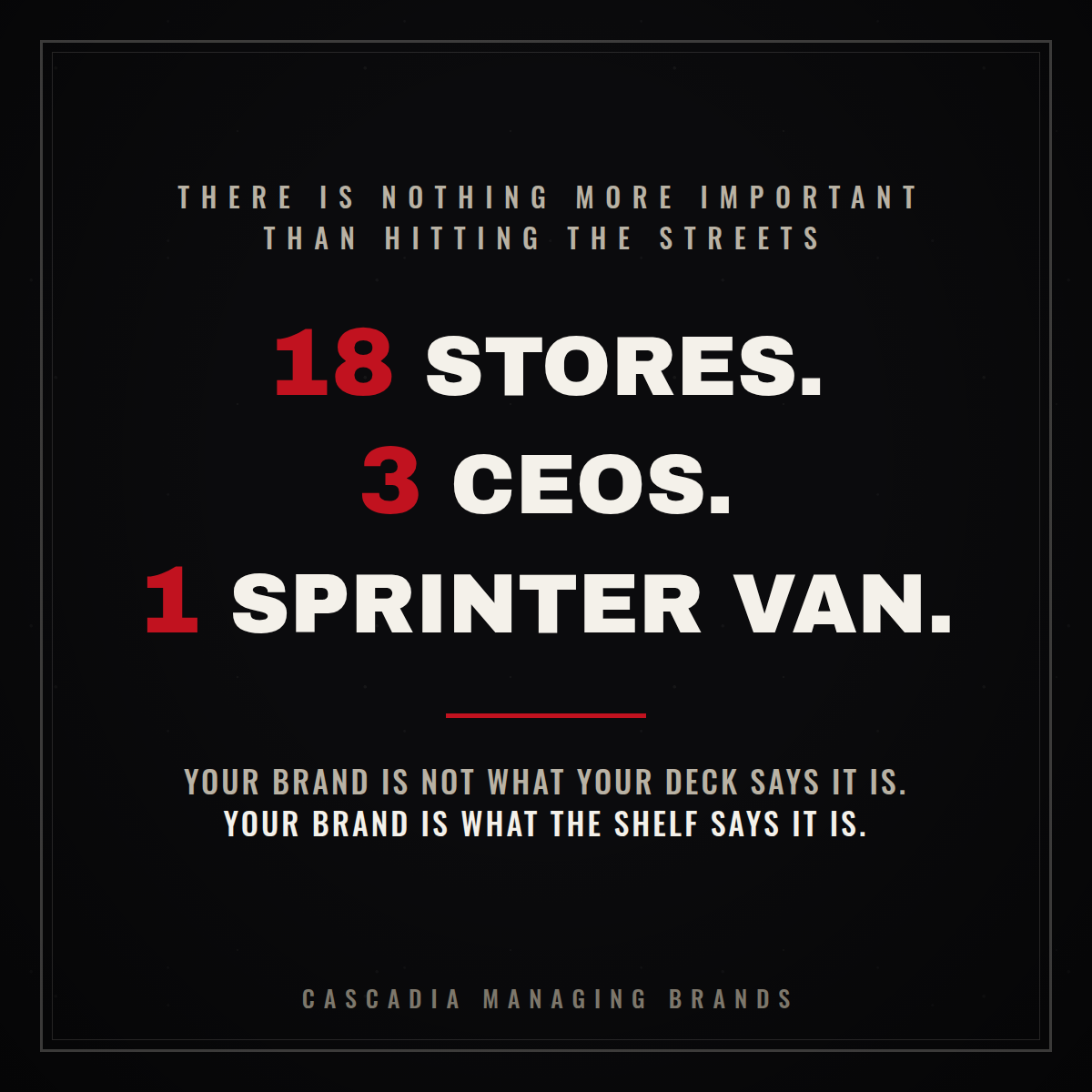
For the rest of the day, that van worked its way through 18 accounts across Brooklyn, Queens, and Manhattan. Bodegas, delis, independent grocers, key retailers — the real world, where brands actually live or die. There were 12 of us on that bus. And here’s the part worth repeating: among them were three CEOs, one of whom is a high-ranking official of a foreign government. Sitting in traffic on the way to the next stop. Walking coolers. Looking at shelves.
Let that sink in. If a man with those responsibilities can make time to stand in a Brooklyn deli and study where his product sits in the cold box, what excuse does anyone else in this industry have?
These weren’t tourists, either. The people on that van built their careers at CPG companies like Coca-Cola and Nestlé. They know exactly what they’re looking at when they walk into a store. That’s precisely why they were there. The smartest people in this business are the ones who never stopped believing the answers are on the shelf, not in the spreadsheet.
There is nothing — nothing — more important than hitting the streets.
What we saw: a lot to be proud of
Let’s give credit where it’s due, because the day was a good one.
This client started distribution in earnest in April. It is now almost August — call it four months. In that time, the brand has been sold into more than 550 A-level retailers in New York City. And in the 18 accounts we walked yesterday, the product looked great in every single one. The full line was in distribution in 95% of the stores we visited. We had secondary displays in at least half the stores. We had point-of-sale material working in a number of them.
Four months in, in the most competitive, most unforgiving beverage market in America. That is what good looks like. The distributor, the field team, and the brand should all take a bow.
And then the van kept driving, because that’s not why we were all in it.
What the streets told us: you can always be better
This is the part that matters. A field day isn’t a victory lap — it’s an inspection. Here’s what 18 stores told us that no dashboard ever would.
POS. We had point-of-sale material in some stores, but not in every store that could take it. To be fair, many of these accounts are “clean” stores — they don’t permit POS at all, and you have to respect that. But even accounting for those, we could have done better. Every store that allows POS and doesn’t have ours is an opportunity someone walked past.
Merchandising. Honestly? We could have done better, and it’s a conversation we need to have with the local distributor. When it comes to shelf placement, eye level to thigh level is the only correct answer. That’s where the consumer looks, that’s where the hand goes, that’s where product sells. We walked into a few accounts where our product was too high, and a few where it was too low. Fixable — but only because we were there to see it.
We were also inconsistent with package and SKU placement. In one store the shelf started with one item; in the next store it started with another. That’s not a brand block — that’s improvisation, and improvisation doesn’t build a billboard. The fix is a proper schematic, and in fairness, our salesperson has been asking for one. So we’ll build it. Then we train our own people and the distributor on how we want to see every single store, and we hold everyone accountable to it. And let’s be clear about what accountable means here: this isn’t a blame game. This is “hey, how can we do better?” On a shelf, there is a right answer and there is a wrong answer. Every time we see the wrong answer, our job is to strive to get to the right one.
Pricing. Here’s a New York reality: it is not 100% common to have price tags on every shelf in this market. Plenty of stores simply don’t tag. But where you can get a price tag on the shelf, the product is more likely to sell — shoppers hesitate to pick up a product when they have to guess what it costs. We were inconsistent on this, and we’ll be working with the distributor to get price tags on as many shelves as possible.
None of these are crises. All of them are the difference between a good brand and a great one. And not one of them is visible from a conference room.
The lesson
Depletion reports tell you what happened. The shelf tells you why. You can read every scorecard your distributor sends and never learn that your product is sitting above the sightline in a store in Queens, or that the cooler in a Brooklyn bodega has your competitor at thigh level and you on the bottom shelf, or that a store that would happily take a shelf strip has never been offered one.
The only way to learn any of that is to go look. Yesterday, three CEOs — people with every excuse in the world to stay at the table — understood that. They rode the van, walked the stores, and left with a punch list. Overall: a great job by everyone involved, and genuine momentum. And still, room to improve — which is exactly what a day in the streets is supposed to find.
If the people running a multinational make time for the streets, so should you. Your brand is not what your deck says it is. Your brand is what the shelf says it is.
Bill Sipper is Managing Partner of Cascadia Managing Brands, which has spent 30+ years building beverage brands in the field — including launches for Liquid Death, Zico, Hint, and Nantucket Nectars. If you want to know what your shelf is saying about your brand, get in touch.