

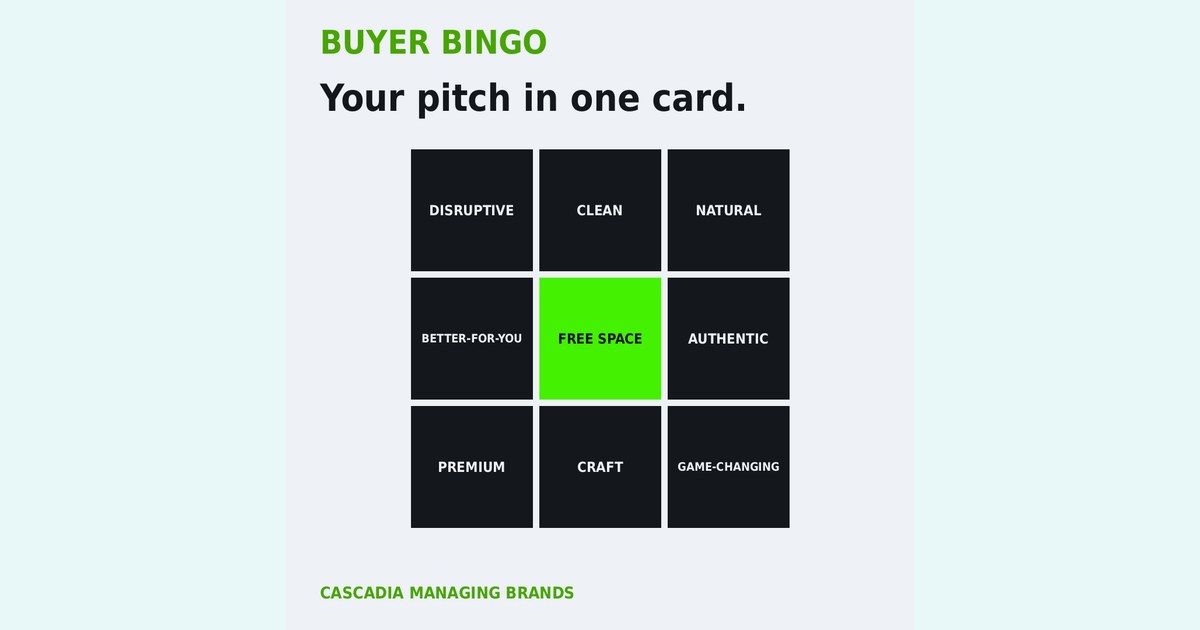
Common food and beverage buzzwords like disruptive, clean, natural, and better-for-you often fail to convince buyers who want clear facts and data.
World Supermarket Tour Blog
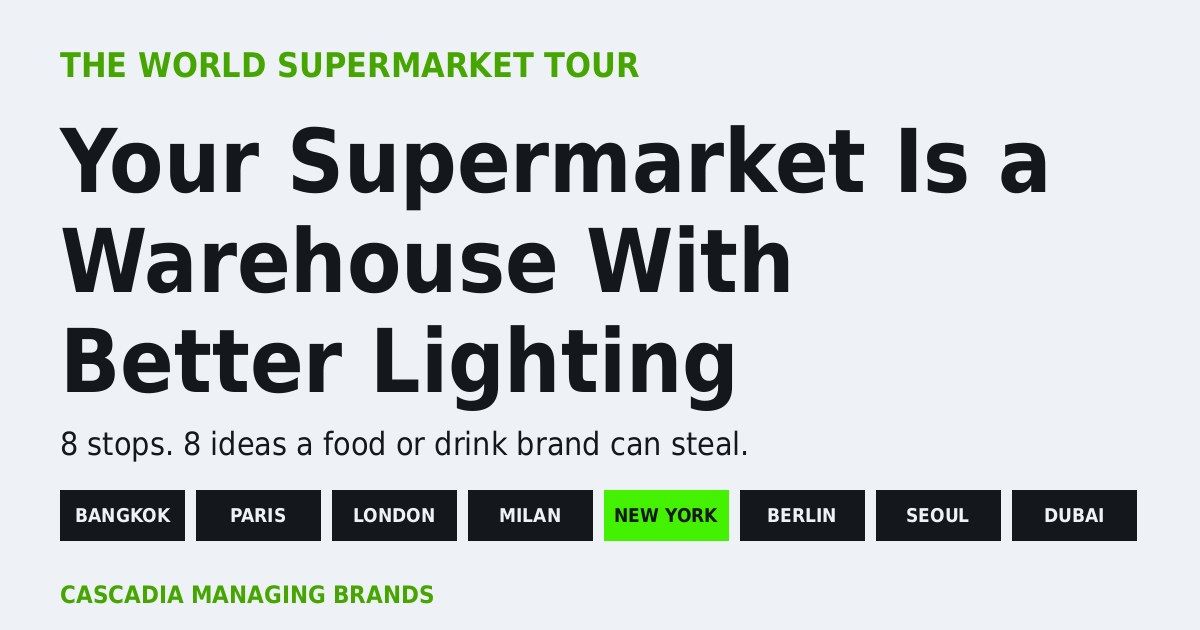
Your Supermarket Is a Warehouse With Better Lighting
I have spent most of my career walking into supermarkets with a sample case and a hopeful look. Some of the best stores I have ever stood in are not in America. You walk in and you do not feel like you are doing a chore. You feel like you have been invited somewhere.
Now walk into the average American supermarket on a Tuesday. Bright lights, a pyramid of seltzer, and one guy in produce who looks like he is serving a sentence. Same planet. Same species buying the food. Completely different experience. We put a man on the moon, and we still sell lettuce under lighting designed for a morgue. So come on a tour of eight of the best in the world, one of them in New York, then we will see how America’s biggest chains stack up. Steal the good ideas. Skip the lighting.
First, Why Is Ours So Different?
A US supermarket keeps somewhere between one and two cents of every dollar it takes in. NYU’s Stern School numbers put the grocery industry’s recent net margin at about 1 percent, and the industry association’s benchmark for 2024 was about 2 percent. That is the whole business. Imagine running a company where your entire profit is the tip you leave at dinner. Everything else is cost.
Yes, most American supermarkets have a bakery and a meat counter. But look at what those departments actually do. The case is stocked, the bread is mostly baked off, and the person behind the glass sells you what is already in the tray. Now think of the meat hall at Harrods, where somebody with a knife and an opinion cuts to your specification while you stand there. That is a service, and service costs labor. A business that keeps a penny on the dollar is always one bad quarter from cutting the people who do it. Of course the guy in produce looks tired. He is the line item.
Size is not the excuse. Central Food Hall Ladprao in Bangkok is about 47,000 square feet. The average US supermarket is about 48,575. Same size box, different idea of what the box is for. One of them is a place. The other is a hangar for cereal. Let us go see.
Stop 1: Bangkok. Central Food Hall and Gourmet Market
Central Food Hall Ladprao has 12 zones, a fishmonger inspired by London’s Billingsgate Market, a baker turning out up to 260 breads and pastries, an open cheese zone, and open show kitchens in the middle of the fresh departments so you can watch lunch get made. At Central Chidlom, the produce zone works with local farmers on what is in season, and there is a wine and whiskey room with more than 1,000 labels.
Across town, Gourmet Market at Siam Paragon runs on a line I love: you hunt, we cook. Buy the ingredients, and the store’s chefs cook them for you. It rotates more than 1,000 items in and out every month, and staff greet the first shoppers each morning. When it renovated for the first time in 17 years, it grew from 6,000 to 8,000 square meters, and the team spent a year visiting small European markets, butchers, cheese shops and bakeries to get it right. Gourmet Market now has 17 stores. The lesson is to sell the cooking as well as the ingredients, and to change the shelf so people have a reason to come back on Thursday.
And then there is the gift basket. At Central I have seen them sell a gift basket with a Mercedes attached. Read that again. A fruit basket, and a car. Meanwhile, in America, we are proud when the self-checkout stops yelling at us. Gift-giving is taken that seriously over there, and I will come back to it.
Stop 2: Paris. La Grande Épicerie
It started in 1923 as a gourmet counter inside the Le Bon Marché department store. Today it carries more than 30,000 products and employs about 550 people, and about 80 of them are artisans. That is roughly one in seven people on the payroll making something with their hands. The store is organized like a market square under a glass cupola, with counters for pastry, chocolate, bread, charcuterie, meat, cheese and fish around the edges. Beneath it, a 1,500 square meter lab houses the bakery, catering and pastry workshops. The lesson is to organize the store by craft, put the maker on the floor, and let the shopper watch.
Stop 3: London. Harrods Food Halls
Harrods began in 1834 as a wholesale grocery and tea business, and the Food Halls still carry that history in their tile work. In the Fresh Market Hall, the butcher counter hand-carves and seasons to order, the fishmonger fillets on request, and a vegetable butchery will prepare produce for the dish you are making. About 150 in-house chefs prepare the deli food daily. The lesson is to make the cutting and prep the premium service, and to put it where shoppers can see it.
Stop 4: Milan. Peck
Peck opened in 1883 when a salumiere from Prague, Francesco Peck, set up shop in central Milan. It is still on via Spadari, and it is still one store. About 4,000 square meters, of which only about 1,200 is retail. The other 2,800 is production. That ratio is the whole story: most of the building is a kitchen. Roughly 100 people work there, about 30 of them cooks and production staff, and the wine cellar holds about 3,000 labels. Revenue is around 16 million euros, and half of it comes in the last three months of the year, when Milan buys its Christmas dinner from Peck.
The lesson is that you do not need 500 stores. You need a product people cannot get anywhere else, made by people who have been doing it for generations, and a reason for the whole city to line up at the holidays.
Stop 5: New York. Zabar’s, and Why America Gets a Seat at This Table
Before you decide that great food stores only exist across an ocean, take the 1 train to 79th Street. Zabar’s started in 1934 as the smoked fish department of a Daitch supermarket on Broadway, run by Louis and Lillian Zabar. The family grew it into five small stores along Broadway, then consolidated them into one market of about 20,000 square feet at Broadway and 80th Street. Nearly 55 million dollars in sales a year. One store. The family owns the building, so no landlord can raise the rent on them, and they have declined to franchise. Four generations of the family have worked there.
Here is what makes Zabar’s the best case in this whole blog. They were doing it before anyone had a name for it. The ground floor is cheese and bread, with about 800 types of cheese. Smoked fish is hand-sliced at the counter. Upstairs is cookware, so you can buy the knife, the pan and the thing you are going to cook in it under one roof. Downstairs, the coffee. In the late 1960s Zabar’s was the first shop in the US to sell Wigomat drip coffee machines, and Saul Zabar is credited with introducing New Yorkers to gourmet coffee, with his own Zabar’s Blend, years before the rest of America discovered it. The store roasts its own and sells about 400,000 pounds a year.
And it shipped. The Zabar’s federal trademark record covers retail store and mail order services for gourmet foods, with first use in commerce in 1955. Shipping and online orders are now somewhere around a quarter to a third of the business. Jeff Bezos was born in 1964. Zabar’s was selling gourmet food by mail nine years before that. Zabar’s was Amazon Fresh before Amazon Fresh, and the lox is better.
The reason it still thrives is the same reason the overseas stars do. The family never sold out, so nobody leveraged it, flipped it or squeezed it. Staff stand at every counter and know the product. Saul Zabar died in October 2025 at 97, after more than seven decades running the place, and he told an interviewer in 2022 that the store was a way of life for the family. The lesson is that an American store can be a world-class destination when somebody who loves the product owns the building and the outcome.
New York has company in this league. Citarella, a family-run seafood and butcher market under Joe Gurrera, who also runs the wholesale seafood business Lockwood & Winant, opened its eighth store, in Westhampton Beach, in April 2026. Owning the wholesale fish side is the same play as Spinneys owning its fresh supply. That is a small chain growing on purpose, and it is the closest thing America has to a Harrods meat hall.
Stop 6: Berlin. KaDeWe
Take the escalator past the fashion to the sixth floor. KaDeWe has been selling delicacies on that floor since 1956. The floor covers several thousand square meters, with several hundred types of cheese, oysters, Kobe beef, a wall of wine, champagne, whisky, and counters where you can sit down and eat what you just looked at. The food is on the top floor on purpose. You walk through the whole store to reach it, and then you stay. The lesson is that the food floor can be the reason the store exists. Here, the food is what is left over after the store finishes selling you everything else.
Stop 7: Seoul. Shinsegae
Shinsegae makes the grocery a restaurant. At its Gangnam flagship, a 4,000 square meter deli section opened in August 2025 and brought the food hall to about 20,000 square meters, which the paper says is the biggest department store food hall in Korea. It moved away from ready-made meals toward live kitchens and made-to-order dishes from chef brands. By July 2026, the food hall had passed 10 million cumulative purchasing customers, about a year after the renovation.
Across town, SSG Food Market in Dogok puts grill-to-order glass kitchens, a 200-seat restaurant, a bakery, a butcher, a fishmonger and a coffee roastery in one basement. The lesson is to make live kitchens and chef brands the draw.
Stop 8: Dubai and Riyadh. Spinneys
Spinneys opened its first Dubai store in the early 1960s, and its first customer was the ruler of Dubai. It now has more than 50 stores in the UAE, is listed on the Dubai exchange, and in the first half of 2026 it grew revenue about 5 percent to 1.9 billion dirhams, with 11 new stores in 12 months across the UAE and Saudi Arabia. What makes it a best-of-the-best pick is how it controls quality. It runs its own fresh-food production, with factories in Jebel Ali and Dubai Investment Park supplying halal-certified meat, seafood, bakery, deli and flowers.
In June 2024 it opened a 43,520 square foot store in Riyadh, with its own production supplying the other Riyadh stores, and it is aiming for up to 12 Saudi stores by 2028. It had a rough patch in March and April 2026 when regional conflict hit trading, then recovered. The lesson is to own the fresh supply. Own it, and you own the quality. Rent it, and you own the apology.
The Gift Basket, and Why It Matters
Back to the Mercedes. In Asia, fruit is a premium gift, and the wrapped basket or box is a product category of its own. In Japan it is the kudamono no tsumeawase, and when you visit someone’s home you bring a temiyage, a small hand gift. In Chinese-speaking markets it is the guǒlán, brought to homes, hospitals and at Lunar New Year, with mandarins and pomelos for luck. In Korea it is the gwail seonmul set, big at Chuseok. In Thailand it is the krachao phonlamai, huge at New Year, and Central and Tops launch New Year baskets of happiness every year.
Arriving empty-handed says you do not care. The gift says thank you for having me, and the wrapping is half of the message. Once you see that, a basket that comes with a Mercedes does not look crazy. It looks like the top of a ladder. The store that understands occasions can sell you a $20 basket or a car. The store that sells cans sells cans.
Now the Big American Chains
Fair is fair. Those eight are mostly single stores and small chains, and it is easy to look brilliant when you only have to be brilliant in one building. Zabar’s and Citarella prove America can play that game. So here is how the big chains do at scale, the ones shoppers actually rank at the top, in the American Customer Satisfaction Index’s 2026 results, which are based on more than 31,000 customers surveyed through 2025.
Trader Joe’s is number one at 86. Publix is second at 84. H-E-B is third at 83. Whole Foods ties at 81 with Costco and Aldi. Notice what is missing from the top of that list. There is not a single cathedral. Nobody in America is winning with a glass cupola and 150 chefs. They are winning at scale, in a box that looks a lot like yours, with a margin that looks a lot like yours.
[PHOTO: Trader Joe’s, Publix and H-E-B storefronts (supply your own or licensed stock)]
Publix: Own the Place You Work
Publix runs 1,431 stores across eight Southeastern states with about 260,000 associates, and it calls itself the largest employee-owned company in the US. It has made Fortune’s 100 Best Companies to Work For list 29 years in a row, and in 2026 it came in at number 50. Here is the contrast. Overseas, the craftsperson makes the store special. At Publix, the owner makes it special. The person bagging your groceries has stock in the place. That is a business model dressed up as a smile.
H-E-B: The Store That Shows Up When the Lights Go Out
H-E-B started in Kerrville, Texas, in 1905, is still controlled by the Butt family, and now runs about 455 stores in Texas and Mexico with roughly 175,000 employees and about 50 billion dollars in revenue. It also runs Central Market, its specialty format, with 10 stores in Texas, and it makes a lot of its own private-label products and is investing 700 million dollars more in its San Antonio manufacturing and distribution complex. When hurricanes and the 2021 Texas power crisis hit, it used that logistics network to move food, water and mobile kitchens to where people needed them. Spinneys owns the fresh supply in Dubai. H-E-B owns the supply chain in Texas. Same lesson, bigger trucks.
Trader Joe’s: Curate Hard, Then Shut Up
Trader Joe’s is first at 86, and it did it by being the opposite of everything above. Small stores, a tight shelf, and a buyer who says no a lot. It is Peck’s philosophy with a Hawaiian shirt. Fewer products, picked by someone with a point of view. In a country with 30,000-item supermarkets, a store that says no to 25,000 of them is an act of rebellion.
Wegmans, Whole Foods and Fairway: The Warning Label
The supermarket as a destination is not a foreign import. It was the original Whole Foods model, and it was the Wegmans model. Build a store people want to go to, not one they have to go to, and the premium follows. Wegmans is family-owned, runs 114 stores, builds them big (the largest is about 160,000 square feet) with Market Café dining, and has been on Fortune’s Best Companies to Work For list every year since 1998.
And yet. In the 2026 satisfaction results, Wegmans scored 78, down 6 percent, and landed below Kroger. Whole Foods sits at 81, a very respectable number for a chain that was once the whole conversation. I will not tell you why. I will tell you the idea is sound and the execution is a daily job, and that staffing, service and fresh food only work as long as somebody keeps paying for them. Destination status is rented, not owned.
Then there is Fairway. It opened in 1933, built a New York following by selling great produce and food at fair prices, and went bankrupt in 2016 and again in 2020. After 2020, Wakefern took the brand, and four stores survived under Village Super Markets. Loved is not the same as profitable. At a 1 percent margin, adoring customers do not pay the rent. Zabar’s owns its building. That is not a coincidence.
So What Do We Learn From the Comparison?
Overseas, and at Zabar’s and Citarella, the best stores are craft. Somebody makes the bread, cuts the beef and cooks your dinner on the spot. In the US, the best chains are systems. Employee ownership at Publix, supply chain at H-E-B, curation at Trader Joe’s. Nobody has ever walked out of a store with a pyramid of seltzer and said, holy f***, what an experience. But people do walk out of Publix, H-E-B and Trader Joe’s and score them in the eighties.
Different tools, same principle. Somebody in the building owns the outcome, and shoppers can feel it. The overseas stores prove what is possible when the store is the product. The American chains prove you can do it at 450 locations. The average store proves what happens when nobody does.
The Honest Math, Both Ways
I am not here to dump on your local grocer. These are premium stores built for shoppers with money and a reason to splurge, and most people in Bangkok, Paris and Seoul buy their groceries at ordinary stores too. A Kroger cannot copy Grande Épicerie and survive on a 1 percent margin. The math does not allow it. You cannot cook a Tuesday-night rotisserie chicken into a Harrods butcher hall.
But look at what the math rewards. Some older industry data on specialty food stores showed net margins around 6 percent, against about 1 percent for supermarkets. The stores that make food, curate hard, and give people a reason to show up can keep more of each dollar. The ones that compete only on price keep the penny, and then fight the other guy for it.
What This Means If You Make Food or Drink
Every great store on this tour has a curator behind the shelf. Curators do not buy a spreadsheet. They buy a story, a maker they can trust, and a brand that will show up, sample, and still be around next year. That is true in Bangkok, and it is true at Trader Joe’s, H-E-B and Publix.
If you are a founder, this changes how you pitch. Do not walk in and say your product is better. Walk in and say who makes it, why it exists, what the shopper does with it on Friday night, and how you will help it move off the shelf. A buyer at a curated store is filling a spot in a story, not a hole in a planogram. Show up with a story. The planogram already has a hundred spreadsheets.
None of this is complicated. It is common sense. Be clear about why your product deserves a spot, make it easy for the buyer to say yes, and then actually show up. Doing that well is possible. It is also rarely easy, and it goes a lot better with people around you who have done it before.
That is the work we do at Cascadia Managing Brands. If you are building a food or beverage brand and want to talk through where the right shelves are for you, we are easy to find at cascadiafoodbev.com.
Sources & Receipts
Grocery net margin about 1 percent (NYU Stern data): https://www.cato.org/commentary/tellingingly-absurd-attack-american-grocery-stores
Food retailer margin and average store size (FMI via Toast): https://pos.toasttab.com/th-us/blog/on-the-line/how-much-do-grocery-stores-make and https://pos.toasttab.com/es-us/blog/on-the-line/how-much-do-supermarkets-make
Specialty store vs supermarket margins (Sageworks via Abrigo): https://www.abrigo.com/?p=4359
Central Food Hall Ladprao: https://www.retailtouchpoints.com/?p=78103 and https://www.rli.uk.com/central-food-hall-opens-in-bangkok/
Central Food Hall Chidlom: https://www.timeout.com/bangkok/blog/first-look-central-food-hall-just-got-a-whole-new-look-082817
Gourmet Market: https://thestandard.co/big-renovation-gourmet-market-siam-paragon/, https://monocle.com/business/gourmet-market-bangkok/ and https://www.bangkokpost.com/business/general/2910036/gourmet-market-sets-out-expansion-plans
La Grande Épicerie: https://hosting.fluidbook.com/LVMH/2023interactiveannualreport/en/150-2023-Interactive-Annual-Report-LVMH.html and https://francetoday.com/archives/a_new_look_and_restaurant_for_la_grande_epicerie_de_paris/
Harrods: https://en.wikipedia.org/wiki/Harrods and https://www.thegrocer.co.uk/news/harrods-opens-essentials-focused-fresh-market-hall/573453.article
Peck (Gambero Rosso, 30 December 2025): https://www.gamberorosso.it/notizie/rubriche/storie/peck-gastronomia-milano/
KaDeWe gourmet floor: https://www.berlin.de/en/tourism/insider-tips/5470143-5766508-gourmet-floor-at-the-kadewe.en.html
Shinsegae: https://www.koreajoongangdaily.com/business/shinsegaes-gangnam-branch-opens-premium-deli-section-to-claim-biggest-food-hall/12048370, https://view.asiae.co.kr/en/article/2026080521592990277 and https://insideretail.asia/2019/02/11/shinsegaes-new-upscale-ssg-food-market-in-seoul/
Spinneys: https://www.spinneys.com/en-ae/our-story, https://www.thenationalnews.com/uae/2022/09/01/the-story-behind-how-popular-uae-shops-spinneys-and-jashanmal-came-to-be/, https://gulfbusiness.com/en/2026/retail/spinneys-h1-revenue-climbs-to-dhs1-9bn-despite-regional-disruption/ and https://www.siasat.com/in-a-first-uae-grocer-spinneys-opens-store-in-saudi-arabia-3049994/amp/
Zabar’s (history, size, sales, family, coffee, Wigomat): https://en.wikipedia.org/wiki/Zabar%27s, https://www.bostonglobe.com/2025/10/07/nation/zabar-saul-food-upper-west-side, https://spectator.com/article/zabars-is-still-thriving/ and https://tiferethisraelgreenport.org/2025/11/saul-zabar/
Zabar’s mail order services, first use in commerce 1955 (trademark Reg. 0977006): https://barrypopik.com/blog/new_york_is_zabars_zabars_is_new_york_zabars
Citarella: https://www.danspapers.com/2026/04/citarella-opens-new-westhampton-beach/
Fairway: https://en.wikipedia.org/wiki/Fairway_Market
Wegmans: https://en.wikipedia.org/wiki/Wegmans_Food_Markets
ACSI 2026 supermarket scores (Trader Joe’s 86, Publix 84, H-E-B 83, Whole Foods 81, Wegmans 78): https://theacsi.com/industries/retail/supermarkets/ and https://www.aol.com/articles/americas-favorite-supermarket-according-30-150400987.html
Publix (1,431 stores, 260,000 associates, Fortune No. 50): https://theshelbyreport.com/2026/04/01/publix-lands-on-fortunes-best-companies-list-for-29th-consecutive-year/
H-E-B: https://en.wikipedia.org/wiki/H-E-B
Thai New Year gift baskets: https://www.nationthailand.com/business/30397482 and https://www.pattayamail.com/thailandnews/bangkok-officials-inspect-new-years-gift-basket-sellers-382470