
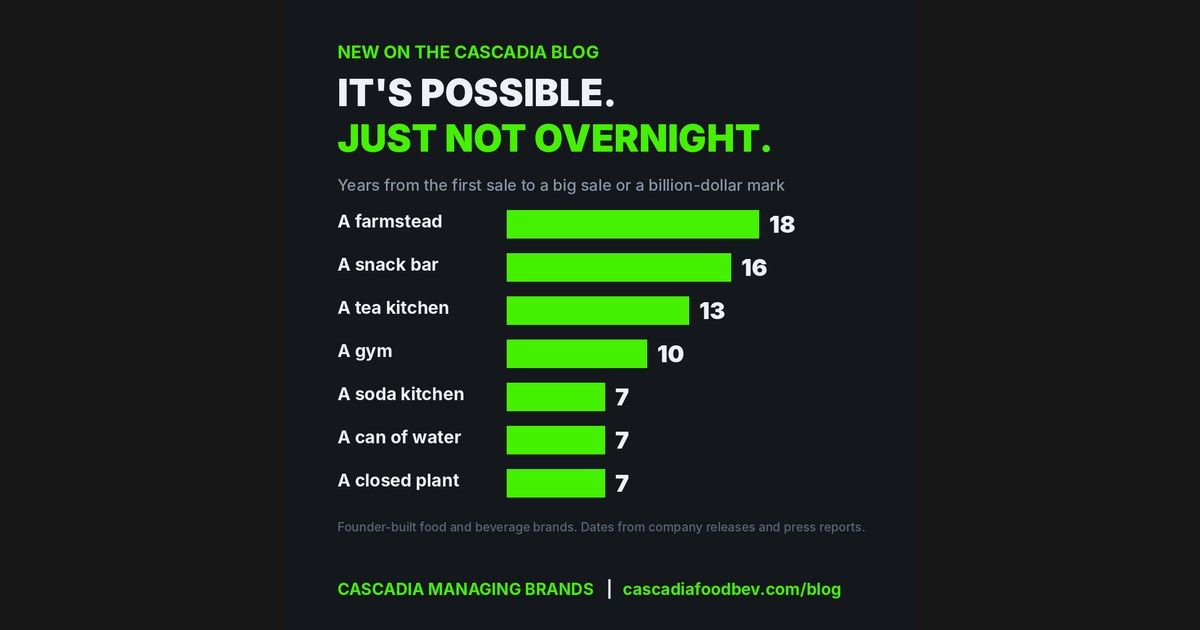
This article shares inspiring stories of seven founders who built successful food and beverage brands over many years, highlighting the realities behind their journeys.
The Poppi Blog 10 22 26
You Can’t Buy Cool
Pepsi paid nearly $2 billion for Poppi. Here’s what the money didn’t buy.
Somebody told you Poppi is down 96% since Pepsi bought it. Wrong. But wrong in a way that tells you everything.
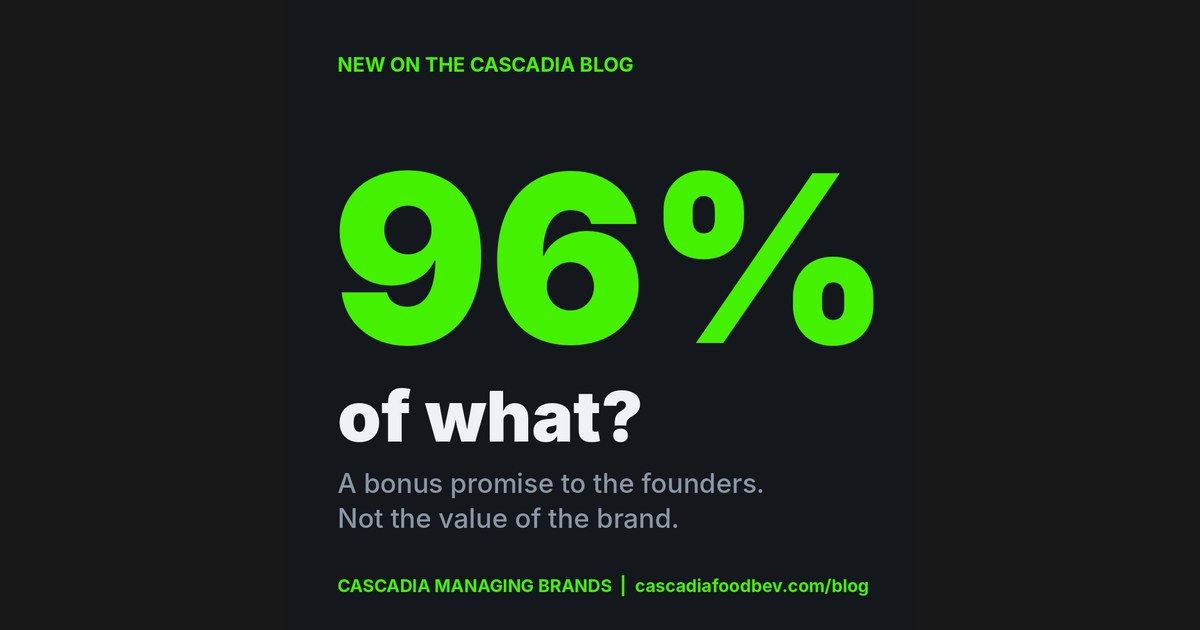
Here is what actually fell 96%. In 2025 Pepsi paid nearly $2 billion in cash for Poppi, and promised the founders up to $300 million more if the brand hit growth targets by 2027. Pepsi has to put a price on that promise in its books. In December the promise was worth $278 million. As of September it was worth $12 million. That’s your 96%. It’s not the value of Poppi. It’s Pepsi’s own accountants admitting, in a very quiet voice, that they don’t expect to owe these people much. The founders already have the cash. That part did not fall 96%.
READ THE WORDS
Now let’s read the words, because Pepsi’s own paperwork is the funniest thing in this story. That promise to the founders? Pepsi doesn’t call it a promise. It calls it “contingent consideration.” Consideration! That word used to mean being thoughtful toward other people. Now it means money you might owe, depending. Contingent thoughtfulness. And “up to $300 million”? “Up to” means maybe. It’s the two most expensive words in the deal, and they’re the two nobody reads.
Then there’s the price. Nearly $2 billion, except that includes $300 million of tax benefits, so Pepsi calls the real number a “net purchase price” of $1,650 million. So it’s $2 billion, unless you look at it, in which case it’s $1,650 million. Whoever invented the word “net” was a genius, and I guarantee he wasn’t the one buying.
And the announcement itself. Pepsi’s headline said the deal was “accelerating strategic portfolio transformation.” Say that out loud. They bought a soda. One soda. And the soda is now a strategic portfolio transformation, accelerating. I’ve bought sodas. Nobody accelerated anything.
COOL IS A RUMOR
Now the opinion. Everything from here down is mine.
Cool is a rumor. It travels from one person to another, and it only works while it feels like a secret. The first people who drank Poppi found it. A friend had a can. A roommate brought one to class. Finding it was the whole point.
Then came the megaphone. Poppi has run three Super Bowl ads in a row, and the latest was its first under Pepsi, starring Charli XCX. Adweek noted the spot didn’t explain the product at all. Just vibes. Vibes! That’s what a reported $10 million buys now. When I started in this business you had to tell people what was in the can. Poppi is also on Love Island, with an in-show integration and its own licensed can. It was in the Spider-Man: Brand New Day trailer, which is a long way from a farmers market. And it has been reported in more than 4,300 Walmart doors.
Did Poppi pay for any of that, give product away, or trade favors? I don’t know, and nobody has said. It doesn’t matter. Paid or free, being everywhere is a decision, and cool is the opposite of a decision. The second your thing is on an endcap at Walmart and in a movie trailer, the person who found it first has to go find something else. That’s not betrayal. That’s physics.
Now listen to how Poppi describes itself. Its senior vice president of marketing says the brand has always been about moving at the speed of culture, “not waiting for permission.” Not waiting for permission! It belongs to Pepsi. It has Pepsi’s permission and Pepsi’s checkbook. Its own press release calls it “the ultimate vibe setter.” It’s prebiotics and fruit juice. Calm down. And the marketing team says what it really wants is fans sneaking cans into Spider-Man screenings on their own. A company with a staff and a budget is working overtime to look like it isn’t working at all.
Here’s my guess, and it’s only a guess. The early fans who made Poppi cool are already eyeing the next can. I have no survey. I have more than thirty years of watching shoppers, and the pattern is old: the people who find a thing first are the first to leave when everybody else shows up.
You can buy the shelf. You can buy the truck. You can buy a Super Bowl spot for a reported $10 million. You can’t buy the fucking feeling of finding it first.
BIG BEVERAGE SELLS TRUCKS
My second opinion: the giants are masters of mass, and mass is not niche. Trucks, shelf space, television. They are brilliant at it. Nobody builds a machine that size to whisper.
In 2025 Pepsi took a $1,860 million write-down on two brands, Rockstar and Be & Cheery. Rockstar’s US and Canadian business then went to Celsius. Meanwhile one of the better energy drink stories of recent years, Alani Nu, belongs to Celsius, a much smaller company. Pepsi distributes it. Pepsi doesn’t own it and doesn’t run it. Celsius builds the brand. Pepsi brings the trucks.
Now the newsletter. One newsletter headlined this week’s news “Poppi is going flat.” It’s a soda! Going flat is what a soda does! They’re describing a soda doing the one thing sodas do and calling it news. The same newsletter says the shelf is crowded, the category may be peaking, and Poppi and Olipop have both pivoted away from gut health toward just saying they’re a better-for-you soda. So the gut health drink is now a soda that would like you to feel good about it. That’s one newsletter’s view, and I can’t prove it. But when every giant shows up at the party at once, the people who threw it start looking for another party.
Fair is fair. Poppi is not dead. That same newsletter, citing Pepsi, says volume still grew in double digits last quarter, just well below its pre-deal pace. Double digits is not failure. It’s a brand that was priced for more. And the founders sold at the top and kept the cash. Good for them.
I WOULD LOVE THIS PROBLEM
Let me be clear. I wish all of my products were on 4,300 Walmart shelves and selling well. I would be retired, happy, and insufferable at dinner parties. Getting to that shelf is the dream, and nobody in this business should apologize for wanting it.
But not every brand is ready for Walmart. Ready means you can supply it, afford it, and sell through once the product gets there. And when a brand is ready, and good enough that a giant wants to buy it, the owner gets a huge check. Good. They earned it.
The hard question comes after the check. Does the brand stay cool and keep growing? Only time will tell, and time has a track record. I have watched this movie before. Sobe, Odwalla, Mistic, Snapple and Nantucket Nectars all ended up with big owners, and in my opinion none of them was ever quite the same cool brand again. Others are on the record. Coca-Cola bought Zico in 2013 and stopped making it in 2020. It bought Odwalla in 2001 and shut it down in 2020, trucks and all. It bought all of Honest Tea in 2011 and shut that down in 2022, saying it wanted to free up money for stronger brands. I would add Izze, Vitaminwater and Fuze to the list. Pepsi bought Izze in 2006, and Coke paid $4,100 million for Vitaminwater’s maker, Glacéau, in 2007. Whether they stayed cool is my opinion, not a finding.
WHAT A FOUNDER SHOULD TAKE FROM THIS
None of this means turn down the big door. It means know what the big door does and doesn’t do.
First, distribution is not demand. Getting into 4,000 stores is a victory on the day it happens. It only counts if people come back for the second can. The shelf gives you a chance. It doesn’t give you a customer.
Second, pace. Every new door and every new ad is a trade. You gain reach and you spend a little rarity. Choose the trades on purpose before a buyer or a retailer chooses them for you.
Third, know who is carrying what. A big company can give you shelf, trucks and a check, and you should take that call. What nobody can hand you is the reason people wanted you in the first place. That part is yours to protect. It’s also the part the giants will pay for and can’t build.
This industry is mostly common sense. Knowing which door to say yes to, and how fast, is the hard part, and it is possible but rarely easy. That’s the part we help with at Cascadia Managing Brands. We work the distributor and retailer side every day, and we’ve watched plenty of founders face the big-door question. If you’re staring at one right now, come talk to us at cascadiafoodbev.com.
SOURCES & RECEIPTS
Facts are sourced below. The opinions are mine, including what happened to Sobe, Odwalla, Mistic, Snapple, Nantucket Nectars, Izze, Vitaminwater and Fuze after they were sold. Where I don’t know something, the post says so.
PepsiCo cuts Poppi payout estimate to $12M (Seeking Alpha)
Earnout value of $12 million as of September 5.
PepsiCo slashes valuation of Poppi bonus payouts (Investing.com via Yahoo Finance)
$12 million versus $117 million in June and $278 million in December; $300 million maximum; targets due by the third quarter of 2027.
Pepsi’s Poppi Acquisition Is Going Flat (Calcbench)
Fair value of the earnout at the end of 2025 and the decline since.
When the Buyer Holds the Scorecard (Manica Blain)
Confirms the 96% figure refers to the earnout estimate, that Pepsi paid nearly $2 billion in cash, and shows Pepsi’s announcement headline, “accelerating strategic portfolio transformation.”
Poppi Tries to Catch a Gen Z Vibe With Super Bowl Ad (Adweek)
Third straight Super Bowl, first under Pepsi, no product explanation.
Super Bowl Commercials 2026 (Stereogum)
Reported $10 million price for a 30-second Super Bowl spot (attributed to Bloomberg).
How Poppi keeps its cultural marketing fizz (Marketing Dive)
Love Island integration and licensed can; the goal of organic sharing, including Spider-Man fans.
Poppi teams with Spider-Man (Brand Innovators)
Product appears in the film’s teaser trailer; Love Island in-show integrations.
Four In Five Gen Z Consumers Drink Functional Beverages (Winning With Walmart)
Poppi availability at Walmart grew to more than 4,300 doors.
PepsiCo Form 8-K, second quarter 2026 (SEC)
$1,860 million impairment on Rockstar and Be & Cheery in the 2025 comparison period.
Celsius Holdings and PepsiCo Strengthen Long-Term Strategic Partnership (PepsiCo)
Celsius owns Alani Nu and acquired Rockstar in the US and Canada; PepsiCo leads distribution.
Coca-Cola is discontinuing Honest Tea (CNN Business via KRDO)
Coca-Cola took a 40% stake in 2008, bought the full brand in 2011, and ended it in 2022 to free up investment for stronger brands.
Coca-Cola to discontinue Zico, other underperforming brands (WCPO)
Zico bought in 2013 and discontinued in 2020.
Coca-Cola To Discontinue Odwalla Juice (BevNET)
Coca-Cola discontinued the Odwalla juice and smoothie brand and its chilled delivery network in 2020; it had bought Odwalla in 2001 (per Food Business Middle East, which also reports the brand rights were later sold).
PepsiCo Acquires IZZE Beverage Company (BevNET)
PepsiCo bought Izze in 2006. Acquisition date only; I did not verify any later decline.
Coca-Cola to Buy Vitaminwater Maker Glaceau (CNBC)
Coca-Cola agreed to buy Glacéau in 2007 for $4,100 million. Acquisition only; I did not verify any later decline.
PepsiCo Slashes Poppi Earnout Estimate (BigGo Finance)
Net purchase price of $1,650 million after $300 million of anticipated cash tax benefits; earnout timeline.
poppi debuts Super Bowl LX teaser with Charli xcx (LBB)
Poppi’s marketing executive on moving at the speed of culture, not waiting for permission.
poppi returns to the Super Bowl (press release via Galveston County Daily News)
Poppi’s own description of itself as the ultimate vibe setter, and of its ingredients as prebiotics and fruit juice.
Pepsi’s no-good, very bad week (Express Checkout)
Newsletter report, citing Pepsi, that Poppi volume grew in double digits last quarter. Also the source for Coke’s Simply Pop, Pepsi’s two prebiotic sodas, the crowded shelf, and the view that the category may be peaking and Olipop is slowing.