
Discover how supermarkets from Bangkok to New York offer distinct shopping experiences that challenge the typical American grocery store model.
Buzzword Bingo Blog 10 15 26_1
Bingo! Your Brand Is Disruptive, Clean, and Better-for-You. So Is Everyone Else’s.
Four words, zero information, and a buyer who gets 55 to 75 requests a week to hear them again.
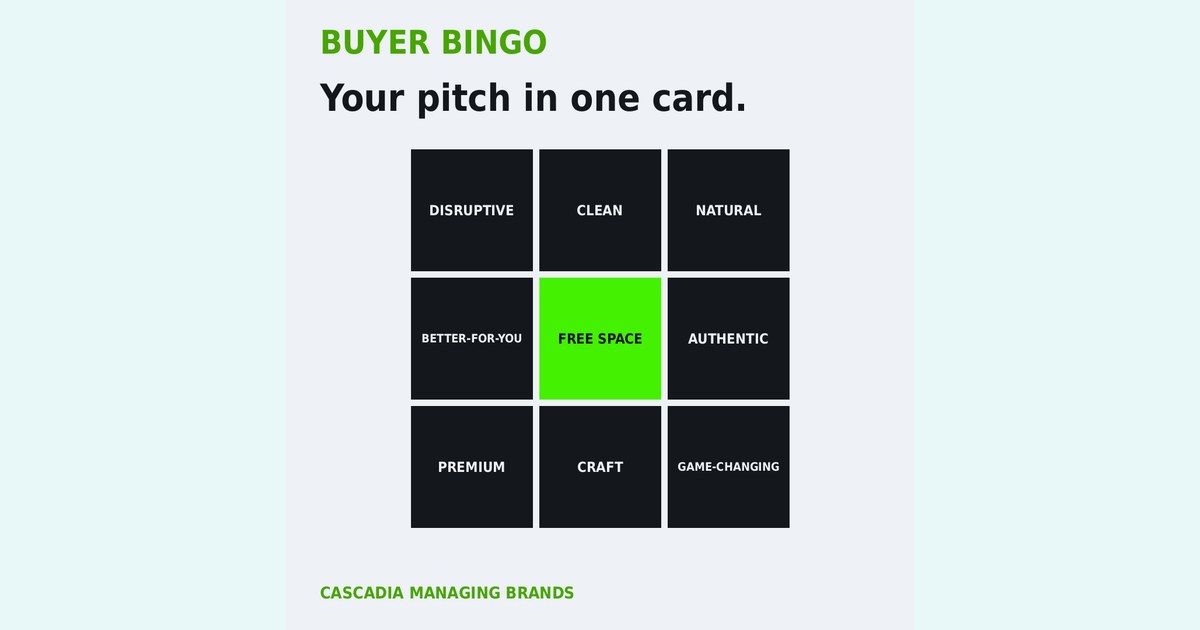
Every founder pitch I have ever sat through comes with a free game. You get a card. The squares say disruptive, clean, natural, better-for-you. Somewhere around minute three somebody yells bingo, and it is always the buyer, silently, on the inside, while nodding at your slide.
Here is the part nobody tells you. A buyer at a big retailer can get 55 to 75 emails a week from suppliers begging for a meeting. Vanessa Ting, a former Target buyer who now consults, says only about 10 percent of the introductory ones contain what a buyer needs to decide. Ninety percent of the mail is a person saying the word “unique” with no evidence of anything. So the buyer isn’t reading your pitch. The buyer is playing bingo with it. And you just filled in the whole card.
First, the vocabulary
George Carlin taught us to read the words before we read the numbers. So let’s read the words.
Disruptive. In 2015, Clayton Christensen, the Harvard professor who made that word famous, told the Boston Globe he never saw this coming. He said people slap it on any breakthrough or industry change, and most of the time it doesn’t apply. His research, he said, explains how the world works in a very specific set of circumstances. He even wished he had listened to a friend, Andy Grove, and called it the Christensen Effect. Think about that. The man who invented the word is standing in the street waving his arms, and everybody’s driving past him honking “disruptive!” Meanwhile, a kid who screams during the movie is also disruptive. Nobody puts that on a deck.
Clean. Clean compared to what? Who is out there making the dirty one? Nobody has ever put “dirty” on a label. The genius of the word is that it’s an insult to the product next to you, delivered with a halo. And nobody agrees what it means. Clean label has no legal, scientific or industry-wide definition. A Cargill survey of 302 grocery shoppers found that over half had heard the term, and only one in 10 was confident what it meant. Nine out of ten people are looking at the front of the package, nodding like they understand, and have no idea.
Natural. Hemlock is natural. So is a rattlesnake. A 2019 survey of 1,000 US adults for Label Insight found that shoppers read natural as minimally processed, with no artificial flavors, sweeteners, preservatives or colors, and that claims like it motivate more than half of them to buy. So, the word has the pull of a law and the enforcement of a suggestion. It’s the only word in the grocery store that means everything to the shopper and nothing to anybody else.
Better-for-you. Better than what? A hammer? That phrase is a comparison with the second half missing. It’s a guy at a bar saying, “I’m taller,” and walking away. Taller than who, sir? Whom are you better for? Better for you. Fine. And what, exactly, are you?
Let the record show
Lenny Bruce would have put this witness under oath, so let’s.
Let the record show the witness is a protein bar. Name for the record: Clean Crunch. The following is a transcript.
Q: What does clean mean? A: It’s clean. Q: Without using the word clean. A: It’s natural. Q: Define natural. A: It’s better-for-you. Q: Better than what? A: (long pause) The record will show the witness has asked for a lawyer, and the lawyer is also a protein bar.
Same transcript. Same four words. Same buyer, on page two of a deck, writing one word in the margin. That word is not “yes.”
Stack it up
So, add it up, and let Lewis Black take it from here.
The man who invented “disruptive” begged people to stop saying it. Nine out of ten shoppers can’t tell you what “clean” means. “Natural” is a word with no definition, working a full-time job. “Better-for-you” is a sentence somebody forgot to finish. Mintel found only 44 percent of US consumers even trust the health claims on food and beverage packages, so more than half of the shoppers don’t believe the words either. The buyer, who sees 55 to 75 asks a week, doesn’t. And the founder paid a designer real money to put all four on the package in a font called “trustworthy.” Everybody’s disruptive, which means nobody’s fucking disruptive.
Four words. Zero numbers. Not one fact a buyer can write down.
What the buyer wants to hear instead
Here’s the good news. Buyers will tell you exactly what they want. Ting laid it out, and it’s not a secret. It’s common sense with a spreadsheet.
Say a number. Don’t say clean. Say 6 ingredients, and list them. Don’t say natural. Say how much sugar per serving, and what the leader in the category has. Don’t say better-for-you. Say better than what, by how much, and prove it. A number is the one thing a bingo card can’t fake.
Show it’s moving. Ting says buyers want to catch products on the way up, so give them sales data early, ideally pointed in the right direction. A buyer doesn’t buy an adjective. A buyer buys velocity.
Be different in a way they can see. Ting says buyers want products that won’t just cannibalize what’s already on the shelf. The me-too product gets the no, and the me-too product with four buzzwords gets the no faster.
Get the price and the package right, and protect everybody’s margin. A grocery retailer keeps one to two cents of every dollar it takes in, so nobody across that table can afford to take your word for it.
Bring the plan. Buyers expect to see how you’ll market the product once it lands, and how it fits what the retailer is already trying to do, whether that’s Made in the USA or health and wellness.
And be ready to ship. Ting says buyers are wary of vendors who haven’t been around long, and that weak logistics and inventory ruin relationships fast. The buyer isn’t buying your story. The buyer is buying your truck showing up Tuesday.
The verdict
I’m not saying never use the words. Say natural if it’s true. Say clean if you can define it in one sentence and back it up. Just don’t lead with it, and never let it stand alone. A buzzword is a label on a fact. It is not a replacement for one. Try this at home: take every adjective off your deck and replace it with the thing that made you say it. Count how many slides you have left. That’s your real pitch.
Possible? Absolutely. Easy? Almost never. Ting even points out that suppliers who show up with a broker or consultant who already has retailer relationships get a head start. That’s not a plug. That’s her advice. Somebody who has sat on the other side of that table, and heard the bingo a thousand times, knows how to skip to the part where the buyer picks up a pen.
That’s the work we do at Cascadia Managing Brands. If you want help turning your adjectives into a pitch a buyer can say yes to, we’re easy to find at cascadiafoodbev.com.
Sources & Receipts
Buyer email volume (55 to 75 supplier meeting requests a week at large retailers; about 10 percent contain the needed information), what buyers say yes and no to, and buyer wariness of new vendors: Vanessa Ting, former Target buyer, in Talk Business & Politics, The Supply Side: Learning more about the inside of a retail buyer’s mind. https://talkbusiness.net/?p=58908
Christensen on the misuse of disruptive and the Christensen Effect: Boston Globe, Clay Christensen explains, defends ‘disruptive innovation,’ October 2015. https://bostonglobe.com/business/2015/10/24/clay-christensen-explains-defends-disruptive-innovation/fmYOKIJXOSPPMquj8HQM1O/story.html
Clean label has no legal, scientific or industry-wide definition; Cargill and Decision Analyst survey of 302 US grocery shoppers: Kantha Shelke, Food Technology Magazine (IFT), February 1, 2020. https://www.ift.org/food-technology-magazine/clearing-up-clean-label-confusion
Clean eating has no official meaning; 44 percent of US consumers trust food and beverage health claims: Mintel, Is clean the new healthy? (2018, updated 2024). https://www.mintel.com/insights/food-and-drink/is-clean-the-new-healthy/
Natural and clean label motivate over half of shoppers, no regulated definition, what shoppers think natural means; survey of 1,000 US adults by Wakefield Research for Label Insight, March 28, 2019: FoodNavigator-USA. https://www.foodnavigator.com/Article/2019/03/28/Label-Insight-survey-reveals-loosely-defined-claims-such-as-natural-still-have-pull-with-consumers/
Grocery net margin of about 1 percent: NYU Stern data cited by the Cato Institute. https://www.cato.org/commentary/tellingingly-absurd-attack-american-grocery-stores