



This article shares first-hand experiences selling American food brands globally, exploring unique grocery retail traditions and what they reveal about culture and business.
150 Things To Do
I once saw a to-do list with more than 150 tasks on it. It was the most organized way I have ever seen to get nothing done.
Thirty years in this business and I’ve seen every kind of task list there is. Legal pads. Whiteboards. Sticky notes on a monitor like the monitor had a skin condition. Apps that cost more per month than the coffee.
And then I saw the big one. More than 150 tasks. Organized. Categorized. Color-coded. Some of them had subtasks. A few of the subtasks had subtasks. It was beautiful. You could have framed it.
And almost none of it was getting done.
So let me say the whole point of this article in one sentence, right up front, for anyone who has to leave early: there is no point in having a task on your list if you don’t do it. None. A task you don’t do isn’t work. It’s decoration.
I’m not going to tell you whose it was. If you’re wondering whether it’s yours, that’s a sign. Keep reading.
Here’s the dirty secret of the to-do list: writing a task down feels exactly like doing it. Same little hit. Same sense of progress. You write “update the pricing sheet” and your brain goes, great, handled. It is not handled. It is filed. Filing is not finishing. Filing is where things go to retire.
A list of 150 tasks isn’t a plan. It’s a confession with bullet points.
First, the Language
You know I can’t talk about this without checking the words, because the words are where the lie lives.
Nobody has a job to do anymore. We have action items. An action item is a job that has been to a seminar. It has a title, it has a status, it has a little colored dot next to it. What it doesn’t have is anybody doing it.
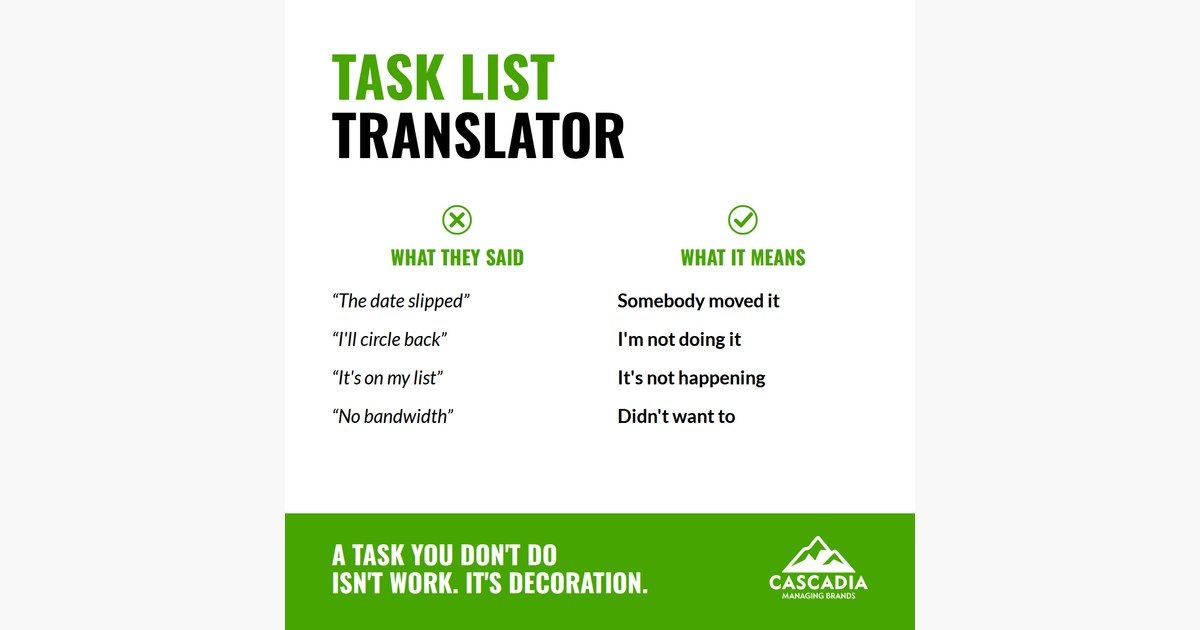
We don’t talk to people. We touch base. We don’t answer. We circle back. Circling is what vultures do over something that died a while ago. That’s exactly what’s happening to your action item.
We don’t say we’re busy. We say we don’t have the bandwidth. Bandwidth is a word for cable modems. You are not a cable modem. You are a person who didn’t want to do it.
And then there’s the big one. Priorities. Greg McKeown points out in his book *Essentialism* that when “priority” came into English, it was singular. It meant the very first thing. The one. It stayed singular for centuries, and then sometime in the 1900s we pluralized it. So now everybody has twelve priorities. Which means nobody has one. Twelve first things is not a list. It’s a traffic jam.
If everything on your list is a priority, the only thing you’re prioritizing is the list.
Why the List Keeps Growing
There’s a real reason 150 tasks feels so heavy, and it isn’t laziness.
In 1927 a psychologist named Bluma Zeigarnik noticed that people remember unfinished tasks better than finished ones. The unfinished thing keeps a little light on in your head. Now multiply that by 150. You’re not running a business. You’re running a haunted house. Every room has something in it you meant to deal with.
Here’s the part that matters. Later research, by E.J. Masicampo and Roy Baumeister, found that you don’t have to finish a task to turn that light off. You have to make a specific plan for it. When, where and how. The plan quiets the noise. The list alone doesn’t. The list just keeps the lights on in 150 rooms and sends you the electric bill.
So the list isn’t organization. It’s storage. And storage isn’t free.
How I Learned It the Hard Way
We’ve been building our own CRM, called CPG Command. And for a while, the plan was: “Let’s fix the CRM.”
Let’s fix the CRM. That’s not a task. That’s a weather system. It spawned tasks the way a leak spawns buckets. Clean up duplicate companies. Standardize titles. Merge records. Build the product hierarchy. Hook up the ERP. Pricing. More pricing. Every task was reasonable. Together they were a hole with a shovel in it.
Here’s the moment it turned. The database showed two records that looked like duplicates: Gordon Food Service and Gordon Food Service Store. Same name, mostly. The clean move was to merge them. It would have looked great. One tidy record.
And it would have been wrong. In the real world those can be different businesses with different buyers, doing different things. The system said “duplicate.” The business said “don’t you dare.” If we had knocked out that task fast, we would have been efficiently wrong.
A clean database that lies about your business is worse than a messy one that tells the truth. Same goes for your to-do list.
So What Is the Right Thing?
We changed the question. We stopped saying “let’s fix the CRM” and started saying “let’s improve one business outcome at a time, and only touch the system when we understand what will happen.”
Then we put a loop on the wall. Seven steps. Every task goes through it or it doesn’t happen.
Question. What are we actually trying to improve? Not “clean up the data.” Something a customer or a salesperson would notice.
Investigate. Look before you touch. What’s really going on?
Show the evidence. Put what you found in front of the people who own the decision. Data is evidence, not authority. A job title suggests a role. A domain suggests a company. Neither one decides anything by itself.
Get the business decision. Is this a business call, a data problem, a system problem, or a someday idea? Those are four different piles, and you don’t solve a business decision with a spreadsheet.
Make the smallest change. Not the biggest. Not the cleanest. The smallest change that moves the outcome.
Verify. Check it actually worked. Ideally somebody other than the person who did it.
Move on. And this is the step nobody takes. Cross it off. Close the room. Turn off the light.
Before anybody touches anything, four questions. Why are we changing this? Who benefits? What changes? What could break? If you can’t answer all four, you stop. You don’t start. You stop.
Seven steps sounds slower than just doing the task. It isn’t. It’s slower than writing the task down. That’s the point.
One Filter to Rule the List
Here’s the filter that kills a 150-task monster. For our CRM, the one outcome that matters right now is email targeting: getting the right message to the right buyer. So every task gets one question: does this improve email targeting?
Yes? Work on it now.
No? It goes in a separate pile to be judged on its own day.
Company identity, trade channel, smart lists, contact quality: yes. Work now. Product hierarchy, ERP, pricing: important, real, and not today. The mistake before was letting the future block the present. We were building a mansion when what we needed was a front door that opens.
Your filter won’t be email targeting. It might be reorders. It might be cash. It might be one retailer. But it’s one thing. Singular. Like the word used to be.
A Task Has to Move
Let’s be honest about the number. A hundred and fifty tasks is not a work plan. If those were real tasks, they’d be moving. Every day, something would go from the Task column to the Finished column. That’s what a task is. It’s a thing on its way to being done.
If it isn’t moving, it isn’t a task. It’s a wish with a checkbox.
So here’s the rule. Don’t write it down as a task if you aren’t going to get to it, or can’t. That’s not a task. That’s a parking lot item. A parking lot is a perfectly good place. It’s where ideas wait for their turn without pretending they’re next. The problem is when the parking lot moves into the task list and starts charging rent.
Second rule. Give every real task a realistic date. Not a heroic date. Not a date you picked to look busy in a meeting. A date you’d bet your own money on.
Third rule. Stop pushing the date.
Listen to how we talk about this. “The date slipped.” Did it? Dates don’t slip. Dates don’t have feet. Nobody’s calendar has ice on it. The date didn’t slip. Somebody moved it. “It got pushed.” By whom? “It’s been rescheduled.” By what, the weather? Every one of those sentences is built so nobody’s standing in it. It’s a crime scene with no fingerprints.
Say it the honest way: I moved the date because I didn’t do it. That sentence hurts. That’s why it works.
And if it can’t be done, say that. Out loud. “I can’t get to this.” Then give it to somebody who can, put it in the parking lot, or kill it. Admit it and move on. There is no shame in a task that dies. The shame is in a task that’s been on life support since spring because nobody wanted to be the one to pull the plug.
A date you keep moving isn’t a deadline. It’s a hobby.
Who Checks the Checker?
Now the part managers don’t like, because it’s about managers.
A task list doesn’t grow to 150 in the dark. Somebody looked at it. Somebody saw it at 50, and at 100, and at 125, and said “looks like you’ve got a lot going on,” and went to lunch. That’s not management. That’s weather reporting.
If you manage people, here’s the job.
Look at the movement, not the length. Don’t ask how many tasks are on the list. Ask what moved from Task to Finished this week. A long list with nothing moving is a warning light. A short list where everything moves is a healthy person.
When the list is too big, cut it together. Sit down with the person and go through it. Every item gets one of four answers: do it, give it away, park it, or kill it. Most people will not do this alone, because every item feels like a promise. Your job is to give them permission to break the ones that should never have been made.
When the dates are unrealistic, say so before they’re missed. A manager who accepts a fantasy date is co-signing the loan. Ask: what has to be true for this to happen by Friday? If the answer is “a miracle,” pick a new date now, not after it’s blown.
When a date moves twice, have a conversation. When it moves three times, make a decision. Do it, reassign it, park it or kill it. What you don’t do is let it move a fourth time. A task that’s been moved three times is telling you something. Listen.
Ask for the next step, not the status. “How’s it going?” gets you “good.” “What’s the very next thing you’ll do on this, and when?” gets you the truth, or an awkward silence, which is also the truth.
Make it safe to say “I can’t.” If people get punished for admitting a task is stuck, they’ll stop admitting it. They’ll hide inside the list. The list will grow. And you’ll have built the 150-task monster yourself.
And check your own list first. The manager’s list gets the same rules. Same movement. Same honest dates. Same parking lot. You can’t ask for finished tasks while your own list is a museum.
The manager isn’t there to count the tasks. The manager is there to make sure they move, or die with dignity.
What Happens to the 150
Run a 150-task list through that filter and here’s what you find. Most of it doesn’t need to get done. Some are duplicates. Some are someday ideas dressed up as today. Some are other people’s jobs that got adopted like stray cats. And some are tasks that exist mainly so somebody can say, in a meeting, “it’s on my list.” A handful matter. Those get the loop, and those get finished.
And here’s what nobody tells you about deleting tasks. It feels terrible for about a minute. Then it feels like opening a window.
You don’t get paid for what’s on your list. You get paid for what comes off it.
Stack It Up
Stack it. All of it.
A hundred and fifty tasks. Twelve priorities. Action items with colored dots. A calendar full of touching base and circling back. A brain running 150 open rooms with the lights on. Dates that “slipped” with nobody’s hands on them. A manager who saw it at 100 and went to lunch. A CRM project the size of a weather system. A merge that would have been fast, tidy and wrong. And a list so organized you could frame it, while the one thing that mattered sat on page nine under “misc.”
Writing it down was never the job. Doing the right thing was the job. And the right thing is almost never the thing at the top of a 150-item list. It’s the one thing that moves the business, done small, checked twice, and crossed the fuck off.
A Word to Anyone Who Works With Me
You don’t have to show me your list. I don’t want to see your list. I want to see what came off it this week, and what it changed for a customer. That’s the whole report. It fits on an index card.
Verdict
The court finds the to-do list not guilty. It’s a good tool. It’s just not a strategy. It’s a parking lot, and nobody ever got anywhere by admiring a parking lot.
Pick one outcome. Put every task through the loop. Kill what fails the filter. Finish what passes. Then move on.
Court adjourned. Go cross something off.
Sources & Receipts
-
Bluma Zeigarnik, “Das Behalten erledigter und unerledigter Handlungen” (On finished and unfinished tasks), Psychologische Forschung, 1927: the Zeigarnik effect, better recall of interrupted tasks.
-
E.J. Masicampo and Roy F. Baumeister, “Consider It Done! Plan Making Can Eliminate the Cognitive Effects of Unfulfilled Goals,” Journal of Personality and Social Psychology, 2011.
-
Greg McKeown, Essentialism: The Disciplined Pursuit of Less (2014), on the history of the word “priority.”
-
The operating loop, the four questions, the four decision buckets and the email-targeting filter: Cascadia Managing Brands’ working framework for CPG Command, author’s own.
-
Gordon Food Service example: author’s experience; used to illustrate a data decision, not a comment on either business.
-
The 150-task list: author’s observation; not identified.