

This article reveals how mergers in the food industry create massive debt, leading to high costs that don’t lower consumer prices.
Swipe
From The $200 Grocery Bill: An Uncomfortable Look at Why American Food Costs So Much
Investigative satire. Skeptical of everyone. Funny, but fact-based. Nobody gets off easy — including you.
Last time I showed you who decides what’s on the shelf. Today: the one charge on your grocery bill that isn’t printed on your grocery bill — and the only party in this entire series that touches none of the food, takes none of the risk, and gets paid on every single cart in America.
Pull out your last grocery receipt. It’s in the bag, or the glovebox, or that drawer.
Look how honest it is.
Every item. Every price. Every ounce. It tells you what the bananas weighed to three decimal places. It tells you the peanut butter’s cost per ounce, because a law says it has to. It tells you what you saved, which is a different kind of lie, but at least it’s a printed lie. It tells you the sales tax to the penny, itemized by rate, because the government insists.
There is one charge that came out of that transaction and appears nowhere on that piece of paper.
It’s bigger than the sales tax in some states.
It’s bigger than what the store made on the whole trip.
And you have never once seen it, because nobody is required to show it to you, and everybody involved would very much prefer to keep it that way.
They Named It Themselves
Here’s the part I can’t get over.
The industry calls it a swipe fee.
Swipe.
Go look it up. Merriam-Webster will give you the sweeping blow, and the gesture on a touchscreen, and the sharp critical remark. Then, down in the verb senses, sitting right there in the dictionary of record, is the one everybody actually uses. The one your mother used. The one that shows up in police reports.
Swipe: to steal.
He swiped it off the counter. Somebody swiped my bike.
An entire financial sector looked at a fee, considered the naming options available in the whole of the English language, and landed on the word for petty theft. Nobody made them do that. No regulator mandated it. They just picked it, and it stuck, and now it’s in Wall Street Journal headlines and congressional testimony and nobody blinks.
That’s not even the good one.
The formal name for this charge — Visa’s own name for it, in Visa’s own published rate schedule — is an “Interchange Reimbursement Fee.”
Reimbursement.
Read that word again. Reimbursement means you are being paid back for money you already spent. It is a word for making somebody whole. You reimburse a guy for the gas.
Reimbursement for what?
Nobody at Visa unloaded a truck. Nobody at Mastercard tasted the yogurt, argued with a co-packer, stocked a shelf at four in the morning, ate a deduction, took a markdown on lettuce that didn’t move, or signed a lease on forty-two thousand square feet of building in a town with a competitor across the street.
A message went from a terminal in a grocery store to a computer, and then a different computer said yes, and that took about a second and a half.
And the word they chose for what happens next is “reimbursement.”
Now do the first half of the name.
Interchange.
Say it out loud. What does it sound like? It sounds like a highway. An interchange is that big concrete cloverleaf where two roads meet and the traffic flows through in every direction at sixty miles an hour and — and this is the part I want you to hold onto — nobody stops.
That’s the entire point of an interchange. It’s the piece of road specifically engineered so you don’t have to slow down.
They named a toll booth after the part of the road where you don’t stop.
And while we’re in here, one more.
Rewards.
You get rewarded. For what? For spending your own money at a grocery store you were going to go to anyway, on food you were going to eat regardless, at a price that already includes the cost of rewarding you.
A reward is what you give a dog for sitting.
What It Actually Costs, From Visa’s Own Schedule
I’m not going to make you take my word for any of this, because Visa publishes the whole thing. It’s a public PDF. It is, no exaggeration, one of the strangest documents in American commerce — dozens of pages of rates, tiers and card types, published openly, and essentially never read by the people paying it.
The current one took effect on the eighteenth of April, 2026. Here’s your $200 cart, run four ways.
You pay with a debit card. If it’s from a big bank, the fee is 0.05 percent plus twenty-one cents. On $200, that’s thirty-one cents. If it’s from a small bank or a credit union, Visa’s supermarket debit rate is a flat thirty cents, no percentage at all.
Thirty cents. For the whole cart. Fine. Nobody’s getting hurt.
You pay with a basic credit card — a plain one, or a modest rewards card. At a big chain, that’s 1.18 percent plus a nickel. On $200: $2.41.
You pay with the good card. The one with the metal edge that makes a satisfying sound on the counter. Visa Signature Preferred. Visa Infinite. At a big chain the supermarket rate is 1.65 percent plus a nickel.
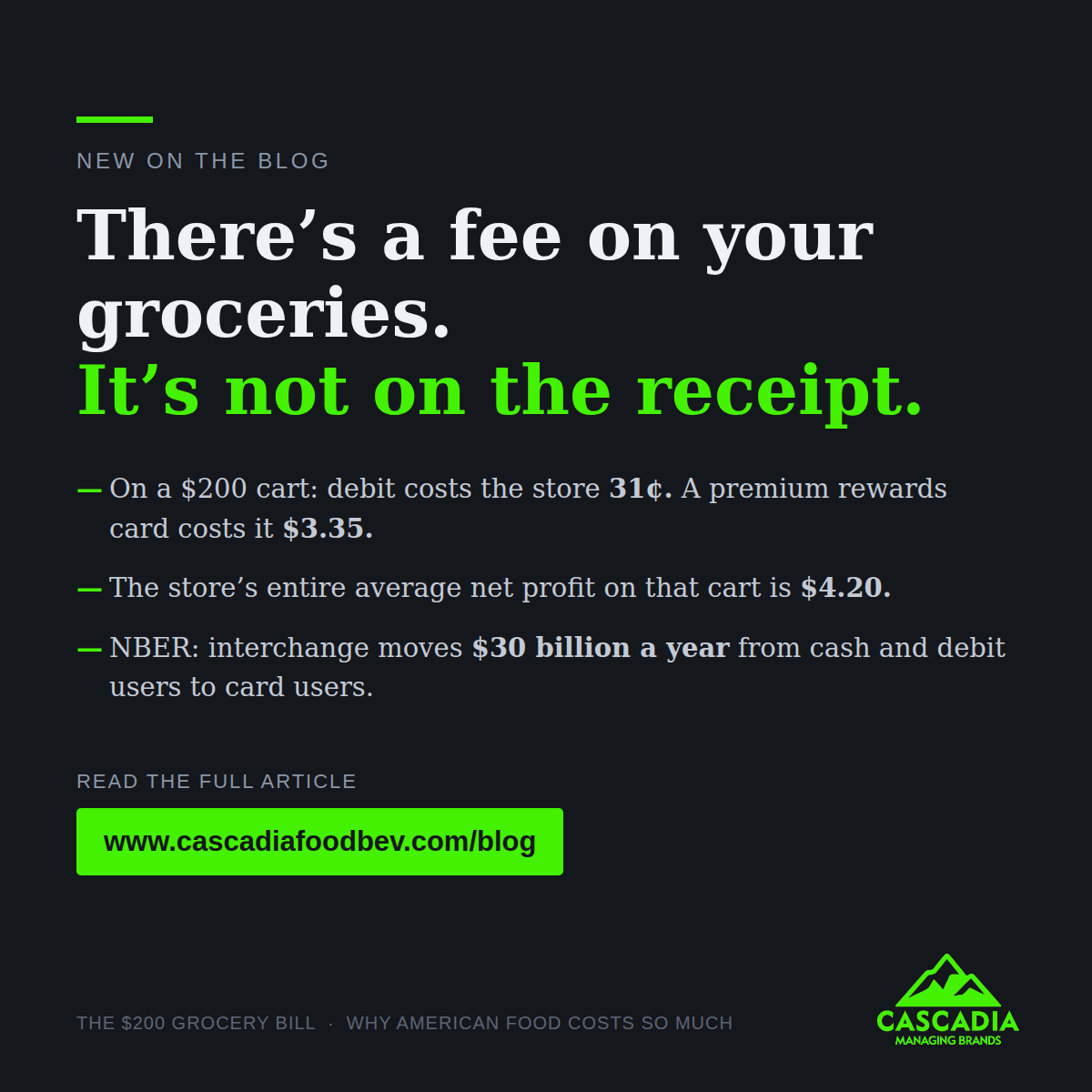
On $200: $3.35.
Same store. Same groceries. Same cashier. Same second and a half.
Thirty-one cents, or three dollars and thirty-five cents.
Ten times the money, and the only variable in the entire transaction is which rectangle of plastic came out of your wallet.
And on Mastercard’s schedule, a World Elite card at a small independent grocer runs 2.10 percent plus a dime — four dollars and thirty cents on that same $200 cart.
Now Here’s the Number That Made Me Stop
The Food Marketing Institute publishes what a supermarket actually earns. Not revenue. Earns.
The average net profit for a food retailer, 2025: 2.1 percent.
On your $200 cart, the entire grocery store — the building, the lights, the trucks, the eleven hundred employees, the walk-in cooler, the guy who mops up the broken jar of pickles in aisle six, the whole enterprise — keeps about four dollars and twenty cents.
Now put the two numbers next to each other.
The store keeps $4.20.
The card takes $3.35.
And at a smaller store, on a World Elite card, the card takes $4.30, which is more than the store’s average net profit on the entire transaction.
I want to be precise here, because this is exactly the kind of comparison people fudge and I’m not going to. That 2.1 percent is what’s left after the swipe fee is already paid — it’s an operating cost, deducted along the way, like electricity. So the honest sentence isn’t “Visa out-earns the grocery store.” The honest sentence is worse and simpler:
The fee charged for moving the money is roughly as large as everything the store gets to keep for selling you the food.
One of those two parties bought produce that rots.
And the Small Store Pays More
Oh, and one more thing, because this series has a running theme and here it comes again like a rash.
Those rates I gave you are the best rates. They’re Visa’s Tier 0 and Tier I — the tiers you qualify for by doing enormous volume.
Look at what the schedule charges everybody else. Visa’s “All Other Supermarket” category — which is to say, the store that is not a national chain — pays 2.00 percent plus seven cents on that same premium card, against 1.65 percent for the giant.
Mastercard’s spread is wider. A World Elite card at a top-tier chain: 1.25 percent. The same card at a base-tier store: 2.10 percent.
Same card. Same cart. Same cashier. Same second and a half.
The big store pays $2.55. The small store pays $4.30.
Sixty-nine percent more, for being small.
Nine parts ago I told you this industry consolidated because scale buys better terms. Here is one more place it buys better terms, printed on a public schedule by a company that has never sold a grocery in its life. Every independent grocer in America is subsidizing the checkout lane of the chain that’s trying to put them out of business.
Nobody voted on that either.
A Deposition Regarding the Points
Let the record show.
Q: You have a credit card that earns points at the grocery store.
Yes. Four percent back on groceries.
Q: Who pays for those points?
The credit card company.
Q: And where does the credit card company get the money?
…
Q: Let me help. The store pays a fee every time you use that card. Correct?
Correct.
Q: And the store runs on a two percent margin. Does it absorb that fee out of the goodness of its heart, or does it price the groceries to cover it?
It prices to cover it.
Q: So the price of the food includes the fee.
Yes.
Q: Does the store charge a different price to the customer paying cash?
No. Same price.
Q: So the woman paying cash is paying a price that includes a fee she did not generate.
…Yes.
Q: And where does that money end up?
In my points.
Q: Say the last part again. Slowly.
The witness would like a recess.
The Part That Should Make Everybody Uncomfortable
I could have stopped at the deposition and let you feel clever. But that’s an argument, and this series doesn’t run on arguments.
Here’s the evidence. It’s four months old.
In April 2026 the National Bureau of Economic Research published working paper 35067, “Who Pays for Payments?” — Mark L. Egan, Gregor Matvos, Amit Seru, Lulu Wang and Vincent Yao. Not an advocacy group. Not a trade association. The most boring, most respectable economics outfit in the United States.
I’m going to quote their finding exactly, because the sentence itself is the best thing in this article:
“Interchange fees transfer approximately $30 billion every year from cash and debit users to credit card users.”
Thirty billion dollars. A year.
Now read that sentence one more time and tell me who did it.
Transfer
Transfer.
Go find the human being in that sentence. Go on. I’ll wait.
There isn’t one. The fees transfer it. The fees! The fees got up off the couch, walked across the room, took thirty billion dollars out of one person’s pocket and put it in another person’s pocket, and then presumably sat back down.
Nobody transferred anything. A transfer happened.
That’s not an accident of style. Transfer is a word we reserve for things that occur without anybody choosing them. Heat transfers. Static charge transfers. You get a transfer on a bus. It is a word for physics.
Here is the identical fact, translated into English:
Every year, thirty billion dollars is taken from people who mostly don’t have good credit and handed to people who do.
Same math. Same paper. Same authors. Same decimal point.
One of those sentences goes in a working paper.
The other one goes on a picket sign.
And look at what it calls the people, while we’re in here. Not customers. Not families. Not a woman at a register.
“Users.”
User is what you call somebody operating a machine, or somebody with a habit. It is not a word you use about a person you intend to think about for more than a second.
Now — I want to be fair to the economists, because they didn’t do this to fool you. They wrote it that way because it’s precise, and precision is their job, and if they’d written the picket-sign version no journal would print it.
But precision has a side effect.
There are no fingerprints on the glass.
Thirty billion dollars moved and the grammar doesn’t contain a single person who moved it.
And About Those “Basis Points”
The same paper gives you the damage per person, and it gives it to you in basis points, which is a unit almost nobody outside of finance can actually feel. So let’s fix that first, because you’re about to need it.
A basis point is one one-hundredth of one percent.
That’s it. That’s the whole thing. One hundred basis points equals one percent. Ten basis points is a tenth of a percent. One basis point is 0.01 percent.
Why does a unit this small exist? The honest reason is that it prevents confusion — if a rate goes from 2 percent to 3 percent, did it rise “one percent” or “fifty percent”? Basis points remove the argument. Fine. Useful. Real.
And the other reason, which nobody will say out loud:
It is a unit of measurement in which a normal person cannot tell whether to be angry.
Somebody says “four basis points” and your face does nothing, because your face has no idea. That is not a bug.
So here are the paper’s findings with the units translated into money.
Cash users lose about 96 basis points of purchasing power. That’s 0.96 percent — call it a penny on the dollar. On a $200 grocery run: about a dollar ninety-two. Every trip. For the offense of paying with money.
Debit users lose about 47 — roughly ninety-four cents on that same cart.
Basic credit users gain about 48. Premium card users gain about 59 — call it a dollar eighteen, handed to them, on the same $200.
(The percentages are the authors’. Turning them into dollars on a $200 basket is my illustration, not theirs.)
So look at the two ends of it.
The woman paying cash is down a dollar ninety-two.
The man with the metal card is up a dollar eighteen.
Same store. Same Tuesday. Same gallon of milk.
And now the income cut, which is the one that should end the conversation: $9.2 billion a year flows from households earning under $150,000 to households earning over it.
Not “correlates with.” Not “is associated with.”
Flows.
And the reason it keeps getting worse is a single line in that paper that I think is the most important sentence in this whole article. Premium cards were 15 percent of credit card volume in 2006.
By 2022 they were 60 percent.
Four times the share, in sixteen years. Every one of them carrying a higher fee than the card it replaced. The airport lounges got nicer, the metal cards got heavier, and the entire cost of that upgrade got baked into the shelf price of food and distributed to everybody in the store, including the people who will never see the inside of a lounge.
The authors even ran the obvious objection — that people sort themselves, that fees differ by merchant, that it might wash out. It reduces the regressive transfer by about a quarter.
It does not eliminate it.
Honest Math, Both Ways
Now the part where I hand you every argument against me, because that’s the deal here and it’s the only reason to believe the rest.
One: cash is not free either, and anybody who tells you it is has never counted a till at eleven at night.
Here’s what “the cost of cash” actually means, because it’s a phrase that gets thrown around by people who’ve never touched a drawer, and it sounds like an abstraction. It isn’t. It’s a list of jobs.
Somebody counts the drawer at the start of the shift. Somebody counts it again at the end. Somebody counts it a third time in the cash office, because the first two counts disagreed by four dollars and now a human being has to find four dollars. Somebody makes up a deposit slip. Somebody buys a safe. Somebody pays an armored car service to come get it — an actual truck, actual guards, actual insurance, on a schedule, whether or not there’s much in the bag that day. Somebody’s bank charges the store a fee to accept a cash deposit, which most people don’t know is a thing, and it is. Somebody eats the counterfeit twenty. And every so often — this is the part nobody says politely — somebody steals some of it, and the store writes that off too.
An economist named Anne Layne-Farrar added all of that up and put a number on it.
Fifty-three cents per hundred dollars.
Translate that to your cart: on $200 in cash, the store spends about a dollar and six cents just handling the money.
For comparison, from the same work: a PIN debit transaction cost the merchant about 81 cents per hundred, and a signature debit transaction about $1.12 per hundred.
So — and I want this on the record because it cuts against me — cash is genuinely cheaper for the grocery store than the cards are. It is not free. It never was. Anyone running the “cash is pure profit” argument at me is wrong, and I’m not going to pretend otherwise to make my case tidier.
Two: the card does real things. The money is guaranteed. The fraud, mostly, isn’t the store’s problem — that liability sits with the card issuer, and it is not small. The lane moves faster, and lane speed at a supermarket is worth actual money. A payment system this fast and this reliable across this many banks is a genuine engineering achievement, and if you think building one is easy, go build one.
Three, and this is the strongest thing against me: the rewards are real. That four percent back is not imaginary. Millions of families run the whole budget through a card and pull hundreds of dollars a year out of it. The NBER finding isn’t that the money vanishes. It’s that it gets redistributed, and the direction is uphill.
If you’re getting the points, you are genuinely better off.
That’s the whole problem. It works — for you — at somebody else’s expense, which is the most durable kind of bad system there is.
Four: nobody’s forcing the store to eat this. A grocer can legally pass it straight through in most of the country. Only Connecticut, Maine and Massachusetts flatly prohibit surcharging credit cards. (California, Texas, Oklahoma and Kansas have bans that courts have struck down or that are still being fought over, so “legal” there comes with a lawyer attached.) The networks cap the surcharge at four percent.
And grocers, almost universally, don’t do it.
Because the first supermarket in town to put “3% credit card fee” on the register loses every shopper to the one across the street who buries it in the price of cereal instead.
That’s not a defense of anybody. It’s a description of a trap.
Every grocer in America would rather hide it than be the one who charges it. So all of them hide it. And the honest price becomes the uncompetitive price.
The Man Who Walked the Deposit to the Bank
Somebody asked me a question this week that I couldn’t stop chewing on, and I want to take it seriously, because the easy answer is wrong and the real answer is better.
The question was this. There used to be a guy who owned the grocery store. His name was on it. At the end of the night he counted the drawer himself, put the money in a zippered bag, walked it four blocks to the bank, and dropped it in the night slot.
Did the customer pay for that?
The tidy answer is no, and the tidy answer is wrong. Of course the customer paid for it. His time was worth something. Those twenty minutes were twenty minutes of a man’s life, and they were in the price of the milk whether or not anybody ever wrote them on a line.
That’s the honest part, and I’m not going to duck it.
But now watch what actually changed. Because it isn’t whether you pay. It’s four other things, and every one of them matters more than the first one.
It was his to eat.
A man’s own time is the one cost in a business he’s allowed to donate. He could decide — on a Tuesday, in his own head, answering to nobody — I’ll walk it over myself and I won’t put it on the milk. Plenty of them did exactly that.
Nobody donates a contractual fee. You cannot absorb 1.65 percent by working harder.
You cannot walk a percentage four blocks.
It was a fixed cost. Now it’s a percentage.
This is the one I’d underline twice.
Walking the deposit to the bank cost the same whether the day’s take was two thousand dollars or eight thousand. The bag was a little heavier. That’s it. The cost of handling money did not scale with how much money there was.
A percentage scales forever.
And here’s what makes that indefensible rather than merely annoying: authorizing a $300 cart is not one bit harder than authorizing a $30 cart. It is the identical message, over the identical wire, to the identical computer, taking the identical second and a half, burning the identical nothing of electricity.
Same work. Ten times the fee.
Somewhere in the second half of the twentieth century, the cost of handling money stopped being a job and became a percentage of the groceries.
Nobody voted on that either.
It used to stay in town.
That zippered bag went four blocks to a bank on the same street, and that bank lent it to a farmer eleven miles out, or the guy opening a hardware store, or somebody’s kid buying a first house.
The money did a lap and came home.
Today the fee leaves the county before the customer reaches the parking lot — to a network in California and an issuing bank that could be anywhere.
It is never coming back to that town. Not in any form. Not ever.
And now nobody in the building can do a thing about it.
The store manager cannot negotiate the interchange rate. Neither can the district manager. Neither, in any meaningful sense, can the chain — the rate is published, take it or leave it, and “leave it” means not accepting Visa, which means not having a grocery store.
Every single person you can actually look in the eye at that supermarket is powerless over one of its largest costs.
The guy with his name on the store could walk to the bank.
Nobody works there anymore who’s allowed to decide anything.
Nineteen Years
You’re going to ask what anybody’s doing about it. I looked. Sit down.
Merchants have been suing Visa and Mastercard over this since the mid-2000s. Nineteen years. Nineteen. A child born when that case was filed can now vote, drink in most of the world, and rent a car.
In November 2025, a revised settlement was announced. Here are the terms.
Swipe fees come down four basis points for three years, and seven basis points over five.
You know what a basis point is now, so let me do this to you properly.
Four basis points is four one-hundredths of one percent.
On your $200 grocery cart, four basis points is eight cents.
Nineteen years of federal litigation. Two of the largest payment networks on Earth. Rooms full of the most expensive attorneys in America, billing by the tenth of an hour, since the Bush administration.
Eight cents.
And it expires.
The National Retail Federation, which does this for a living, put it against the actual rate: average swipe fees run about 226 basis points — that’s 2.26 percent, which on your cart is about four dollars fifty. Visa and Mastercard fees came to roughly one hundred billion dollars last year.
So the remedy is about one and a half percent of the problem, for three years, after which the rates can climb again without restraint.
The retailers’ own word for it was “a drop in the bucket.”
They were being generous.
And Then There’s the Tax
This is the detail that finally got me out of the chair.
The fee is charged on the total.
The total includes the sales tax.
So when your state levies a tax on a grocery item, a private company takes a percentage on top of the government’s tax, and the store pays it, and the store prices it into the cereal.
A private toll. On a public tax. On food.
Illinois tried to stop exactly that, carving tax and tips out of the calculation. In February 2026 a federal judge upheld it. Then in June, on remand, the court permanently blocked it as to national banks, federal savings associations, out-of-state banks and the card networks — which is to say, as to essentially everybody who actually issues the cards.
What survives applies to Illinois-chartered state banks and credit unions. The legislature pushed the start date to July 2027.
The law survived the way a building survives a fire if you count the foundation.
Stack It Up
Let’s put the whole thing on the counter at once.
There is a fee on every grocery transaction in America that is not printed on any receipt, not disclosed to any shopper, and not itemized in any way a normal person could find.
It is roughly as large as everything the store keeps for selling you the food.
It varies by a factor of ten depending on which card you pull out — and the expensive one is the card that hands you a reward.
It’s bigger for the small grocer than for the giant, because of course it is.
It’s charged on top of your sales tax, so a private company is collecting a percentage of a government levy on food.
It used to be a fixed cost a man could absorb by walking four blocks. Now it’s a percentage that scales forever, on work that has not changed since the nineteen-seventies.
The most respectable economics outfit in the country says it moves thirty billion dollars a year uphill.
Nineteen years of litigation produced eight cents on your cart.
And every bit of it is legal, published, and sitting on Visa’s own website right now.
That’s the part that gets me. It isn’t hidden. It’s posted. They put it on the internet.
The reason nobody’s rioting is that the whole thing is written in a dialect specifically evolved so that reading it feels like a chore instead of a mugging.
So here is the whole racket in one sentence, and then I’ll get out of your way:
A woman paying cash for hamburger at a store she can barely afford to shop at is buying somebody else’s flight upgrade, and not one fucking person in the transaction is required to tell her.
The Verdict
And now the part where I implicate you, because I promised in Part 1 that nobody gets off easy and that includes the reader and, for the record, the writer.
I have the card.
The good one. The metal one. I use it at the grocery store because I’d be an idiot not to — the points are real, the money is real, and refusing them wouldn’t lower anybody’s grocery bill by a nickel. It would just move my nickel to the bank instead of to me.
That’s the trap, and it’s a beautiful one. There is no individual moral exit. You can’t opt out of a system by paying cash; you just move yourself to the losing side of it and change nothing. The only fix is structural, and the structure has had nineteen years of lawyers and produced four basis points.
So no, I’m not telling you to cut up your card.
I’m telling you that the next time somebody explains that your grocery bill is high because of labor, or fuel, or greed, or the weather — all of which are true, and all of which we’ve covered — there is also a toll booth in the checkout lane that nobody put on the map, and the toll is about the same size as the store’s entire profit on your food.
It’s not on the receipt.
It was never going to be.
Case open. Court adjourned, not dismissed.
Next time — the one I’ve been putting off, because I’ve been on both sides of it. The plant. The line. The four a.m. shift. And the number of American food companies that don’t actually make anything at all anymore.
Sources & Receipts
Author’s Note On Method
A precision note, because the easy version of this article is wrong and I’d rather be right.
The widely quoted “2.35% to 2.91%” average credit interchange figure is an average across all merchant categories. Groceries are not an average merchant category — supermarkets have their own preferential tiers on both networks, and the real grocery rates are lower. I used the published supermarket rates instead. It makes the headline less dramatic and the article more true, and that trade is the entire point of this series.
Second: interchange is not the whole cost a store pays to accept a card. On top of it sit network assessment fees and the processor’s own markup, so the grocer’s all-in cost per transaction is higher than the numbers I’ve quoted. I used interchange alone because it is the part Visa and Mastercard publish and I can hand you the document. The direction of the error is against my own argument.
Third: the 2.1% net profit figure is what remains after the swipe fee has already been paid. I’ve said so in the text rather than running the comparison people usually run, which implies Visa out-earns the supermarket. That version is punchier and it isn’t accurate.
What I have not claimed: that eliminating interchange would lower your grocery bill by the amount of the fee. Nobody can prove that counterfactual. Australia and the European Union both capped interchange and the pass-through research there is genuinely mixed. What is documented is who pays it now, and in which direction the money moves.